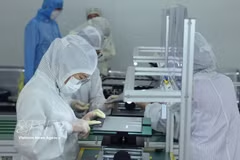
Shrinking farmland forces agriculture to go high-tech

Ministry of Finance data show that about 60% of companies have started using basic digital tech, while roughly 20% now have clear digital strategies. But only 5% has gone all the way with full-blown digital transformation.
An unmanned aerial vehicle is used in rice cultivation in Vi Thanh 1 commune, Can Tho city. (Photo: VNA)

Hanoi (VNA) – As Hanoi urbanises at a fast pace and farmland shrinks, the exploding demand for quality food is forcing farmers to maximise value out of every hectare, turning digital tools and green practices into absolute must-dos.

At one of Hanoi’s largest safe vegetable production zones, Nguyen Van Tung, Director of the Dong Anh safe vegetable cooperative, can adjust nutrient levels in irrigation water, control the cooling system, monitor pest outbreaks and check crop health in real time, all from a single smartphone. The tech upgrade has delivered a massive 30% jump in productivity while slashing water and fertiliser use by more than 40% compared to traditional farming.

The packages of vegetables come with a QR code so buyers can instantly trace when it was planted, how it was grown and whether it meets quality standards. The co-op now pumps out tens of tonnes of clean, safe produce every month straight to schools and supermarkets across the capital.

In Ho Chi Minh City, the GAP safe vegetable cooperative in Dong Thanh commune used 50-70 million VND (192-269 USD) per ha with conventional methods. After switching to high-tech and circular farming practices, costs have been slashed dramatically to just 20-30 million VND per ha.

These are only two snapshots from a growing wave of enterprises and cooperatives in Vietnam’s biggest cities that are using digital tools and green practices.

The move aligns with the Politburo’s Resolution 57-NQ/TW, from December 22, 2024, which presents guidelines for breakthroughs in science and technology, innovation and national digital transformation.

Prof. Dr. Mac Quoc Anh, Deputy Chairman and Secretary General of the Hanoi Association of Small and Medium Enterprises, pointed to the Ministry of Finance data showing that about 60% of companies have started using basic digital tech, while roughly 20% now have clear digital strategies. But only 5% has gone all the way with full-blown digital transformation.

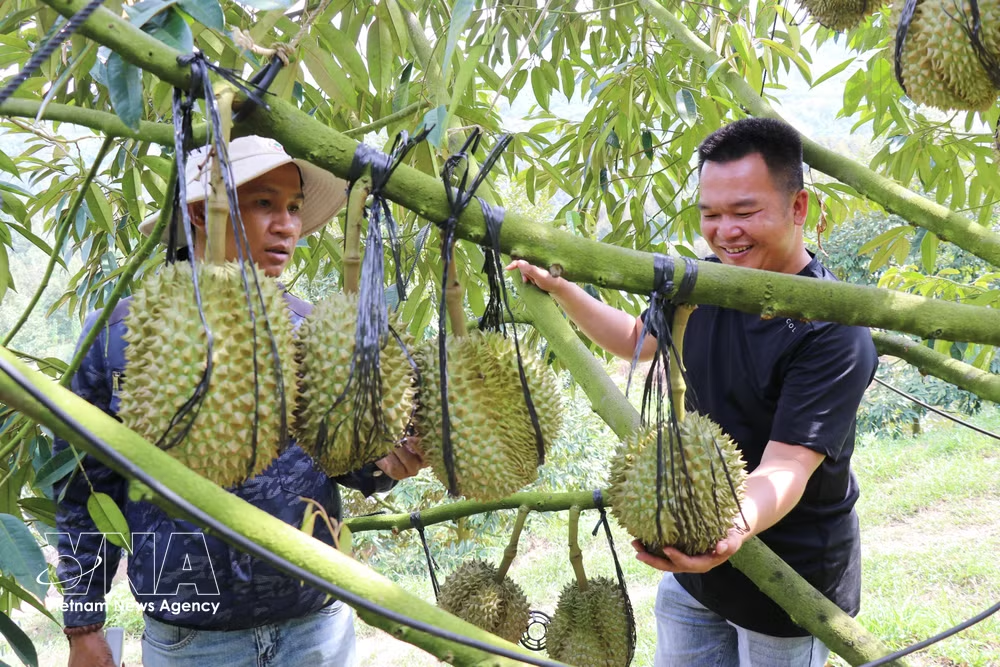
A hi-tech durian farming model at Sakura Farm in Dong Khanh Son commune, Khanh Hoa province. (Photo: VNA)

A hi-tech durian farming model at Sakura Farm in Dong Khanh Son commune, Khanh Hoa province. (Photo: VNA)

A Vietnam Chamber of Commerce and Industry survey revealed that around 40% of firms are finally paying attention to Environmental, Social and Governance (ESG) standards, yet just 10% have rolled out large-scale green production models. The numbers indicate that Vietnam’s business makeover is still in its early stages, with ample room left to grow.

To speed up the dual transition, experts said authorities must refine institutional frameworks for the digital and green economies, expand the green finance ecosystem, and roll out stronger incentives for small and medium-sized enterprises through consulting, training and technology transfer. Greater investment in the training workforce for digital technology, ESG governance and green innovation is also critical, alongside keeping the national digital infrastructure rolling forward.

Deputy Minister of Agriculture and Environment Vo Van Hung said the sector will focus on three key tasks, including moving from experience-based, manual management to data-driven governance, completing shared industry databases that are “accurate, sufficient, clean, and up-to-date”, and adopting digital tools for better monitoring, forecasting, and decision-making./.
VNA

See more

The Vietnam – Bangladesh business forum in Dhaka on May 19 (Photo: VNA)

Vietnam, Bangladesh eye to foster economic ties

Addressing the forum, Vietnamese Ambassador to Bangladesh Nguyen Manh Cuong highlighted the fruitful development of the bilateral ties over the past 53 years, noting that trade turnover has consistently exceeded 1.1 billion USD despite global disruptions. The two sides are now striving to raise the figure to 2 billion USD in the coming years.

The opening ceremony of the 10th International Livestock, Dairy, Meat Processing and Aquaculture Exposition on May 20 (Photo: VNA)

ILDEX Vietnam 2026 showcases livestock, agri-food innovation

The three-day event is jointly organised by VNU Asia Pacific and Thailand’s ITEC, serving as a platform for business networking, technology exchange and knowledge sharing in the livestock, aquaculture and food industries in Vietnam and Southeast Asia.

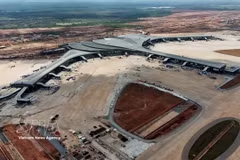
Permanent Deputy Prime Minister Pham Gia Tuc and officials inspect the Gia Binh International Airport project on May 20, 2026. (Photo: VNA)

Gia Binh international airport project accelerated ahead of APEC 2027

Tuc described Gia Binh International Airport as a national key project requiring strict adherence to construction timelines, particularly as it is expected to be put into operation in time for the 2027 APEC Economic Leaders' Meeting. Several associated projects are also being implemented under special mechanisms to serve major national tasks.

Vietnamese Ambassador to the Republic of Korea Vu Ho speaks at the forum.(Photo: VNA)

Forum promotes Vietnam–RoK supply chain connectivity

Cao Thi Phi Van, Deputy Director of ITPC, said that after more than three decades of cooperation, Vietnam–RoK ties are shifting from traditional manufacturing cooperation towards mastering future-oriented technologies such as semiconductors, artificial intelligence (AI), digital finance, renewable energy and global supply chains.

Fitch Ratings gives positive assessment of Vietnam’s economic fundamentals (Illustrative image. Source: VNA)

Fitch Ratings gives positive assessment of Vietnam’s economic fundamentals

Deputy Minister Tran Quoc Phuong stressed that Fitch’s credit assessments have enhanced Vietnam’s image and credibility in international financial markets, and provided additional motivation for the country to continue improving institutions, strengthening policy management efficiency and increasing economic transparency.

Consumer purchases E10 biofuel at a PVOIL petrol station on Thai Thinh street in Hanoi. (Photo: VNA)

Hanoi strengthens oversight of transition to E10 biofuel

To ensure compliance with the transition roadmap, the Hanoi Market Surveillance Sub-Department has requested petrol traders to proactively review and upgrade storage tanks, fuel pumps and other technical conditions necessary for E10 distribution, thereby preventing disruptions to fuel supply serving consumption and production demands across the capital.

A Phu Tho civil servant guides a local how to switch from presumptive tax mechanism to tax sef-declaration. (Photo: VNA)

📝OP-ED: Vietnam’s tax reform: Fair play, not revenue squeeze

At a time when social media disinformation grows more sophisticated, transparency and public disclosure are the most potent counter to distortions. Facts, data and real-world results deliver the strongest rebuttal to attempts that twist reality and erode trust in tax administration reform.

Experts are expected to analyse opportunities for boosting exports and investment cooperation between Vietnam and South American countries at the coming seminar. (Illustrative photo: VNA)

Seminar on trade promotion in South American market to take place in Hanoi

A seminar on opportunities and challenges in developing the South American market will be held in Hanoi on May 28. It aims to provide updates on the economic outlook, market trends and import demand in South America, particularly in Argentina and Chile, amid continued fluctuations in global supply chains.