Hanoi scales up high-quality schools, raises standards

In addition to 23 accredited institutions, the city plans to establish 37 more, lifting the total to 60. The move signals a shift in approach rather than a mere technical adjustment, aligning with the Politburo’s Resolution 71-NQ/TW on education breakthroughs and Hanoi’s Action Programme 05-CTr/TU.

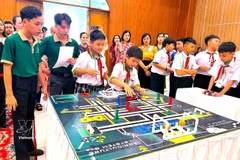
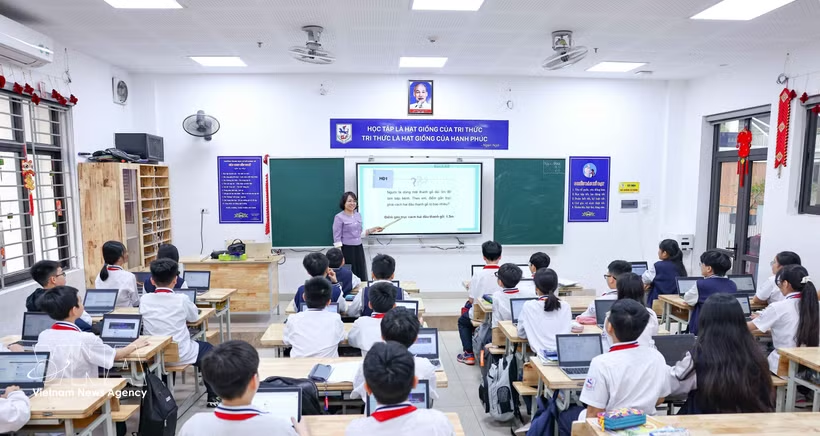
“Google Digital Classroom”, a space that inspires passion and builds core digital skills for students. (Photo: VNA)

Hanoi (VNA) – Hanoi is accelerating plans to expand its high-quality school system while tightening output benchmarks, aiming to build a genuinely high-performing network capable of spearheading wider education reform.

In addition to 23 accredited institutions, the city plans to establish 37 more, lifting the total to 60. The move signals a shift in approach rather than a mere technical adjustment, aligning with the Politburo’s Resolution 71-NQ/TW on education breakthroughs and Hanoi’s Action Programme 05-CTr/TU.

Key reforms

Of the current 23 schools, 17 are public, and six are private. The model has already shown clear results, particularly in upgrading facilities, reducing class sizes and enhancing curricula, contributing to improved quality.

These schools have also led innovation in teaching methods, creating ripple effects across the broader public system by promoting digital adoption and competency-based learning. At the same time, they have broadened options for parents and helped ease pressure on top-tier schools.

In the next phase, expansion will focus on areas with favourable socio-economic conditions. The State will continue to guarantee baseline standards, while parents contribute to premium services, with transparent quality commitments in place.

Deputy Director of the Hanoi Department of Education and Training Pham Quoc Toan said the model will move from input-based management to end-to-end quality governance, shifting from rigid criteria to an open standards framework grounded in national level-2 benchmarks, while allowing schools to surpass these standards and build distinct identities.

Curricula will blend core and advanced content, designed to be open, integrated and competency-focused, with emphasis on foreign languages, STEM, digital skills, arts, and sports. Quality control will also be strengthened through regular monitoring and the potential withdrawal of accreditation if standards are not maintained.

The additional 37 schools will comprise four preschools, 12 primary schools, 13 lower secondary schools and eight upper secondary schools. Selection will be based on existing capacity, readiness for implementation and social demand, ensuring alignment with the city’s overall education planning.

Broader access, balanced development

The expansion plan has attracted strong attention from parents, a timely response to growing demand for high-quality education. With a clear roadmap, effective quality oversight and appropriate support mechanisms, it is expected to widen access and raise system-wide standards.

Pham Hai Luong from Nghia Do ward said increasing the number of such schools would give families more choice, rather than concentrating demand on a handful of elite institutions. However, he stressed the need for stringent quality control across teaching staff, curricula and infrastructure, along with reasonable tuition policies to ensure equity.

Nguyen Thi Hanh from Thach Ban ward shared similar views but warned against gaps between inner-city and suburban areas, emphasising the need to improve mainstream public schools to ensure broader impact.

Vice Chairwoman of the Hanoi People’s Committee Vu Thu Ha noted that the high-quality school model is a distinctive feature under the Capital Law and relevant Politburo resolutions. After more than a decade of piloting, she said a clearer, more substantive approach is needed to expand access.

Under the revised model, schools will be organised by service areas rather than administrative boundaries or enrolment zoning, enabling students to access better learning environments locally. Hanoi targets around 150 high-quality schools by 2030, equivalent to about 5% of the total, with implementation beginning from curriculum design aligned with the 2018 general education programme, ensuring no added academic burden on students./.
VNA

See more

The opening ceremony of the Hoa Binh - Xuan Mai clean water plant. (Photo hanoimoi.vn)

5trillion VND clean water plant opened in Phu Tho

Cplant’s launch marked a key milestone in developing technical infrastructure in Phu Thọ and surrounding regions, helping meet rising demand for clean water in Hanoi while supporting urban, industrial and services growth.

The exquisite mother-of-pearl inlaid cabinet that Lumban Sianipar meticulously brings back from Vietnam (Photo: VNA)

“Vietnam Museum” in the heart of Indonesia

The house of Lumban Sianipar, former Indonesian Defence Attaché in Vietnam, unfolds as a cultural journey through Vietnam, with walls adorned with mother-of-pearl inlay works, eggshell art, lacquer and oil paintings. Intricately crafted wooden cabinets, Bat Trang ceramics and various handicrafts are thoughtfully arranged, creating a space that is both elegant and warmly imbued with Vietnamese character.

More than 1,000 amateur performers take part in Ha Long Carnaval 2026. (Photo: VNA)

Ha Long Carnaval 2026 affirms cultural industry development mindset

More than a vibrant festival, Ha Long Carnaval 2026 served as a vivid demonstration of efforts to implement Resolution No. 80-NQ/TW of the Politburo on the development of Vietnamese culture, reaffirming Quang Ninh’s evolving mindset of turning heritage into a powerful internal resource to drive breakthroughs in cultural industries in a new era.

Numerous pieces of evidence and documents related to activities of individuals in “Hoi thanh Duc Chua Troi Me” (World Mission Society Church of God) are seized. (Photo: VNA)

Quang Tri warns of religious group promoting superstition for profit

A group linked to “Hoi thanh Duc Chua Troi Me” (World Mission Society Church of God) in Quang Tri reportedly operated under a tightly organised structure with direction from an overseas “head organisation”, employing various plans to approach and psychologically manipulate individuals.

The 172nd repatriation ceremony of US serviceman’s remains held in Da Nang. (Photo: qdnd.vn)

Vietnam hands over more MIA remains to US

The remains were recovered during a recent joint Vietnam–US excavation in central Hue city. On April 27, Vietnamese and US forensic specialists conducted a preliminary examination, indicating the remains may be linked to a missing US serviceman. They will be sent to a forensic laboratory in Hawaii for further analysis and identification.

Activities within the Visit Vietnam Year – Hue 2025 attract a large number of visitors (Photo: VNA)

Ministry rolls out plan to promote national image

At its core, the plan emphasises mobilising the combined strength of the political system and society, linking communications with the promotion of cultural values and soft power of the country.

People donate blood at the launch of the Humanitarian Month 2026 in Hanoi on April 29. (Photo: VNA)

Humanitarian Month 2026 launched with community support activities

Over the past five years, Humanitarian Month campaigns have raised more than 3 trillion VND (nearly 114 million USD), assisting more than 6.6 million people. Beyond figures, the initiative has helped strengthen social trust and foster compassion across society.

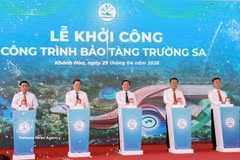
The groundbreaking ceremony for the Truong Sa Museum in Cam Lam commune, the south central province of Khanh Hoa, on April 29 (Photo: VNA)

Truong Sa Museum to honour generations safeguarding national sovereignty

The museum covers a total area of approximately 17,100 square metres, with total investment estimated at 299.7 billion VND (11.37 million USD). Funding for the project is provided through sponsorship from Vinhomes JSC, and construction is expected to be completed in the first quarter of 2028.

Social housing projects help meet the housing needs of low-income earners and workers, while contributing to sustainable urban development. (Photo: VNA)

Social housing construction target exceeds by 44%

Minister of Construction Tran Hong Minh has issued an official dispatch urging localities to accelerate the development of social housing projects to meet the target of more than 158,700 units in 2026, as set out in Government Resolution No. 7/NQ-CP.

Deputy Director of the Ministry of Home Affairs’ Department of Local Government Nguyen Thi Tu Thanh speaks at the press briefing. (Photo: VNA)

Two-tier local administration model runs smoothly: ministry

After slashing layers of bureaucracy and pushing more power down to the commune level, a substantial volume of work has shifted to the grassroots officials. In many areas, the workforce is unevenly skilled, with a shortage of specialists. Additionally, certain units operate across multiple locations, making management, coordination, and day-to-day operations a real mess.