PM Le Minh Hung underscores strategic role of education in driving productivity-led growth

PM Hung emphasised that the education and training sector carries an extensive and demanding workload, and has been consistently identified by the Party and the State as a top national priority, receiving special attention from the Politburo as well as Party General Secretary and State President To Lam.

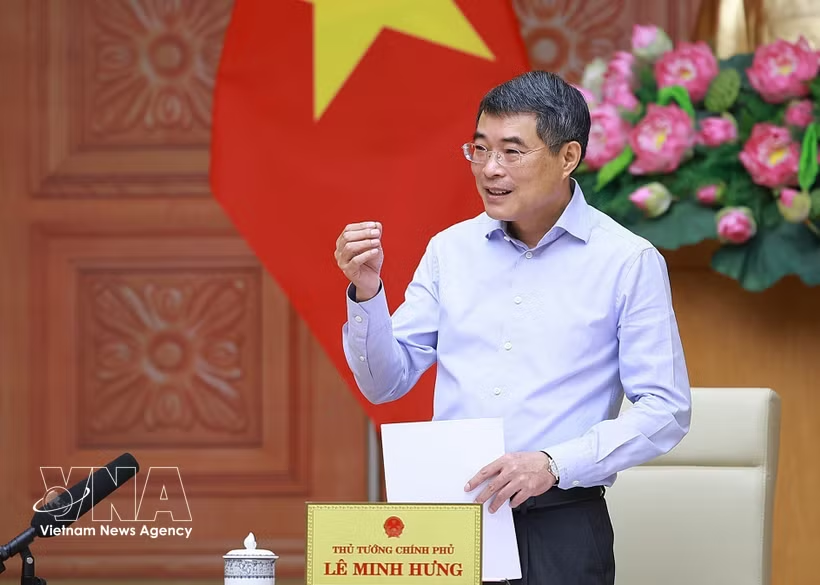
Prime Minister Le Minh Hung speaks at the working session with the Ministry of Education and Training. (Photo: VNA)

Hanoi (VNA) – Prime Minister Le Minh Hung on April 25 chaired a working session with the Ministry of Education and Training (MoET) to review priority tasks, address bottlenecks, and accelerate key reforms in the sector, during which he underscored education’s central role in sustaining Vietnam’s long-term economic growth.

PM Hung emphasised that the education and training sector carries an extensive and demanding workload, and has been consistently identified by the Party and the State as a top national priority, receiving special attention from the Politburo as well as Party General Secretary and State President To Lam.

He reaffirmed the pivotal role of the sector in delivering on the country’s development goals and targets, particularly through its contributions to total factor productivity, the pace of labour productivity growth, and the proportion of trained workforce.

The Government leader acknowledged the ministry’s efforts in advancing major reforms, including the completion of key legal frameworks, the introduction of policies to promote innovation ecosystems, and the expansion of high-quality training programmes in strategic and high-tech fields. The sector has also made strides in early childhood education, digital transformation, and fostering closer cooperation between the State, educational institutions, and enterprises.

However, he also pointed out persistent shortcomings that require urgent attention. These include delays in implementing policy frameworks and projects, slow restructuring of higher education and vocational training institutions, uneven quality across regions, localised teacher shortages, and gaps in infrastructure and teaching materials. The digitalisation of sector-wide data and administrative reform also remain a challenge.

The PM attributed these limitations largely to subjective factors, including insufficient awareness in some areas, lack of strong political determination, ineffective inter-agency coordination, and weak administrative discipline.

Therefore, PM Hung outlined a set of strategic directions, including the continued institutionalisation of the Party's guidelines into concrete policies, with a focus on streamlining governance under the principle that each task is assigned to a single lead agency.

Greater emphasis should be placed on planning, reorganising, and improving the quality and operational efficiency of public service units in education and training, he noted.
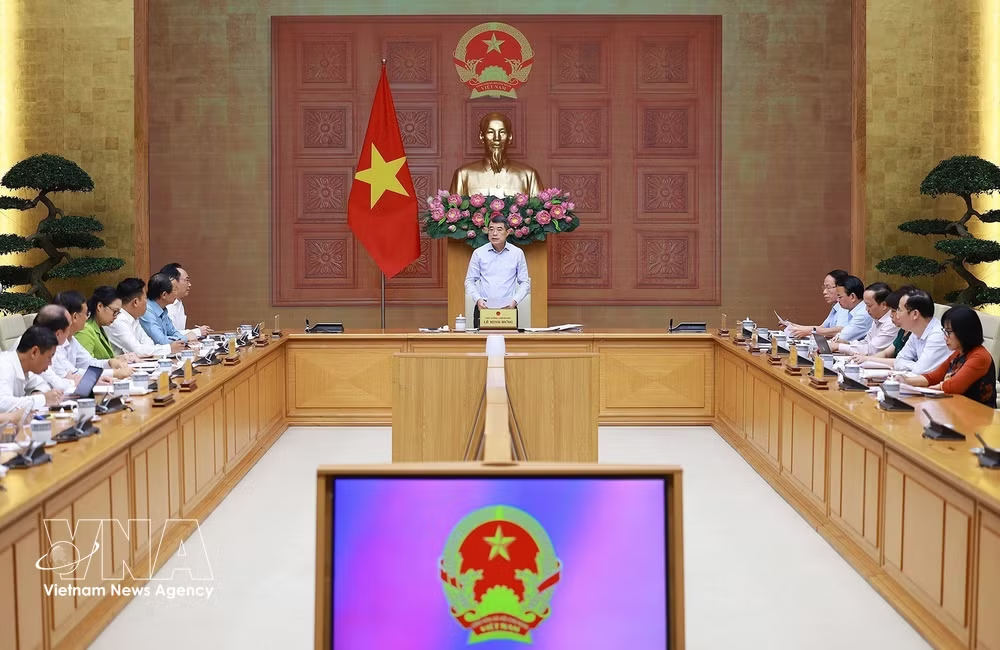
vnanet-leminhhung2.jpg
Prime Minister Le Minh Hung speaks at the working session with the Ministry of Education and Training. (Photo: VNA)

In parallel, the sector was tasked with accelerating the restructuring of universities and vocational institutions, and eliminating substandard entities. Strengthening early childhood education, ensuring the nationwide rollout of a unified general education textbook system from the 2026–2027 academic year, thorough preparations for the organisation of the upcoming high school graduation exam, and enhancing foreign language teaching - particularly the gradual adoption of English as a second language in schools - were also highlighted as priorities.

For higher education and vocational training, the PM called for stronger alignment with scientific research and technological development, particularly in emerging fields such as semiconductors, artificial intelligence, and cloud computing. He emphasised the need for large-scale national programmes to train and retrain the workforce in strategic sectors, alongside expanded State-school-enterprise partnerships.

He also called for closer monitoring and stronger oversight of localities to ensure adequate staffing of teachers and school personnel in line with prescribed norms, and finalise and submit for approval preferential policies on salaries and allowances for educators, particularly those working in remote and disadvantaged areas.

Regarding sector-wide digital transformation, PM Hung directed the development of a unified architecture and governance framework, along with the standardisation of data systems. He stressed the need to expedite the completion of the national database on education and training, restructure administrative procedures toward the reuse of shared data and information, and further refine the regulatory framework for operations in the digital environment.

The PM also urged intensified efforts to simplify administrative procedures and improve the business environment in education, noting that even incremental reforms could yield immediate and substantial contributions to economic growth.

He also requested the MoET to expedite delayed policy proposals, including those on tuition and textbook support, scholarship funds, and the development of major universities into regional and global centres of excellence.

Reaffirming his expectations, PM Hung called on the ministry's leadership to act with greater initiative, determination, and accountability, focusing on removing bottlenecks and ensuring that reforms are translated into tangible outcomes./.

VNA

See more

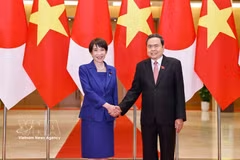
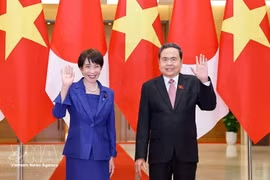
NA Chairman Tran Thanh Man (R) and Japanese Prime Minister Takaichi Sanae (Photo: VNA)

NA Chairman meets with Japanese PM

Both leaders expressed satisfaction with the robust and substantive development of the Vietnam–Japan Comprehensive Strategic Partnership, underscoring the importance of parliamentary cooperation. They agreed to further bolster political trust, high-level exchanges and interactions between two legislatures’ specialised committees, and cooperation among friendship parliamentary groups, young and female legislators.

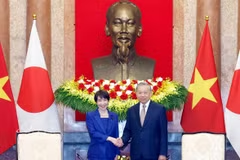
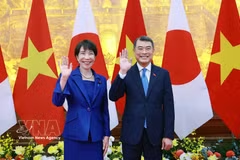
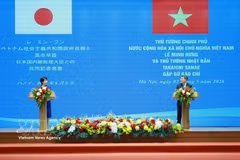
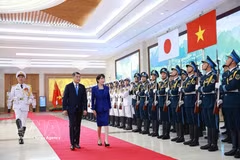
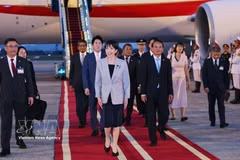
Prime Minister Le Minh Hung and Japanese Prime Minister Takaichi Sanae pose for a photo at the official welcome ceremony on May 2, 2026. (Photo: VNA)

Vietnam, Japan push for more substantive, effective ties

Noting the strong momentum in bilateral ties, built on solid political trust, extensive economic cooperation and growing people-to-people exchanges, PM Hung called for closer coordination to take the partnership to new heights and broaden collaboration across all sectors.

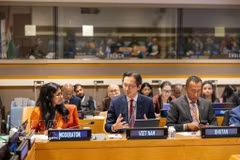
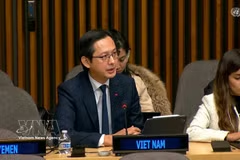
Ambassador Do Hung Viet, Vietnam’s Permanent Representative to the United Nations, speaks at the meeting. (Photo: VNA)

Vietnam calls for solidarity in support of Cuba

Ambassador Do Hung Viet, Vietnam’s Permanent Representative to the United Nations, called on member states to uphold the movement’s spirit of solidarity, continue supporting Cuba, oppose unilateral embargoes and sanctions, and back dialogue efforts between Cuba and the US based on mutual respect, peace, stability and the interests of their people.

Vietnamese Ambassador Ngo Minh Nguyet poses for a group photo with representatives of the Communist Party of Uruguay. (Photo: VNA)

Communist Party of Uruguay enhances cooperation with Vietnam

The Communist Party of Uruguay (PCU) is ready to coordinate and share materials to support the development of the Communist Party of Vietnam Museum. A photo archive centre in Montevideo currently stores many valuable images and materials on Vietnam and is expected to support information exchange between the two sides.

Nguyen Viet Duc, Vice President of the Union of Vietnamese Associations in Germany, delivers remarks at the working session. (Photo: VNA)

Vietnamese community in Germany strengthens connectivity

Solidarity, mutual support, and resilience remain key characteristics of the Vietnamese community in Germany, with Vietnamese people continuing to value family, prioritise education, make continuous efforts to integrate into host society, and preserve cultural identity while maintaining ties with their homeland.

Ambassador Mai Phan Dung and WTO Director-General Ngozi Okonjo-Iweala in a meeting. (Photo: VNA)

Vietnam continues to contribute effectively to multilateral mechanisms: Ambassador

With a solid foundation of political stability, a clear development orientation, and strong international support, Vietnam is well-positioned to continue enhancing its role in multilateral forums, contributing actively to addressing global challenges, and realising its aspiration to become a high-income, developed country by 2045.

Ambassador Do Hung Viet (centre) and Chairman of the Presidium of the Central Committee of the Japanese Communist Party Shii Kazuo (third from the left) and other delegates pose for a group photo (Photo: VNA)

Vietnam values growing ties with Japan: diplomat

Vietnam attaches great importance to the increasingly close and effective Comprehensive Strategic Partnership with Japan, as well as the close and foundational ties between their Communist Parties, Ambassador Do Hung Viet has said.

Minister Counsellor Nguyen Hoang Nguyen, Deputy Permanent Representative of Vietnam to the UN addresses the session (Photo: VNA)

Vietnam calls for de-escalation of tension in Middle East

Minister Counsellor Nguyen Hoang Nguyen, Deputy Permanent Representative of Vietnam to the UN reaffirmed Vietnam’s consistent stance of supporting the Palestinian people’s right to self-determination, Palestine’s UN full membership, and the two-state solution based on pre-1967 borders, in accordance with international law and relevant UN resolutions.

Vietnamese Ambassador to Algeria Tran Quoc Khanh (R) meets with Annaba Governor Abdelkrim Lamouri. (Photo: VNA)

Vietnam promotes multifaceted cooperation with Algerian locality

Ambassador Tran Quoc Khanh affirmed that Vietnam attaches importance to its relationship with Algeria and wishes to expand cooperation with localities, including Annaba, particularly following the elevation of bilateral ties to a Strategic Partnership in November 2025.

Deputy Minister of Foreign Affairs Le Thi Thu Hang, head of the Vietnamese delegation to the 11th NPT Review Conference, addresses the roundtable discussion on April 29. (Photo published by VNA)

Vietnam chairs roundtable on peaceful use of nuclear energy

Deputy Minister of Foreign Affairs Le Thi Thu Hang called for strengthened international cooperation in nuclear applications, with a focus on capacity-building, training, technology transfer and mobilisation of sustainable financial resources to support long-term development goals.