Rooftop solar power to ease pressure on electricity supply

As electricity demand surges, particularly during the hot season, Vietnam is stepping up efforts to promote rooftop solar power as a practical solution to ensure energy security, improve efficiency, and ease pressure on the national grid.

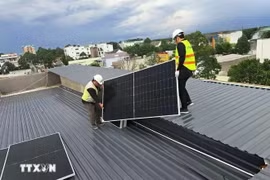
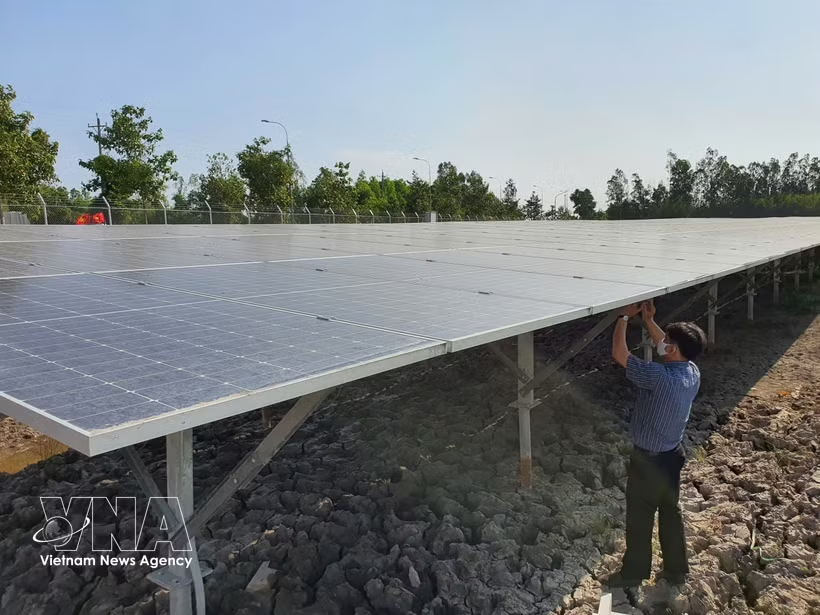
Rooftop solar panels in the Mekong Delta city of Can Tho. (Photo: VNA)

Hanoi (VNA) – As electricity demand surges, particularly during the hot season, Vietnam is stepping up efforts to promote rooftop solar power as a practical solution to ensure energy security, improve efficiency, and ease pressure on the national grid.

​The issuance of Directive No. 10/CT-TTg by the Prime Minister is an important policy framework for ministries, localities, businesses, and households to save energy while accelerating the development of rooftop solar systems.

​The directive comes in the first year of the 2026–2030 socio-economic development plan, which sets ambitious growth targets and, in turn, raises electricity demand. Meanwhile, global energy markets remain volatile, adding to supply risks. To address these challenges, the directive outlines six key tasks, focusing on demand-side management, efficient energy use, and the expansion of self-distributed renewable energy.

​Localities have moved quickly to translate the directive into action. Vice Chairman of the Thanh Hoa provincial People’s Committee Mai Xuan Liem said authorities have assigned specific responsibilities to relevant agencies and are developing detailed implementation plans. The province is also drafting a programme on efficient energy use for 2026–2030, prioritising rooftop solar installations at public offices while encouraging households to participate.

The coordinated rollout of such measures can help reduce peak load, optimise system operations, and limit the need for costly investment in new power sources, especially as baseload capacity cannot be expanded rapidly. Flexible load management and closer coordination with the power sector are also being promoted.

​Energy expert Ha Dang Son described the push for rooftop solar as a “well-suited direction”, noting that it is a clean, easy-to-install energy source with a relatively short payback period. Investment costs have fallen sharply to around 40–50% of levels five years ago, allowing capital recovery within about five years, even in northern regions.

​However, he cautioned that rooftop solar is weather-dependent and not a fully dispatchable source, requiring integration with energy storage systems to enhance reliability and flexibility.

​At the enterprise level, the benefits are becoming increasingly evident. Nguyen Quang Tao, Deputy General Director of Ngai Cau Mechanical Company in Bac Ninh province, said the firm has installed a rooftop solar system with a capacity of around 1 MWp. In addition to boosting renewable energy use, it cools factory buildings when combined with greenery, significantly reducing air-conditioning demand. During peak summer heat nearing 40 degrees Celsius, indoor temperatures have dropped noticeably, lowering operating costs and improving work conditions.

​In the service sector, businesses are also adopting energy-saving practices. A representative of Long Thanh Hotel in Thanh Hoa said electricity bills can reach 400–500 million VND per month during peak periods. To cut costs, the hotel has optimised air-conditioning operations, installed LED lighting with sensors, and tightened control over high-consumption equipment. It is also considering rooftop solar to enhance energy autonomy and reduce long-term expenses.

​Households are similarly seeing tangible gains. A family in Thanh Hoa reported that its 3.1 kWp rooftop solar system has significantly reduced electricity bills, with most daytime demand now met by on-site generation.

​From a system operation perspective, Nguyen Ba Hoai of National Power System and Market Operator Company stressed the importance of data transparency. Accurate information on rooftop solar capacity is essential for forecasting output and ensuring safe, stable system operation.

​Directive No. 10/CT-TTg targets about 10% of public offices and 10% of households adopting rooftop solar, or achieving total installed capacity equivalent to 20% of the 2026–2030 plan, and calls for improved financial, green credit, and technical support mechanisms./.
See more

Construction of Tu Lien bridge in Hanoi (Photo: VNA)

CPI up 0.84% in April on rising energy, dining costs

The CPI in April advanced 3.31% compared to December 2025 and 5.46% from a year earlier. For the first four months of 2026, the index climbed 3.99% against the same period last year, with core inflation growing 3.89%.

At Giang Dien Industrial Park in Dong Nai province (Photo: VNA)

FDI flows to Vietnam up 32% in four months

Realised FDI in Vietnam during the first four months was estimated at 7.40 billion USD, up 9.8% year-on-year, the highest level for the period in the past five years.

An unmanned aerial vehicle is used in rice cultivation in Vi Thanh 1 commune, Can Tho city. (Photo: VNA)

Shrinking farmland forces agriculture to go high-tech

Ministry of Finance data show that about 60% of companies have started using basic digital tech, while roughly 20% now have clear digital strategies. But only 5% has gone all the way with full-blown digital transformation.

SIAL Canada CEO Stéphane Thuillier (right) visits the Vietnam pavilion and speaks with a representative of the Vietnam Trade Office. (Photo: VNA)

Vietnamese exports expand foothold in Canada

The Vietnam Trade Office in Canada organised a national pavilion this year, supporting 15 companies in product displays while helping connect five others operating independent booths. The initiative is designed to enhance product promotion, facilitate partnerships and broaden market access in North America, particularly in the processed food segment.

Core site (Vinh Truong hamlet, Phuoc Dinh commune) for the construction of the Ninh Thuan 1 nuclear power plant. (Photo: VNA)

All-out push to fast-track Vietnam’s first nuclear power plants

Khanh Hoa province has also intensified oversight, introduced housing support of 5 million VND (nearly 190 USD) per month for displaced residents awaiting resettlement, and clarified responsibilities for land inventory, measurement and site selection. Notably, more than 9.8 billion VND has been disbursed to relocate 570 graves, helping accelerate clearance for the Ninh Thuan 1 Plant.

Traditional handicraft products at the Vietnamese booth attract visitors at the Paris Fair (Photo: VNA)

Vietnamese products shine at Paris Fair

Amid deepening international integration, the presence of Vietnamese enterprises at the annual Foire de Paris continues to affirm the appeal of Vietnamese goods and culture in the French market. The event also provides an opportunity for Vietnamese businesses to directly engage with French and European consumers, thereby strengthening their foothold in this promising market.

Do Gia Thang, Secretary-General of the Vietnam Business Association in Australia (VBAA) and Chairman of the Vietnam–Australia Young Entrepreneurs Club (Photo: VNA)

International Financial Centre - Vietnam's strategic move in global race: Expert

Vietnam is pursuing a “one centre – two destinations” model. Ho Chi Minh City is envisioned as a comprehensive financial hub linked with a free trade zone, while Da Nang will focus on innovation, fintech, digital assets and serve as a testing ground for new financial models. This complementary structure allows Vietnam to develop a tailored approach rather than replicate existing financial centres.

Financial buildings in central Ho Chi Minh City along the Saigon River, facing the Thu Thiem peninsula in An Khanh ward. (Photo: VNA)

Ho Chi Minh City attracts significant investment from France

Ho Chi Minh City is emerging as an attractive destination for French investors, particularly in infrastructure, sustainable urban development and green transition. French investment of more than 2.2 billion USD is contributing to economic growth and opening up broader prospects for long-term cooperation.

An aerial view of a crossroads in Hanoi (Photo: VNA)

Hanoi pushes SOEs to lead breakthrough growth

According to experts, Resolution 79-NQ/TW reaffirms the state economic sector’s leading role in the socialist-oriented market economy. The real shift, however, is moving SOEs from simply “holding” assets to actively “leading” development, and from traditional “management” to enabling growth across the board.

A representative of the Coast Guard speaks at the meeting. (Photo: VNA)

Ho Chi Minh City steps up decisive action to lift IUU “yellow card”

The city will fast-track eCDT implementation, study the feasibility of a fishing port in Can Gio, and propose granting accounts to border guard stations to strengthen oversight of vessel movements. Enhanced inter-provincial coordination, particularly with Lam Dong, Da Nang, Quang Tri and Ninh Binh, was also emphasised to tighten control and strictly handle violations, especially those related to VMS.

An overview of Prime Minister Le Minh Hung's working session with the Ministry of Finance on April 29 (Photo: VNA)

PM emphasises need for governance shift to drive growth

Ministries and agencies must enhance forecasting capacity, adopt more responsive policy tools, and fundamentally rethink how policies are designed and executed in a rapidly evolving environment, said PM Le Minh Hung.