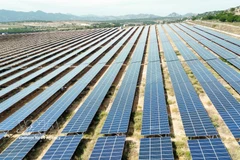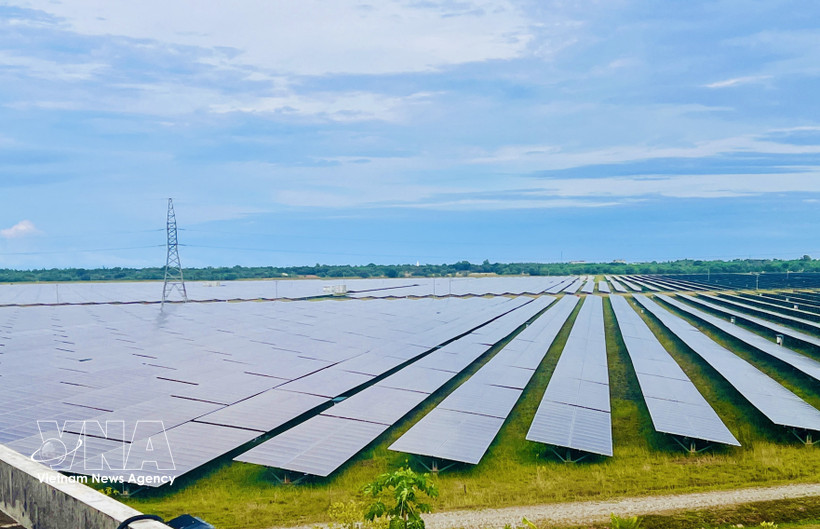
Hanoi (VNA) – Prime Minister Pham Minh Chinh has issued a directive, requesting stricter electricity-saving measures and accelerated development of self-produced, self-consumed rooftop solar power, as Vietnam moves to secure energy supply amid rising demand and global uncertainties.
The directive underscores the top and urgent priority to ensure safe, stable and uninterrupted power supply for production and daily life is saying that these hold decisive importance for economic growth and national energy security.
To proactively implement solutions for managing electricity demand in 2026, the PM has instructed ministries, sectors, local authorities, state-owned groups and corporations, as well as organisations and individuals to urgently and effectively carry out assigned tasks and measures in a timely and decisive manner.
The target is to save at least 3% of total national electricity consumption in 2026, and to achieve a minimum 10% reduction in electricity use during peak hot months (April, May, June, and July).
The PM also requested synchronously implementing demand-side management and demand response (DSM/DR) programmes, aiming to cut at least 3,000 MW of load capacity during peak hours when there is a risk of supply–demand imbalance in the power system.
The directive underlined the need to prioritises rapid expansion of rooftop solar for self-use across public offices, production and service facilities, and households, and the installation of integrated battery energy storage systems (BESS), towards realising the goal for around 10% of public offices and 10% of households nationwide to adopt rooftop solar systems annually, or for total installed capacity to reach 20% of planned rooftop solar capacity in each locality during 2026–2030.
Local governments are tasked with developing tailored deployment plans.
The PM also called for maximising on-site and backup power sources at enterprises and institutions, while Vietnam Electricity (EVN) is required to reduce transmission and distribution losses to below 6%.
Ministries, agencies, localities, businesses and households must formulate and implement action plans for 2026 with defined targets, roadmaps and responsibilities. Performance in electricity saving will be linked to leadership evaluation, the directive said.
Meanwhile, public offices must enforce strict energy-saving practices during peak hours, replace inefficient equipment, and adopt digital monitoring tools. Public lighting systems are required to cut consumption by at least 30%, including switching off decorative and advertising lighting where possible, while still ensuring safety.
Commercial establishments such as hotels, restaurants, office complexes and apartment buildings must reduce at least 50% of outdoor decorative lighting capacity during evening peak hours. Households are encouraged to install rooftop solar and energy storage, as well as solar water heating systems.
Industrial producers, especially major energy users, must integrate energy-saving targets into business plans, participate in DSM/DR programmes, and shift production away from peak hours. Facilities consuming over 500,000 kWh annually are required to reduce electricity use by at least 3%.
EVN is instructed to upgrade grid infrastructure, enhance technical management, and ensure reliable operation, while supporting customers in adopting rooftop solar and participating in demand response programmes.
The directive also urges stepping up communication and public awareness campaigns on the benefits and policies of energy saving. Media agencies are tasked with intensifying communications on the guidelines, targets, benefits, and policies related to efficient and economical electricity use, as well as the advantages and incentives for rooftop solar development, thereby contributing to promoting renewable energy, and advancing the green transition./.
See more
Vietnam steps up crackdown on IUU fishing, implementation of EC recommendations
After reviewing reports from the Ministry of Agriculture and Environment and relevant agencies, Ha tasked the ministry with taking full responsibility before the Government and the Prime Minister for the implementation of anti-IUU fishing measures and the EC's recommendations.
Malaysia appreciates Vietnam’s competitive edge in investment attraction
Speaking at the New Japan–Malaysia Industrial Cooperation Seminar, Nazir Razak, Chairman of the ASEAN Business Advisory Council (ASEAN-BAC) Malaysia, acknowledged growing competition from regional economies such as Vietnam, which benefits from political stability, an abundant labour force, and a larger domestic market.
State Bank moves to keep interest rates stable
Banks must continue publicly disclosing average lending rates, the spread between deposit and lending rates, and interest rates of credit schemes and packages on their websites, making it easier for individuals and firms to access capital.
Vietnam remains among fastest-growing economies in Southeast Asia-6
Notably, Vietnam recorded the highest real GDP growth among the Southeast Asia-6 economies in 2025, reaching 8%, significantly higher than the pre-pandemic average of 7.1%.
Tay Ninh builds new edge through industrial park – logistics integration
Beyond serving as production hubs, the province’s industrial zones are evolving into a broader development platform integrating industry, logistics, urban areas and services, helping reposition Tay Ninh in the southern key economic region amid shifting global investment flows.
Textile firms strengthen resilience amid rising global risks
As soon as the conflict in the Middle East broke out, companies quickly developed strategies such as securing raw material supplies, diversifying sourcing and customer bases and avoiding dependence on limited clients, said a business insider.
A historic opportunity for Vietnam’s economy
Amid ongoing global geopolitical turbulence, Vietnam stands at a pivotal moment, with favourable conditions and untapped potential positioning it for sustained, high-quality growth—and possibly a historic leap toward high-income status.
Vietnamese Party official hosts leader of US-based The Asia Group
Vietnam welcomes and encourages US businesses – known for their strengths in technology, governance, and innovation – to further expand investment and operations in the Southeast Asian country, said Chairman of the Commission for Policies and Strategies Nguyen Thanh Nghi.
Central Vietnam’s investment rebounds as Da Nang, Gia Lai draw massive capital inflows
Da Nang is reasserting its position as the premier investment hub in the central region, with an increasingly transparent and pro-business environment.
Reference exchange rate edges up on March 31
With the current trading band of +/- 5%, the ceiling rate applicable for commercial banks during the day is 26,357 VND/USD, and the floor rate 23,847 VND/USD.
FDI into Ho Chi Minh City jumps over 200% in first quarter
Strong foreign investment inflows reflect the city’s resilience in the face of global volatility, said a local official.
SaigonTex – SaigonFabric 2026 to showcase latest industry trends
Expected to draw more than 32,000 trade visitors, the event ranks among the largest specialised international exhibitions in textiles, machinery, materials and fabrics.
HSBC arranges 200 million USD loan for GELEX Infrastructure JSC
According to Tim Evans, CEO and Head of Banking, Legal Representative at HSBC Vietnam, the deal was completed amid challenging market conditions and a tight execution timeline. The syndicated loan drew strong interest from lenders and was structured to align with GELEX Infrastructure’s medium-term funding requirements.
Russia eyes expanded technological footprint in Asia through Vietnam’s nuclear project
For Vietnam, the agreement marks the culmination of years of deliberation and signals a return to nuclear power development. For Russia, meanwhile, large-scale projects such as Ninh Thuan 1 provide a solid foundation to expand its presence in Asia and export its nuclear technologies and infrastructure.
Italian scholar praises Vietnam’s energy security strategy
Like other Asia-Pacific economies, Vietnam is closely monitoring developments in the Gulf region. Despite possessing considerable oil and gas reserves, rapid industrialisation has made the country a net importer of both gas and oil.
Indonesian expert offers ideas for Vietnam’s energy security
Vietnam is shifting from a mindset of “ensuring sufficient energy supply” toward a framework of “safe, self-reliant, and sustainable energy”, said an Indonesian expert.
Can Tho seeks to expand investment cooperation with Indian partners
In recent months, many Indian enterprises have sought investment opportunities in Vietnam, particularly in technology, food processing, machinery, and the application of artificial intelligence in agriculture, via the Indian Consulate General in Ho Chi Minh City, said Consul General Vipra Pandey.
Australia’s three-tier response offers lessons for Vietnam’s energy security
In the longer term, Vietnam should align clean energy industrial policy with supply chain security, while enhancing institutional coordination to ensure a balanced approach to growth, affordability, sustainability and energy security.
Vietnam becomes Southeast Asia’s second-largest importer of European poultry
Poland remained the dominant European supplier to Vietnam, exporting more than 37,300 tonnes last year. France followed with about 4,900 tonnes, while Hungary, Italy and the Netherlands supplied 4,680 tonnes, 2,750 tonnes and 2,170 tonnes, respectively.
Sun PhuQuoc Airways launches its first international route to Taipei
On March 29, 2026, Sun PhuQuoc Airways - the airline of Sun Group - officially launched its first international route connecting Phu Quoc and Taipei (Taiwan, China), marking the initial step in its strategy to connect Phu Quoc with the world and gradually position the island as one of Vietnam’s emerging international gateways.