Hanoi, Tokyo step up cooperation in technology, sustainable development

Hanoi hopes to further expand cooperation with Tokyo in high technology, green transition and energy transition, its Chairman Vu Dai Thang said.

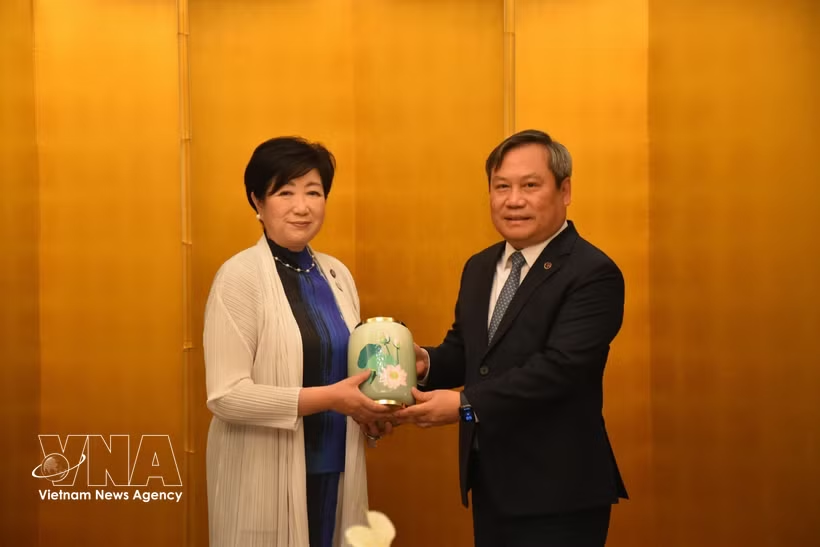
Chairman of the Hanoi People's Committee Vu Dai Thang (right) presents a gift to Governor of Tokyo Koike Yuriko at their meeting on April 28. (Photo: VNA)

Tokyo (VNA) – Hanoi and Tokyo are deepening cooperation in high technology, digital transformation and sustainable development as the Vietnamese capital seeks to accelerate innovation-driven growth and strengthen international partnerships.

On April 28, as part of a working visit to Japan, a high-level delegation from Hanoi led by Chairman of the municipal People’s Committee Vu Dai Thang met with Tokyo Governor Koike Yuriko.

At the meeting, Koike welcomed the Hanoi delegation and thanked Thang for participating and delivering remarks at the 2026 Global Network of Cities for Sustainability (G-NETS) leaders summit, as well as attending a dialogue on sustainable development between Tokyo and ASEAN capitals. She expressed her hope that G-NETS 2026 and related dialogues will further strengthen ties between Tokyo and cities worldwide, particularly those in Southeast Asia, including Hanoi.

For his part, Thang thanked Tokyo authorities for inviting Hanoi leaders to take part in the forum on sustainable technology development and artificial intelligence (AI) application. He described the event as a valuable opportunity for city leaders to exchange views on technological trends and digital transformation.

He noted that Tokyo’s organisation of G-NETS meetings for three consecutive years has helped enhance connectivity among global cities. The 2026 edition, focusing on sustainable technology and AI application, is particularly relevant to urban development today. Hanoi, he added, will share its experience in deploying AI solutions, promoting sustainable development, and applying high technology.

The Hanoi leader also expressed gratitude to Tokyo and Japan for their longstanding support in the Vietnamese city’s economic – industrial development and environmental protection. He stressed that the memorandum of understanding signed between the two cities in 2013 has proven effective, and their friendship epitomises the breakthrough growth of Vietnam – Japan relations across all fields.

Looking ahead, Hanoi hopes to further expand cooperation with Tokyo in high technology, green transition and energy transition, he said, extending an invitation to Governor Koike and her colleagues to visit the Vietnamese capital in the near future.
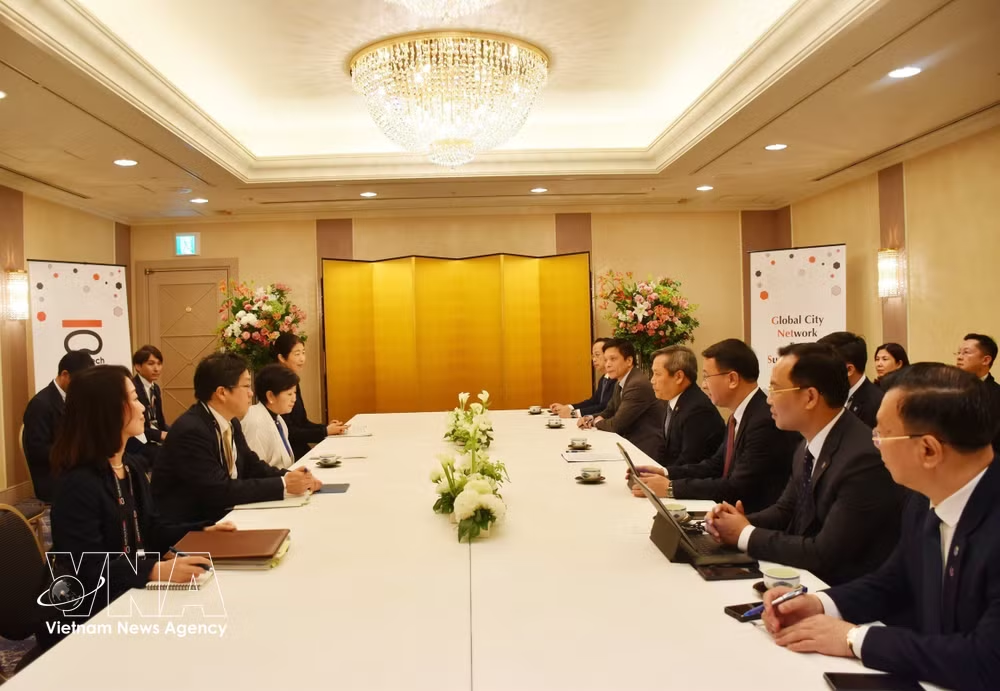
The meeting between Chairman of the Hanoi People's Committee Vu Dai Thang and Governor of Tokyo Koike Yuriko on April 28. (Photo: VNA)

The meeting between Chairman of the Hanoi People's Committee Vu Dai Thang and Governor of Tokyo Koike Yuriko on April 28. (Photo: VNA)

At the G-NETS leaders summit, Thang delivered a presentation on artificial intelligence and digital technology. He highlighted Hanoi’s adoption of an “AI First” approach, placing data and AI at the core of building a digital administration and improving governance efficiency. AI applications have been widely introduced across areas, helping improve public services, reduce costs and increase citizen engagement, notably through the iHanoi digital platform.

Addressing concerns raised by participants about potential job losses due to AI, the official emphasised that AI development must centre on people and businesses. He affirmed that AI will not lead to mass layoffs but instead support workforce restructuring towards better alignment with individual capabilities, alongside appropriate policies to safeguard workers’ rights. AI, he stressed, is intended to improve job quality rather than reduce headcount.

At the closing plenary, Thang, Koike and representatives of participating cities adopted a joint declaration outlining commitments to sustainable urban development and technological innovation.

Also on April 28, the Hanoi delegation attended the SusHi Tech Tokyo 2026 exhibition at Tokyo Big Sight, where Thang visited booths of Vietnamese digital transformation enterprises and tech startups, praising their rapid growth and innovation capacity.

In a separate meeting with representatives from the Asian Development Bank (ADB), the Hanoi leader highlighted the city’s significant demand for resources to meet its ambitious growth targets. In addition to domestic resources, Hanoi is seeking support from traditional partners and new financial sources, particularly bilateral and multilateral institutions such as the ADB.

He thanked the ADB for its assistance in the implementation of Hanoi’s Metro Line No. 3 project, which has largely remained on schedule.

In response, Winfried Wicklein, Director General of the ADB's Southeast Asia Department, reaffirmed the bank’s commitment to accelerating project completion and exploring further cooperation in urban railways, science and technology, and transport infrastructure.

On April 27, the Hanoi delegation met with young Vietnamese scientists and experts working in Japan in the fields of science, technology and digital transformation. At the meeting held at the Vietnamese Embassy in Japan, participants proposed initiatives on technology application, digital transformation and urban planning for Hanoi.

Thang said the exchange demonstrated the strong contributions from Vietnamese intellectuals abroad and reaffirmed the city’s determination to make science, technology and innovation a key driver of development, with the goal of turning Hanoi into a major science hub in the coming years./.
VNA

See more

Vietnamese Ambassador to the RoK Vu Ho speaks at the event. (Photo: VNA)

President Ho Chi Minh honoured in RoK on 136th birth anniversary

With Vietnam–Korea ties expanding across multiple fields, he noted that honouring President Ho Chi Minh in the RoK carries significance beyond the overseas Vietnamese. It offers a chance to raise mutual understanding, empathy, and bonds between the Vietnamese and Korean people built on shared values of peace, cooperation, and development.

President Ho Chi Minh works at the Presidential Palace in Hanoi. (File photo: VNA)

Ho Chi Minh Thought guides development path: Top leader

In an article written on the occasion of President Ho Chi Minh’s 136th birth anniversary (May 19, 1890 – 2026), the top Vietnamese leader affirmed that “Ho Chi Minh Thought serves as a guiding light along our development path.”

Vietnamese Ambassador to Venezuela Vu Trung My speaks at the event (Photo: VNA)

President Ho Chi Minh’s enduring legacy highlighted at Venezuela commemoration

Vice President of the United Socialist Party of Venezuela (PSUV) Jesús Faria expressed deep admiration for President Ho Chi Minh and Vietnam’s indomitable struggle for national independence. He described President Ho Chi Minh as an immortal symbol of 20th-century national liberation movements, whose legacy continues to inspire leftist parties, progressive movements, and peoples across Latin America, including Venezuela.

Standing Vice Chairman of the municipal People’s Committee Nguyen Loc Ha (R) and EU Ambassador to Vietnam Julien Guerrier. (Photo: VNA)

Ho Chi Minh City, EU boast ample room for sustainable development cooperation

Since the establishment of their diplomatic ties in 1990, Vietnam and the EU have deepened the bilateral ties into one of the bloc’s most dynamic and in-depth partnerships with an ASEAN member, Ha noted, adding that the relationship entered a new chapter in January when the President of European Council’s visit upgraded it to a Comprehensive Strategic Partnership.

Deputy Minister of Foreign Affairs Nguyen Minh Hang speaks at a discussion session on reforming multilateral systems and global governance, held on May 15, 2026, as part of the expanded BRICS Foreign Ministers’ Meeting in India. (Photo: VNA)

Vietnam ready to strengthen BRICS connection with Asia-Pacific

Hang called on countries to act responsibly in accordance with international law and the UN Charter; respect the independence, sovereignty and territorial integrity of states; refrain from using or threatening to use force; and settle disputes peacefully through dialogue. She also underscored the importance of ensuring security, safety and freedom of navigation through straits in line with international law, including the 1982 United Nations Convention on the Law of the Sea (UNCLOS).

Vietnamese Minister of Foreign Affairs Le Hoai Trung (centre), DPRK Vice Minister Pak of Foreign Affairs Sang Gil (left), and Vietnamese Ambassador to the DPRK Le Ba Vinh cut the ribbon to open the exhibition. (Photo: VNA)

Photo exhibition highlights Vietnam–DPRK relations

Visitors at the exhibition were moved by historical photographs dating back nearly 70 years, including images of the founding leader of the DPRK Kim Il Sung personally welcoming President Ho Chi Minh and a CPV delegation at Pyongyang’s Sunan International Airport during their visit to the DPRK from July 8–12, 1957. In return, the DPRK leader paid an official visit to Vietnam from November 27 to December 3, 1958.

Illustrative image (Photo: VNA)

Deputy PM calls for substantive assessment of two-tier local administration operations

Chairing a meeting on the development of a scheme to review the first-year operations of the political system’s organisational apparatus and the two-tier local administration model, Tra emphasised that the review must comprehensively and objectively evaluate the nationwide implementation of administrative unit restructuring and the operation of the new local administration model.

Vietnamese Ambassador to Russia Dang Minh Khoi (right) and First Deputy Chairman of the Federation Council of Russia Andrey Yatskin at their meeting in Moscow on May 14. (Photo: VNA)

Key directions for Vietnam–Russia cooperation in 2026

Vietnamese Ambassador to Russia Dang Minh Khoi had a working session with a delegation from the Russian Federation Council led by First Deputy Chairman Andrey Yatskin, in Moscow on May 14, discussing the expansion of multifaceted cooperation in 2026.

Officials from Cao Bang province of Vietnam and Baise city in the Guangxi Zhuang Autonomous Region of China hold talks on May 15. (Photo: VNA)

Cao Bang, China’s Baise city eye to boost all-around cooperation

Cao Bang province of Vietnam and Baise city in the Guangxi Zhuang Autonomous Region of China are exploring a “red tourism” route linking Pac Bo and Meng Mo (China) to promote revolutionary tradition education and strengthen bilateral friendship. They are also stepping up cooperation in human resource development through training exchanges and efforts to improve workforce quality.

Atsaphangthong Siphandone (centre), Secretary of the Vientiane Party Committee and Chairman of the municipal People’s Council, speaks at the working session. (Photo: VNA)

Ho Chi Minh City, Vientiane strengthen cooperation for 2026–2030

Under the MoU, the two sides will strengthen cooperation in politics – diplomacy, security – defence, legal and judicial affairs, economic affairs, education, culture and society, cooperation among mass organisations and socio-political organisations, and development support.