Vietnam, RoK step up investment cooperation in tech, innovation startups

The Vietnam – RoK cooperation is shifting from traditional models to innovation-driven partnerships and co-creation of value, said Minister Counsellor Nguyen Thi Thai Binh.

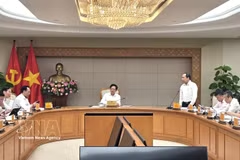
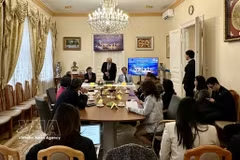
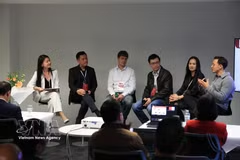
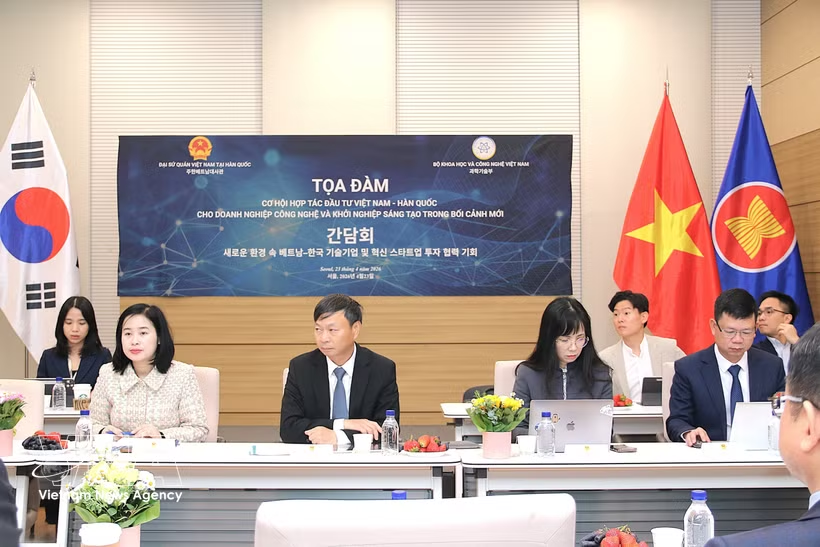
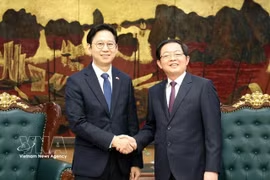
Participants in the meeting. (Photo: VNA)

Seoul (VNA) – The Ministry of Science and Technology (MoST) in coordination with the Vietnamese Embassy in the Republic of Korea (RoK) on April 23 organised a seminar exploring international investment cooperation opportunities for technology enterprises and innovative startups in the new context.

The event attracted strong interest from investment funds, businesses and industry associations in the RoK.

Speaking at the event, Deputy Minister of the MoST Hoang Minh said Vietnam is targeting double-digit GDP growth for the 2026–2030 period. To achieve this, the country is prioritising the development of emerging sectors such as semiconductors, artificial intelligence (AI), clean energy and green transformation. Those areas are expected to offer more opportunities for cooperation with Korean partners.

He stressed the need to upgrade Vietnam’s innovation ecosystem, support startups in meeting international standards, and strengthen links with national venture capital funds to mobilise resources for growth.

Nguyen Thi Thai Binh, Minister Counsellor at the Vietnamese Embassy in the RoK, highlighted the special significance of the seminar, which coincided the state visit to Vietnam by President of the RoK Lee Jae Myung, following the visit to the Northeast Asian country by Party General Secretary To Lam in August 2025. These high-level exchanges underscore strong political trust and the dynamic development of the Vietnam – RoK Comprehensive Strategic Partnership.

She noted that Vietnam is evolving from an investment destination into a strategic link in emerging global value chains. With cumulative Korean investment nearing 100 billion USD and bilateral trade reaching around 90 billion USD, economic ties are entering a more substantive and higher-quality phase.

The Vietnam – RoK cooperation is shifting from traditional models to innovation-driven partnerships and co-creation of value, the diplomat went on, adding that Vietnam is actively improving its institutional framework, business environment, digital infrastructure and human resources while promoting strategic technology sectors.

Meanwhile, the RoK, with its strengths in technology, research and development, and a globally recognised innovation ecosystem, is well positioned to partner with Vietnam in harnessing these opportunities, according to Binh.

Major Korean corporations such as Samsung Electronics, SK Group, POSCO, and Hanwha Group are expanding their presence in Vietnam, increasingly moving beyond manufacturing into high-tech industries, energy and strategic infrastructure.

Beyond capital attraction, Vietnam is positioning itself as a regional hub for innovation and technology development. Proposals discussed at the seminar—from semiconductor and AI cooperation to clean energy and startup funding—are expected to pave the way for a new wave of deeper, more sustainable and long-term strategic collaboration.

The event signals that both countries are entering a new phase of partnership where technology, innovation and strategic trust will serve as new drivers for more effective and substantive cooperation under their Comprehensive Strategic Partnership./.

VNA
See more

CMC signs an AI cooperation deal with Korean partner FuriosaAI (Photo: CMC)

CMC signs AI cooperation deal with Korean partner

Under the agreement, CMC Global - a member of CMC Corporation - and FuriosaAI will collaborate on developing AI application software, leveraging their respective technological strengths and customer ecosystems to roll out joint projects in the coming period.

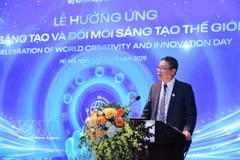
Deputy Minister of Science and Technology Le Xuan Dinh delivers opening remarks at the launching ceremony of the Scientific Innovation Competition 2026 on April 21. (Photo: VNA)

Scientific Innovation Competition opens to OVs, boosting global talent linkages

In response to World Creativity and Innovation Day 2026, the contest provides a platform for individuals and teams nationwide who are passionate about research, creativity, and practical application of science, while promoting a movement of scientific inquiry within the community, particularly among young people.

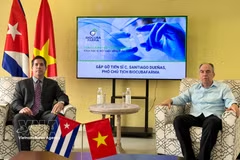
Dr. Santiago Dueñas Carrera (left), Vice President of Cuba’s BioCubaFarma group, and Cuban Ambassador to Vietnam Rogelio Polanco Fuentes at the press briefing in Hanoi on April 21 (Photo: VNA)

Biotechnology cooperation – new driver of Vietnam - Cuba relations

A representative from BioCubaFarma emphasised that the longstanding Vietnam – Cuba friendship provides a solid foundation for further advancing comprehensive cooperation, especially in science and technology – a key driver of socio-economic development and national healthcare sovereignty.

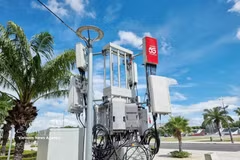
A Viettel 5G base station in Dong Hai ward, Khanh Hoa province (Photo: VNA)

Vietnam develops digital infrastructure aligned with demands of AI era

The data centre and cloud computing sector is entering a phase of redefinition. Infrastructure is no longer merely a backbone for data storage and processing, but is evolving into a foundational platform powering complex digital ecosystems—from AI and advanced analytics to real-time applications.

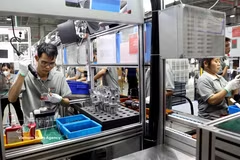
Workers manufacture products at Keystone Electrical Vietnam Co., Ltd. in the Lien Ha Thai industrial park. (Photo: VNA)

Vietnam turning ideas into value, aspirations into reality

Resolution No. 57 of the Politburo on breakthroughs in science-technology development, innovation, and national digital transformation is being vigorously implemented nationwide. Within this framework, innovation is increasingly recognised as a key engine for rapid and sustainable growth.

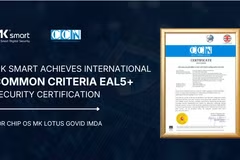
MK Smart achieves Common Criteria EAL5+ Certification, expanding opportunities in global digital identity

MK Smart achieves Common Criteria EAL5+ Certification, expanding opportunities in global digital identity

As countries accelerate the development of digital governments, electronic identification (eID) and electronic passports (ePassport) are becoming essential infrastructure. At the same time, security requirements are becoming increasingly stringent security requirements, particularly for systems that store sensitive data such as citizens’ identity and biometric information.

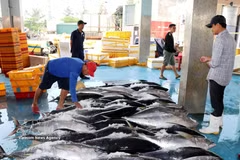
Sorting fish prior to transport for distribution. (Photo: VNA)

Fishermen keep pace with digital technology

Across central coastal provinces, authorities have introduced policies to restructure fleets, reduce vessel numbers, and support fishermen in transitioning to more sustainable livelihoods. Provinces such as Dak Lak and Gia Lai have earmarked nearly 1 trillion VND to support occupational changes and decommission inefficient vessels, while others including Nghe An, Quang Tri, Hue, and Quang Ngai are implementing roadmaps to phase out thousands of underqualified boats.

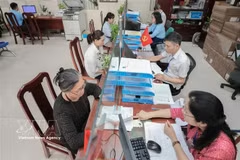
Phuc Loi ward in Hanoi has launched the “Digital Literacy for All” movement, forming support teams to help residents install applications such as iHanoi and eTax. (Photo: VNA)

Hanoi advances technological innovation in key economic sectors

The municipal People's Committee recently issued Plan No. 109/KH-UBND on technological innovation in key economic sectors through 2035, which serves as both a catalyst and a strategic move to systematise, elevate and reinforce the capital’s leading role in the digital era.

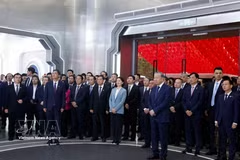
General Secretary of the Communist Party of Vietnam (CPV) Central Committee and State President To Lam (first, right, front row) listens to a presentation about the China-ASEAN AI Application Cooperation Centre (Photo: VNA)

Top Vietnamese leader visits China–ASEAN AI Application Cooperation Centre

The China–ASEAN AI Application Cooperation Centre, jointly established by the Guangxi Zhuang Autonomous Region and ASEAN countries, aims to promote inclusive and mutually beneficial development of AI globally. It is regarded as a flagship project in advancing the “Digital Silk Road” initiative in Nanning.

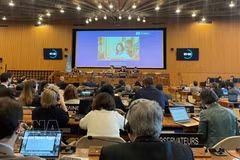
A view of the 224th session of the UNESCO Executive Board in Paris. (Photo: VNA)

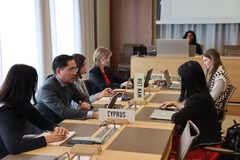
UNESCO extends recognition of 2 Category II science centres in Vietnam

The continued operation and enhancement of the two Category II centres under UNESCO’s auspices reflect Vietnam’s policy of positioning science, technology and innovation as key drivers of development, while closely linking scientific advancement with deeper and more substantive international integration in the current context.

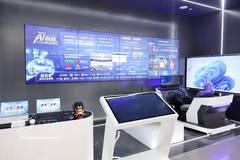
China–ASEAN Artificial Intelligence Application Cooperation Centre deeply integrates future technologies with distinctive ASEAN cultural characteristics. (Photo: VNA)

China–ASEAN AI cooperation centre drives regional tech cooperation

With strong policy support and growing participation from businesses and research institutions, the China–ASEAN Artificial Intelligence (AI) Application Cooperation Centre is expected to act as a digital bridge, promoting technological integration and opening new avenues for Vietnam–China cooperation in the digital era.

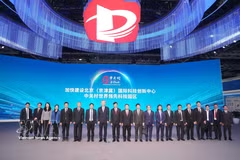
Politburo member and Chairman of the Party Central Committee’s Organisation Commission Nguyen Duy Ngoc (ninth, left) and the Vietnamese delegation pose for a group photo with leaders of the Zhongguancun Science Park and Beijing city. (Photo: VNA)

Vietnam, China step up cooperation in science, technology, innovation

Politburo member and Chairman of the Party Central Committee’s Organisation Commission Nguyen Duy Ngoc, who also serves as Standing Deputy Head of the Central Steering Committee for the Development of Science, Technology, Innovation and Digital Transformation, toured the park’s exhibition area and was briefed on the formation and development of Zhongguancun, along with Beijing’s achievements in science, technology and innovation.