NA passes revised Civil Status Law to advance borderless digital registration

Passed with 488 out of 492 deputies present voting in favour during the first session of the 16th NA, the revised Law on Civil Status introduces sweeping reforms in birth and death registration, decentralisation, and digital public administration.

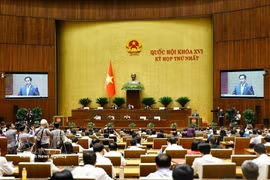
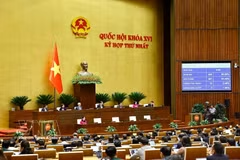
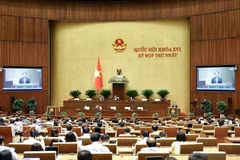
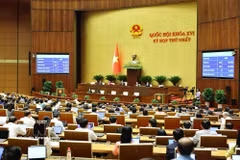
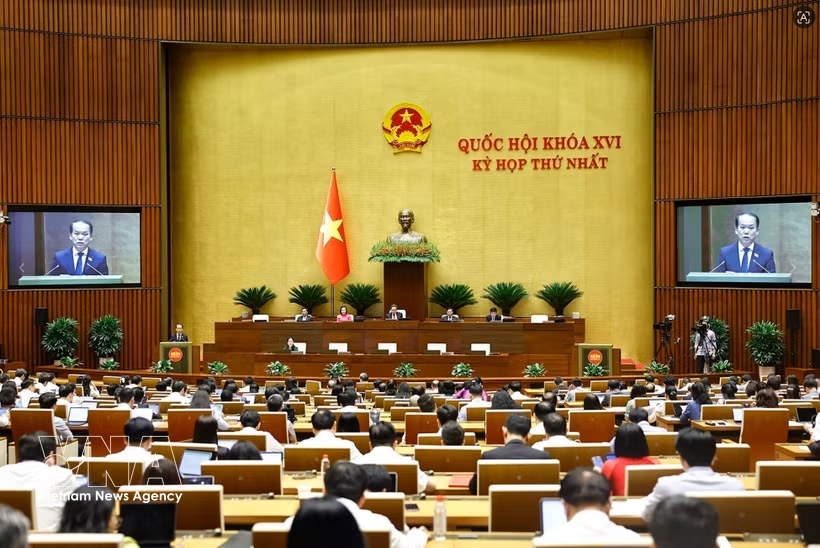
A view of the first session of the 16th NA on April 23 afternoon. (Photo: VNA)

Hanoi (VNA) - The National Assembly (NA) on April 23 approved the revised Law on Civil Status featuring a major digital governance reform, with civil registration services no longer bound by administrative boundaries, in a move aimed at improving public services and accelerating digital transformation.

Passed with 488 out of 492 deputies present voting in favour during the first session of the 16th NA, the amended law introduces sweeping reforms in birth and death registration, decentralisation, and digital public administration.

Presenting a verification report before the vote, Minister of Justice Hoang Thanh Tung said the Government had incorporated lawmakers’ feedback, including a nationwide roadmap to implement proactive birth and death registration no later than January 1, 2031.

The reform marks a shift from a citizen-request model to one in which state agencies proactively provide services, requiring synchronised digital infrastructure and stronger data connectivity, particularly in healthcare. During the transition period, localities with sufficient capacity may implement the model earlier, while the State will continue investing in infrastructure, workforce training and policy communication to ensure feasibility and public consensus.

A key highlight of the law is full decentralisation of civil registration authority and the expansion of registration regardless of administrative boundaries. According to the Government’s assessment, conditions and resources are now in place for implementation. Initial experience under the two-tier local government model, applied since July 1, 2025, has shown the system operating stably without major obstacles.

At the same sitting, the NA also approved the law amending and supplementing several articles of the Notarisation Law, with 489 out of 491 deputies voting in favour, reducing the number of transactions subject to mandatory notarisation by six.

Tung said based on lawmakers’ feedback, the Government had reviewed and revised the draft law in line with the requirement to renewed legislative mindset, ensuring constitutionality as well as consistency and coherence with related laws.

The revised draft law no longer specifies a fixed list of transactions subject to notarisation, instead setting general criteria to determine mandatory cases, narrowing the scope, reducing compliance costs and avoiding overlaps with specialised laws.

It also retains provincial-level authority for notarising real estate transactions while expanding non-jurisdictional notarisation for transactions not directly involving property, making procedures more convenient for citizens and businesses. The Government will also set a roadmap for nationwide notarisation of property transactions regardless of administrative boundaries, linked to fully synchronised data systems.

With all 494 presenting deputies voting in favour, the NA passed the law amending and supplementing a number of articles of the Law on Legal Aid at the session.

The draft law places legal aid beneficiaries at the centre, better safeguarding human and citizen rights, particularly for vulnerable groups. It adds low-income workers who are accused persons or victims to the coverage, while retaining the law’s focus on supporting vulnerable groups in civil, criminal and administrative matters rather than extending support to business and commercial disputes.

At the session, with a large majority of NA deputies present voting in favour, the NA passed the law amending and supplementing a number of articles of the Law on Emulation and Commendation; the Law on Belief and Religion (amended); and the Law on Access to Information (amended). Lawmakers also approved a resolution on the coordination mechanism and specific policies to improve the effectiveness of preventing and resolving international investment disputes; and the Law amending and supplementing a number of articles of the Law on Overseas Representative Missions of the Socialist Republic of Vietnam./.


VNA
See more

Estonian Minister of Foreign Affairs Margus Tsahkna addresses the event. (Photo: VNA)

Vietnam, Estonia look to build long-term cooperation foundation

Highlighting Vietnam’s dynamism, the Estonian minister said businesses joining his delegation are keen to explore mutually beneficial partnerships with Vietnamese counterparts. He added that the visit aims not only to seek business opportunities but also to build trust and people-to-people connections, laying a solid foundation for long-term cooperation between the two countries.

Vice Chairman of the municipal People’s Committee Bui Minh Thanh presents a souvernir to Dutch Consul General in Ho Chi Minh City Raissa Marteaux at the ceremony. (Photo: VNA)

Ho Chi Minh City pledges deeper practical cooperation with Dutch partners

Speaking at a ceremony marking the Netherlands’ National Day (April 27) hosted by the Consulate General of the Netherlands in Ho Chi Minh City on April 23, Vice Chairman of the municipal People’s Committee Bui Minh Thanh reaffirmed the city’s commitment to expanding cooperation with Dutch partners across strategic sectors.

The National Assembly will vote on a number of important laws and resolutions on April 24, 2026 – the final working day of its first session. (Photo: VNA)

Final working day of 16th National Assembly’s 1st session

The resolutions include those on the approval of the final settlement of the 2024 State budget, and on the NA’s supervision programme for 2027 and on the establishment of the NA’s thematic supervision delegation for 2027, the NA resolution on the development of Vietnamese culture and another on piloting the public lawyer system, the resolution on the establishment of Dong Nai city as a centrally governed city, and the NA resolution on special mechanisms and policies to handle land law violations committed by organisations and individuals before the 2024 Land Law took effect, along with solutions to continue removing obstacles for long-delayed and outstanding projects.

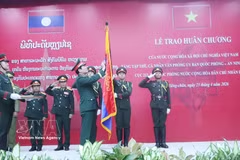
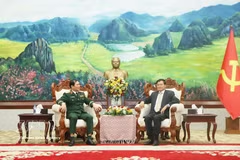
Delegates cut the ribbon to inaugurate the Lao Border Guard Command's headquarters in Vientiane. (Photo: VNA)

Vietnam, Laos strengthen defence cooperation

After more than 16 years of development, Unitel has become Laos’s leading telecom operator, with extensive infrastructure reaching remote and border areas, contributing to socio-economic development and improving living standards.

An overview of the first session of the 16th National Assembly. (Photo: VNA)

98.6% of voters' petitions resolved: National Assembly

Delivering a report on the supervision of petition handling at the NA's plenary meeting on April 23, Chairwoman of the NA's Committee for People's Aspirations and Supervision Le Thi Nga said of the total, the legislature and its bodies handled all 34 petitions under their remit, while the Government and central agencies resolved 1,182 out of 1,200 cases.

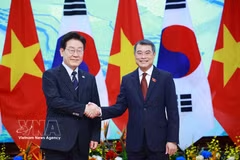
National Assembly Chairman Tran Thanh Man (right) meets with President of the Republic of Korea (RoK) Lee Jae Myung. (Photo: VNA)

Vietnamese legislature backs implementation of agreements inked with RoK: NA Chairman

Chairman Man reaffirmed Vietnam’s commitment to maintaining a transparent legal environment for foreign investors, including Korean firms seeking long-term and stable operations in the Southeast Asian country. He also welcomed expanding cultural and sports cooperation, including in e-sports, as a means of strengthening people-to-people ties.

Prime Minister Le Minh Hung (R) and RoK President Lee Jae Myung at their meeting in Hanoi on April 23. (Photo: VNA)

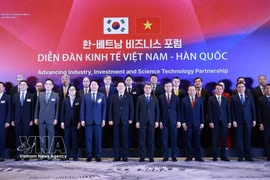
Vietnam, RoK seek more balanced 150 billion USD trade by 2030

President Lee agreed with the proposals, affirming coordination with Vietnam to identify measures to raise bilateral trade to 150 billion USD by 2030 in a more balanced manner, and to facilitate deeper participation by Vietnamese firms in the RoK’s global supply chains.

Politburo member and Permanent member of the Party Central Committee’s Secretariat Tran Cam Tu speaks at the meeting in Hanoi on April 23 with the Party Committees of provinces and centrally-run cities as well as the Party Central Committee’s commissions and agencies. (Photo: VNA)

Senior Party official calls for stronger institutions to drive double-digit growth

Tu underscored the importance of continuing to innovate leadership methods and the organisation of implementation, while directing ministries, sectors and localities to accelerate the review and refinement of institutions, policies and legal frameworks, including at the local level, especially in economic and investment fields, to achieve the double-digit growth target.

Kiosks at Vinh market in Nghe An province (Illustrative photo: VNA)

Lawmakers proposes raising tax exemption threshold to 1 billion VND

The current taxable revenue threshold of 500 million VND (19,000 USD) per year is no longer aligned with reality. Based on projected per capita GDP levels of approximately 125.5 million VND in 2025 and 128–130 million VND in 2026, the existing threshold represents only about four times per capita income, significantly lower than the 8–15 times range commonly observed in comparable economies.

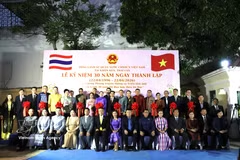
Participants pose for a group photo at the ceremony marking the 30th anniversary of the Consulate General of Vietnam in Khon Kaen, Thailand, on April 22, 2026. (Photo: VNA)

Vietnam’s Consulate General in Khon Kaen helps strengthen Vietnam–Thailand friendship, cooperation

Vietnamese Consul General in Khon Kaen Dinh Hoang Linh affirmed that the past 30 years have reflected the timely attention, direction and encouragement from the leaders of the Party, the State and the Ministry of Foreign Affairs of Vietnam, as well as the support and coordination of Thailand’s Ministry of Foreign Affairs, the authorities of northeastern Thai provinces, and the dedicated efforts of many generations of consulate staff, all of which have contributed to strengthening the increasingly positive friendship and cooperation between Vietnam and Thailand.