Vietnam launches upgraded National Database on Legal Documents

For the first time, artificial intelligence (AI) has been extensively used to ensure that data quality is “accurate, sufficient, clean and up-to-date” while optimising efficiency and precision in data exploitation.

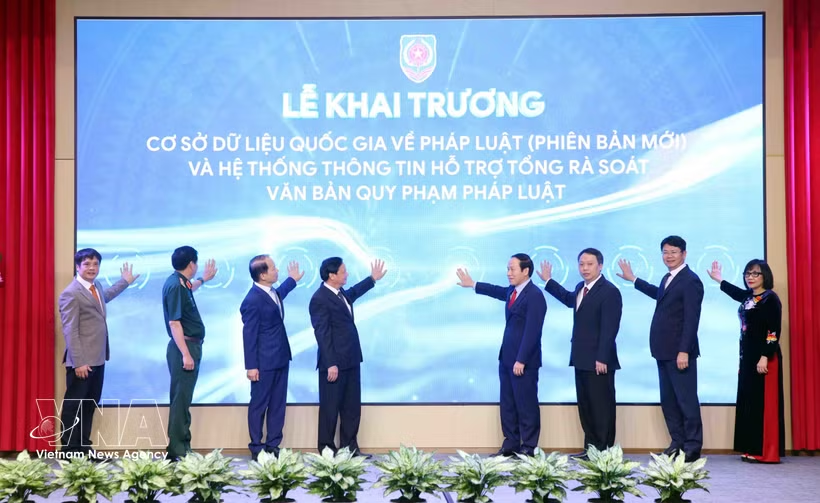
Officials launch the updated National Database on Legal Documents on April 23. (Photo: VNA)

Hanoi (VNA) – National Assembly Vice Chairman Nguyen Khac Dinh and Deputy Prime Minister Le Tien Chau attended the launch of the updated National Database on Legal Documents and a supporting information system in Hanoi on April 23.

The revamped database went live the same day at https://vbpl.vn/.

The Ministry of Justice said the Government first set the framework with a 2015 decree. The system functions as a single nationwide platform delivering accurate and timely legal documents for state management, legal dissemination, research and enforcement by agencies, organisations and individuals. It is also an official source supporting the review of legal documents, enabling reviewers to easily search, compare and flag issues requiring examination on a standardised base.

After more than 10 years of operation and incremental upgrades, the system now features stronger capacity for standardised, scientific data handling and analysis to cope with rising demand for digital legal document retrieval.

The overhaul restructures the database to manage content down to individual articles, clauses and points. All data now follow international legal language standards, turning the repository into a platform that integrates with other digital systems. Legal texts become structured data that machines can read, interpret and process automatically.

The changes matter as Vietnam’s political system begins a sweeping nationwide review of legal documents, a massive task spanning thousands of texts with tight accuracy demands.

For the first time, artificial intelligence (AI) has been extensively used to ensure that data quality is “accurate, sufficient, clean and up-to-date” while optimising efficiency and precision in data exploitation.

Built on standardised data, the National Database on Legal Documents is emerging as a core component of Vietnam’s digital legal platform and the backbone for the countrywide review.

In the coming time, the database is envisioned as a leading digital legal knowledge platform based on five strategic pillars, including full digitalisation of the legal document lifecycle, an interconnected legal data ecosystem, expanded AI use for legal analysis and alerts, a national big data platform on law, and broader digital legal knowledge for society at large.

Backed by standardised technology, AI integration and interoperability, the database is evolving beyond a conventional information store into a national digital legal knowledge infrastructure. Data there is meant to turn into actionable insights and help foster legal trust across society.

The supporting review system includes a dedicated section on the National Legal Portal, plus software for inspecting and reviewing documents. The portal supplies official, timely and comprehensive information on the process, including steering committee activities, guidance and links to related databases and tools, to ensure uniform rollout nationwide.

The review software offers a comprehensive digital solution, standardising data input processes, facilitating aggregation across agencies, enabling real-time progress tracking and generating accurate reports, thereby ensuring consistency in nationwide review results.

The comprehensive review of legal documents is a critical, unprecedented nationwide task involving a vast workload, complex content and involvement from government agencies at all levels.

A training conference on the review took place the same day to align understanding and drive effective, coordinated and timely action. It ran both in-person and online, reaching from central agencies down to commune level to brief officials responsible for the task nationwide./.​

VNA

See more

Students in the Mekong Delta city of Can Tho are honoured for their outstanding performance in startup activities. (Photo: VNA)

Education ministry targets five digital technology incubators at universities

A key target under the new plan is the establishment of five digital technology incubators, or Deeptech Hubs, at universities and research institutes with strong potential. The education ministry also plans to launch a training programme for 1,000 outstanding technology entrepreneurs and develop criteria for selecting and supporting startup ecosystems within educational institutions.

At the equipment handover ceremony for the Narcotics Targeting Centre of Vietnam Customs. (Photo: cand.com.vn)

Vietnam Customs expands capacity to tackle cross-border narcotics crime

Established in November 2025, the NTC comprises six officers from the Anti-Smuggling Investigation Sub-Department specialising in surveillance, intelligence collection and information analysis. The centre is tasked with strengthening customs capacity in risk assessment and drug crime targeting, helping authorities detect and prevent illicit cross-border trafficking of narcotics and other dangerous substances at an early stage.

Representatives of the Club of Cambodian Journalists and the Vietnam Journalists Association at the working session in Hanoi on May 12 (Photo: VNA)

Vietnamese, Cambodian journalists strengthen cooperation

The Vietnam Journalists Association and the Club of Cambodian Journalists agreed to enhance coordination and information sharing between media agencies, exchange experience in professional training and technology application in journalism, and regularly organise training programmes for reporters and editors.

Ca Mau province has consistently attached importance to developing human resources and investing in infrastructure in ethnic minority areas. (Photo: VNA)

Vietnam steps up implementation of ethnic affairs strategy through 2030

To accelerate the implementation of the the Ethnic Affairs Strategy by 2030, with a vision toward 2045, the Prime Minister requested ministries, agencies and local authorities to continue thoroughly carrying out the Party and State’s policies on ethnic affairs, enhancing the effectiveness of State management and strengthening oversight of policy implementation.

Officials from the Market Surveillance Department of Da Nang conduct inspections at business establishments in Hai Chau ward. (Photo: VNA)

No “blind spots” in crackdown on smuggling, counterfeit goods

In the Jan-April period, authorities nationwide uncovered and handled nearly 44,000 cases related to smuggling, trade fraud and counterfeit goods, while initiating 1,464 criminal cases involving 2,277 suspects, according to the National Steering Committee for Combating Smuggling, Commercial Fraud and Counterfeit Goods (National Steering Committee 389).

A delegation of 60 exemplary overseas Vietnamese from 20 countries and territories offers incense to commemorate the Hung Kings. (Photo: VNA)

Overseas Vietnamese community contributes to national unity, development

According to Chairman of the State Committee for Overseas Vietnamese Affairs Nguyen Trung Kien, many overseas Vietnamese entrepreneurs have achieved success in developed economies, gaining experience in corporate governance, advanced technologies, and international-standard operations.

A market surveillance team carries out an unannounced inspection at a fashion business in Hanoi. (Photo: VNA)

Hanoi steps up crackdown on counterfeit goods, IP infringements

The agency has set a target of increasing the number of handled cases by at least 20% compared to the same period last year between May 7 and 30. Inspection and monitoring activities will continue beyond May 30 on a regular, focused and systematic basis across the city.

Construction of Tran Hung Dao bridge, one of seven bridges spanning the Red River, launched in 2025, alongside Hong Ha, Me So, Tu Lien, Ngoc Hoi, Van Phuc and Thuong Cat bridges (Photo: VNA)

📝OP-ED: Beyond rhetoric, urban reconstruction moves ahead

Transport infrastructure development is a key task in the capital’s major development strategies, closely linked with the Hanoi Capital Master Plan with a 100-year vision and the implementation of the revised Capital Law. A series of major projects, including ring roads, urban railways, national railways and regional economic connectivity projects such as the Red River Landscape Boulevard Axis, are being implemented to enhance connectivity, promote the growth of Hanoi and the country, and lay the foundation for urban reconstruction in a modern, synchronised and sustainable direction.