Vietnamese in Japan’s earthquake-hit areas reported safe

The embassy said it is continuing to closely monitor the situation and remains ready to implement citizen protection measures if necessary.

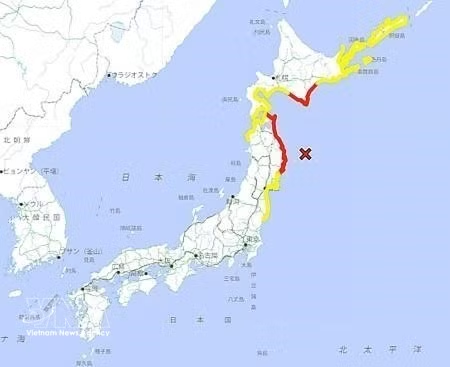
An image from the website of the Japan Meteorological Agency shows a tsunami warning issued after a magnitude-7.4 earthquake struck northeastern and northern Japan on April 20, 2026. (Photo: Kyodo/VNA)

Tokyo (VNA) – Vietnamese nationals living in areas affected by a strong earthquake off Japan’s Sanriku coast on April 20 have been confirmed safe.

The earthquake struck at 16:53 local time (14:53 Hanoi time) with a magnitude of 7.5 and an epicentre located about 100 km offshore. The tremor caused strong shaking across the northeastern prefectures of Aomori, Iwate and Miyagi, prompting Japanese authorities to issue a tsunami warning for several coastal areas, with waves expected to reach up to 3 metres.​

Tsunami waves were later recorded along parts of the coast. At Kuji port in Iwate prefecture, the first wave arrived at 17:26 local time, with the highest recorded wave reaching 80 cm.

In response to the disaster, Japanese authorities swiftly implemented emergency measures and ordered hundreds of thousands of residents in high-risk areas to evacuate. The Japan Meteorological Agency also warned that strong aftershocks could occur in the coming days, particularly within the first two to three days after the quake.

Regarding the Vietnamese community in Japan, monitoring and support measures have been swiftly implemented.

Phan Tien Hoang, First Secretary and head of the Labour Management Board at the Vietnamese Embassy in Japan, said the embassy had contacted several labour unions in the affected areas and been confirmed that all Vietnamese workers were safe.​

Initial information from Vietnamese academics and students in the region also indicated that the situation remained stable. Assoc. Prof. Dr Nguyen Chi Nghia, a lecturer at Tohoku University in Sendai city of Miyagi prefecture, said he had contacted Vietnamese students at Aomori Chuo Gakuin University and confirmed that they were all safe.​

In Tokyo, where a large Vietnamese community resides, only mild tremors of about level 2–3 on Japan’s seismic intensity scale were recorded, causing no significant disruption to daily life.

However, Japanese authorities have urged residents not to be complacent, warning that tsunami waves may arrive in multiple surges and could reach greater heights in the coming hours. The continued warnings are based not only on initial wave heights but also on confirmed tsunami activity, indicating that seismic energy has propagated across the sea.

In this context, the Vietnamese Embassy in Japan has advised Vietnamese citizens, particularly those living in northeastern coastal areas, to strictly follow instructions from local authorities, avoid returning to hazardous zones until safety is confirmed, and regularly update information through official channels.

The embassy said it is continuing to closely monitor the situation and remains ready to implement citizen protection measures if necessary./.​

VNA

See more

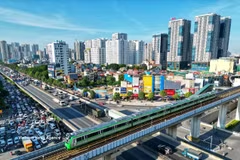
Hanoi has over 1,100 libraries and numerous cultural and educational spaces in the community. (Photo: VNA)

Spreading value of books, building foundations of learning society

Each weekend in Hanoi, the “Reading with Children” Club brings together students to practise reading, explore language, and express ideas creatively. According to founder of the club Nguyen Thuy Anh, the club encourages children to reflect, retell stories, and connect books with personal experiences, making reading more vivid and meaningful.

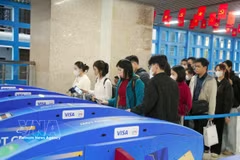
Automated ticketing system is used on the urban railway Cat Linh-Ha Dong line in Hanoi. (Photo: VNA)

Digital transformation powers Hanoi metro expansion

Beyond convenience, stable fares and the elimination of fuel, parking and maintenance costs have made urban rail increasingly attractive. The growing preference for metro travel is also contributing to a greener, more modern urban lifestyle.

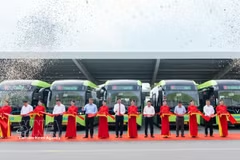
Delegates cut the ribbon to inaugurate the operation of electric bus route No. 43. (Photo: VNA)

Hanoi accelerates shift to green buses, targets 100% by 2030

In the 2027–2030 period, the city will accelerate the transition towards the complete phase-out of fossil fuel-powered buses. The share of electric and green energy-fueled buses is projected to reach 79–89% by 2029 and 100% by 2030.

At the second session of the Ho Chi Minh City People’s Council (Photo: VNA)

Ho Chi Minh City greenlights central square, administrative centre in Thu Thiem

The new central city square and administrative centre will create a modern, centralised political-administrative complex for Ho Chi Minh City, designed to house around 8,000 officials, civil servants, and employees. It will also handle daily traffic of 1,500- 2,000 citizens and business representatives through a unified one-stop-shop administrative service system.

A working session at the job fair (Photo: VNA)

Vietnamese students flock to Seoul Job Fair 2026

The second annual Job Fair 2026 was held for Vietnamese students in the Republic of Korea. Organisers pitched it as a straight-up bridge between eager students and bosses hungry for young talent who can actually handle multicultural workplaces.

Defendants at the court (Photo: VNA)

Ho Chi Minh City court opens trial over Agribank lending scandal

The investigation revealed that multiple credit files were incomplete or riddled with inaccurate information, while some pledged assets lacked proper legal standing yet were accepted and grossly overvalued. As a result, the loans became high-risk and largely unrecoverable, leading to losses surpassing 1 trillion VND.

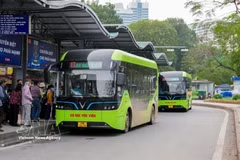
Hanoi introduces 53 electric buses from April 18 (Photo: VNA)

Hanoi to add 53 electric buses from April 18

According to the plan, all buses operating within Ring Road 1 will use green energy by July 1, 2026. The requirement will expand to Ring Road 2 by January 1, 2028, and to Ring Road 3 by 2030.

Illustrative image (Photo: VNA)

National, local traffic safety committees to be dissolved from June 1

Under the dicision, ministries and ministerial-level agencies will assume responsibility for tasks previously performed by the committee, in line with their mandates under the Law on Government Organisation, the Law on Road Traffic Order and Safety, the Law on Roads and other relevant legal frameworks, ensuring that traffic safety and order are maintained without disrupiton.