NA adopts revised Capital Law with special mechanisms for Hanoi

Under the law, the municipal People’s Council is empowered to decide policies and criteria for urban renovation, upgrading and redevelopment to address issues such as population density, environmental protection and urban development. It may also approve special mechanisms for major and important projects, subject to higher-level approval and consultation with relevant ministries and sectors.

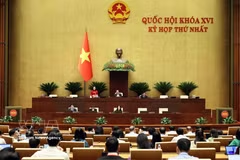
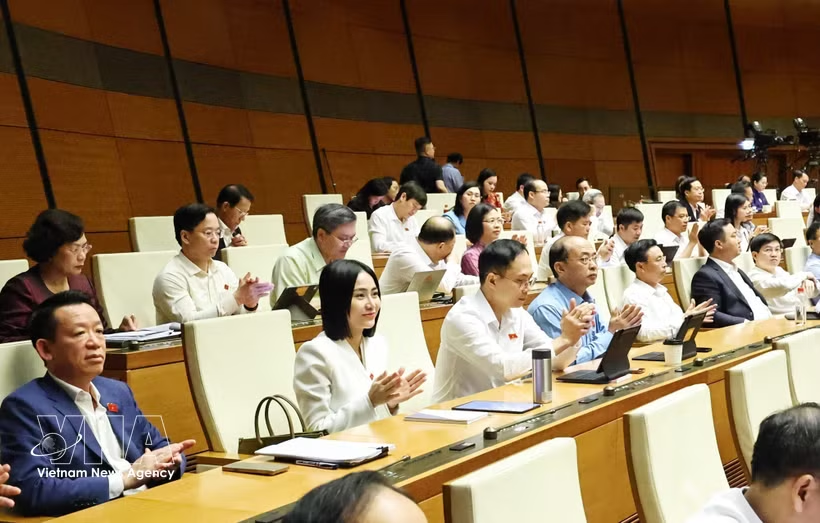
Delegates at the the first session of the 16th National Assembly. (Photo: VNA)

Hanoi (VNA) – The National Assembly (NA) on April 23 passed the revised Capital Law, introducing a range of special mechanisms and policies to enhance governance and development in Hanoi.

The law was approved during the first session of the 16th legislature, with 488 out of 492 deputies present voting in favour.

Presenting a report on revisions before the vote, Minister of Justice Hoang Thanh Tung said the draft law had been refined to more clearly define the authority of different levels of the municipal administration, while improving the design of special mechanisms to ensure they are more comprehensive.

Regarding the formulation and issuance of legal documents, pilot policies, and power control, the law affirms a more proactive role for the capital’s authorities in designing, implementing and testing new mechanisms. At the same time, additional provisions have been introduced to ensure stricter oversight. Notably, the use of fast-track procedures in law-making will not apply. The authority of the Chairperson of the municipal People’s Committee has been clarified, and requirements have been added for inspection, supervision, accountability, post-issuance evaluation, and practical review of legal documents.

The revised law also expands the scope of pilot policies to include other mechanisms as directed by competent authorities. The duration of pilot schemes is capped at five years, with provisions allowing suspension if risks exceed anticipated levels.

Special mechanisms and policies have been further refined to ensure feasibility and effective control. The law outlines the powers of city authorities in planning and managing development spaces, with tighter coordination with relevant ministries, especially regarding underground and high-rise construction.

Under the law, the municipal People’s Council is empowered to decide policies and criteria for urban renovation, upgrading and redevelopment to address issues such as population density, environmental protection and urban development. It may also approve special mechanisms for major and important projects, subject to higher-level approval and consultation with relevant ministries and sectors.

In terms of finance, budgeting and tax incentives, the law maintains consistency with the broader legal framework, avoiding preferential policies that exceed existing regulations, ensuring the central budget’s leading role. Targeted incentives and support have been added to promote priority sectors, alongside more flexible budget management mechanisms to meet development needs and ensure social welfare.

On the Capital Region and regional linkages, the law underscores Hanoi’s central and leading role, while adopting an open and flexible approach to defining the region. It introduces mechanisms enabling localities to voluntarily participate in inter-regional cooperation and apply provisions of the Capital Law to joint projects. Local budgets may also be used for inter-regional investments to address shared challenges in infrastructure, environment and essential services./.

VNA
See more

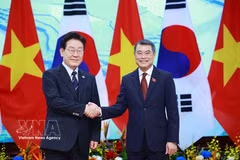
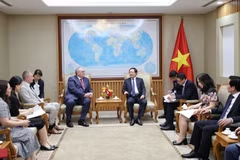
Prime Minister Le Minh Hung (R) and RoK President Lee Jae Myung at their meeting in Hanoi on April 23. (Photo: VNA)

Vietnam, RoK seek more balanced 150 billion USD trade by 2030

President Lee agreed with the proposals, affirming coordination with Vietnam to identify measures to raise bilateral trade to 150 billion USD by 2030 in a more balanced manner, and to facilitate deeper participation by Vietnamese firms in the RoK’s global supply chains.

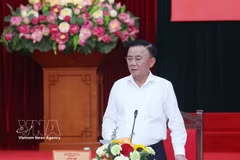
Politburo member and Permanent member of the Party Central Committee’s Secretariat Tran Cam Tu speaks at the meeting in Hanoi on April 23 with the Party Committees of provinces and centrally-run cities as well as the Party Central Committee’s commissions and agencies. (Photo: VNA)

Senior Party official calls for stronger institutions to drive double-digit growth

Tu underscored the importance of continuing to innovate leadership methods and the organisation of implementation, while directing ministries, sectors and localities to accelerate the review and refinement of institutions, policies and legal frameworks, including at the local level, especially in economic and investment fields, to achieve the double-digit growth target.

Kiosks at Vinh market in Nghe An province (Illustrative photo: VNA)

Lawmakers proposes raising tax exemption threshold to 1 billion VND

The current taxable revenue threshold of 500 million VND (19,000 USD) per year is no longer aligned with reality. Based on projected per capita GDP levels of approximately 125.5 million VND in 2025 and 128–130 million VND in 2026, the existing threshold represents only about four times per capita income, significantly lower than the 8–15 times range commonly observed in comparable economies.

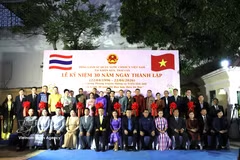
Participants pose for a group photo at the ceremony marking the 30th anniversary of the Consulate General of Vietnam in Khon Kaen, Thailand, on April 22, 2026. (Photo: VNA)

Vietnam’s Consulate General in Khon Kaen helps strengthen Vietnam–Thailand friendship, cooperation

Vietnamese Consul General in Khon Kaen Dinh Hoang Linh affirmed that the past 30 years have reflected the timely attention, direction and encouragement from the leaders of the Party, the State and the Ministry of Foreign Affairs of Vietnam, as well as the support and coordination of Thailand’s Ministry of Foreign Affairs, the authorities of northeastern Thai provinces, and the dedicated efforts of many generations of consulate staff, all of which have contributed to strengthening the increasingly positive friendship and cooperation between Vietnam and Thailand.

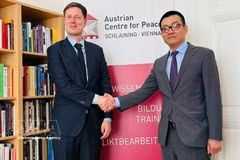
Vietnamese Ambassador to Austria Vu Le Thai Hoang (R) and Tobias Lang, Director of the Austrian Centre for Peace (ACP) at their working session in Vienna on April 23. (Photo: VNA)

Austria ready to cooperate with Vietnam in strengthening UN peacekeeping capacity

Vietnam highly values international cooperation in general, and cooperation with Austria in particular, in training and improving peacekeeping capacity, especially in foreign languages, operational skills, specialised peacekeeping knowledge, understanding of international law and culture, and the application of technology to meet UN standards.

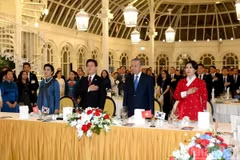
The Vietnamse, RoK leaders and their spouses at the banquet (Photo: nhandan,vn)

Top leader hosts banquet for RoK President

Top leader To Lam expressed confidence that the Vietnam - RoK Comprehensive Strategic Partnership will continue to deepen in a more substantive and robust manner, contributing to peace, stability, cooperation and development in both nations as well as the region and the world.

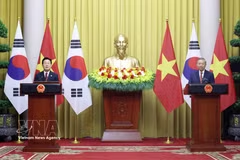
General Secretary of the Communist Party of Vietnam (CPV) Central Committee and State President To Lam (R) and President of the Republic of Korea (RoK) Lee Jae Myung at the press briefing (Photo: VNA)

Vietnamese, RoK leaders meet press in Hanoi

The Vietnamese Government will keep improving the investment climate, making it more transparent and business-friendly, while ensuring all possible support for foreign investors, including Korean firms, to do long-term business in Vietnam.

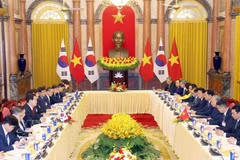
At the talks between General Secretary of the Communist Party of Vietnam Central Committee and State President To Lam and visiting President of the Republic of Korea (RoK) Lee Jae Myung in Hanoi on April 22, 2026. (Photo: VNA)

Top leader holds talks with RoK President in Hanoi

The two sides highlighted the need to realise a strategic vision for economic connectivity in the evolving global context, including joint efforts to achieve bilateral trade turnover of 150 billion USD by 2030.

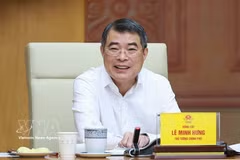
Prime Minister Le Minh Hung speaks at the working session with the Ministry of Science and Technology in Hanoi on April 22, 2026. (Photo: VNA)

PM underscores priority funding for strategic, core technologies

Highlighting the importance of accelerating digital transformation, particularly in the digital economy, Prime Minister Le Minh Hung set targets for the sector to account for 30% of GDP and for over 40% of enterprises to engage in innovation activities.

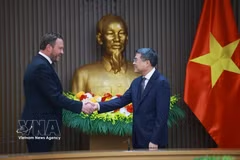
Deputy Prime Minister Ho Quoc Dung (R) and IAEA Deputy Director General Mikhail Chudakov (Photo: VGP)

Deputy PM, IAEA official discuss nuclear power development

Vietnam speaks highly of the IAEA’s role and efforts in promoting the peaceful use of atomic energy and supporting countries in building nuclear infrastructure. Since becoming a member of IAEA, Vietnam has seen the agency as a strategic and reliable partner, with cooperation activities increasingly effective and practical.