PM underscores priority funding for strategic, core technologies

Highlighting the importance of accelerating digital transformation, particularly in the digital economy, Prime Minister Le Minh Hung set targets for the sector to account for 30% of GDP and for over 40% of enterprises to engage in innovation activities.

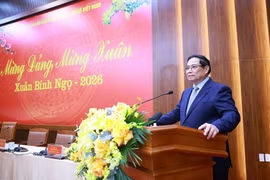
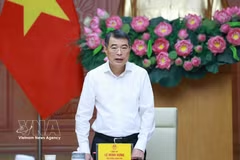
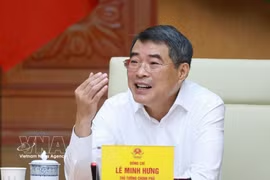
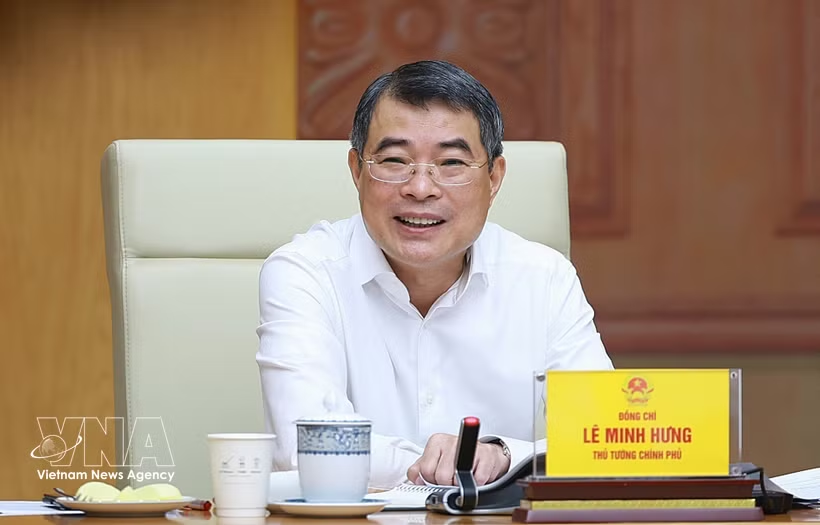
Prime Minister Le Minh Hung speaks at the working session with the Ministry of Science and Technology in Hanoi on April 22, 2026. (Photo: VNA)

Hanoi (VNA) – Prime Minister Le Minh Hung has stressed the need to prioritise resources and increase the proportion of spending on strategic, high-tech, and core technologies within the State budget for science, technology, innovation, and digital transformation.

Speaking at a working session on April 22 with the Ministry of Science and Technology, the Government leader said that, in line with the Politburo’s Resolution 57 on science, technology, innovation, and digital transformation, at least 3% of total annual State budget expenditure should be allocated to these sectors.

Reports at the meeting showed that in 2025 and the first quarter of 2026, the ministry had advised the issuance of 10 laws and one resolution, along with 35 decrees and 60 decisions. It also identified 11 groups of strategic technologies comprising 35 key technology products.

Last year, Vietnam recorded 53 sci-tech organisations reaching regional and international standards, alongside six high-tech parks. High-tech exports accounted for nearly 50% of total exports. The country ranked 44th out of 139 economies in the Global Innovation Index, while its startup ecosystem stood 55th globally.

By the end of March 2026, 5G network coverage reached 91.9% of the population, with over 22.4 million subscribers. Vietnam ranked 14th globally in mobile internet speed and 9th in fixed broadband speed, while its IPv6 infrastructure ranked 7th worldwide.

Progress has also been evident in the development of the digital government, digital society, and digital economy. The number of digital technology enterprises rose sharply, with an additional 1,394 firms established. Exports of digital technology products were estimated at over 45 billion USD, while total export turnover reached approximately 172 billion USD. Meanwhile, the e-commerce market expanded to 36 billion USD, three times its 2020 size.

The total State budget allocated to science, technology, innovation, and digital transformation this year stands at 65.02 trillion VND (2.47 billion USD). To date, 92.27% of recurrent expenditure and 68.58% of investment spending have been disbursed, with the remainder under review.
vnanet-le-minh-hung-2.jpg
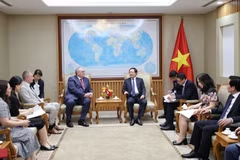
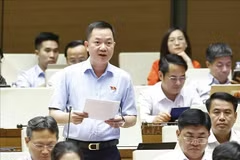
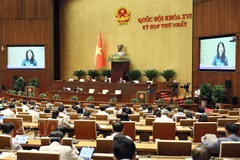
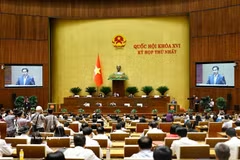
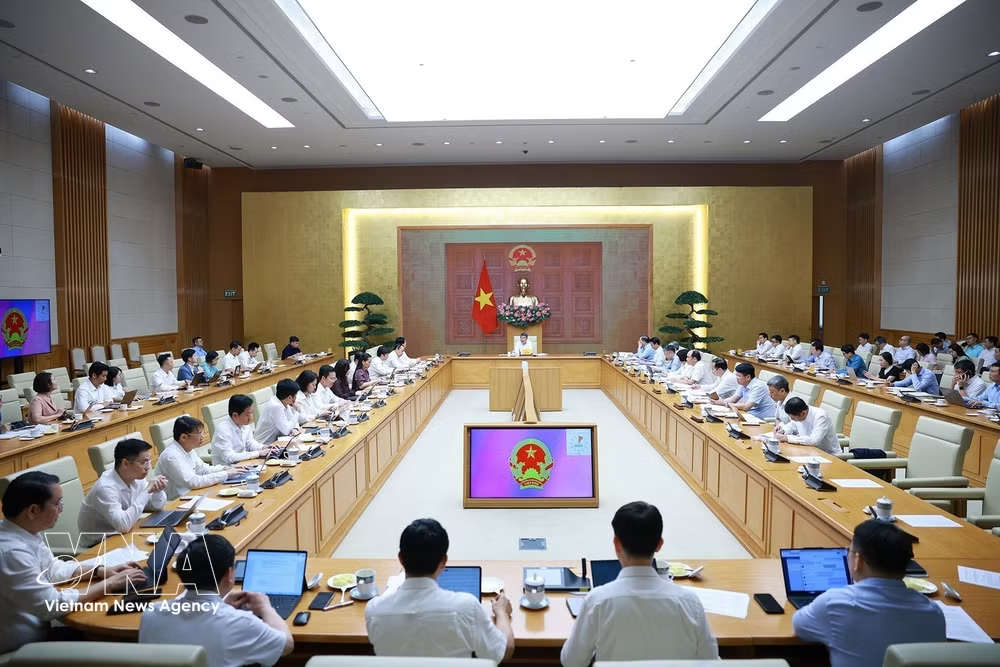
A view of the meeting (Photo: VNA)

Concluding the session, the PM acknowledged the ministry’s efforts while pointing out several shortcomings. Looking ahead, he called for a shift in governance thinking from input-based support for enterprises to output-based mechanisms, alongside the removal of bottlenecks through controlled risk acceptance, mastery of core technologies, and effective management of digital assets and digital currencies.

Highlighting the importance of accelerating digital transformation, particularly in the digital economy, he set targets for the sector to account for 30% of GDP and for over 40% of enterprises to engage in innovation activities.

The leader also directed the ministry to urgently submit, within April, three decrees and two prime ministerial decisions guiding the implementation of the laws on digital transformation and on artificial intelligence. It was also tasked with reviewing and finalising the list of strategic technologies and products.

In addition, the ministry must coordinate with the Ministry of Finance to complete guidelines on criteria, procedures, and funding mechanisms for science, technology, innovation, and digital transformation projects. This includes transitioning from direct budget allocation to an order-based mechanism tied to outcomes, as well as establishing controlled regulatory sandbox frameworks for research.

By the second quarter of 2026, the ministry is required to work with relevant agencies to draft a resolution on a new development model for the country based on science, technology, innovation, and digital transformation, for submission to the Party Central Committee.

PM Hung further called for a comprehensive restructuring of research infrastructure and the innovation ecosystem, including reforms to 16 key national laboratories, the introduction of breakthrough mechanisms for science and technology exchanges, and enhanced support for intellectual property valuation and registration.

He also urged the swift establishment of criteria for recognising innovation centres and innovative enterprises, with completion targeted for May 2026./.
VNA

See more

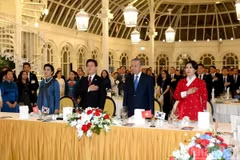
The Vietnamse, RoK leaders and their spouses at the banquet (Photo: nhandan,vn)

Top leader hosts banquet for RoK President

Top leader To Lam expressed confidence that the Vietnam - RoK Comprehensive Strategic Partnership will continue to deepen in a more substantive and robust manner, contributing to peace, stability, cooperation and development in both nations as well as the region and the world.

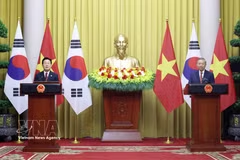
General Secretary of the Communist Party of Vietnam (CPV) Central Committee and State President To Lam (R) and President of the Republic of Korea (RoK) Lee Jae Myung at the press briefing (Photo: VNA)

Vietnamese, RoK leaders meet press in Hanoi

The Vietnamese Government will keep improving the investment climate, making it more transparent and business-friendly, while ensuring all possible support for foreign investors, including Korean firms, to do long-term business in Vietnam.

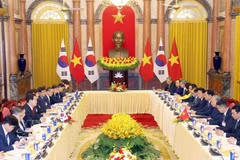
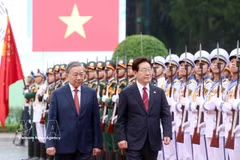
At the talks between General Secretary of the Communist Party of Vietnam Central Committee and State President To Lam and visiting President of the Republic of Korea (RoK) Lee Jae Myung in Hanoi on April 22, 2026. (Photo: VNA)

Top leader holds talks with RoK President in Hanoi

The two sides highlighted the need to realise a strategic vision for economic connectivity in the evolving global context, including joint efforts to achieve bilateral trade turnover of 150 billion USD by 2030.

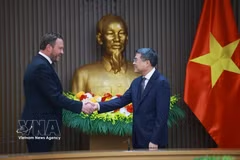
Deputy Prime Minister Ho Quoc Dung (R) and IAEA Deputy Director General Mikhail Chudakov (Photo: VGP)

Deputy PM, IAEA official discuss nuclear power development

Vietnam speaks highly of the IAEA’s role and efforts in promoting the peaceful use of atomic energy and supporting countries in building nuclear infrastructure. Since becoming a member of IAEA, Vietnam has seen the agency as a strategic and reliable partner, with cooperation activities increasingly effective and practical.

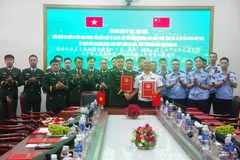
At the signing of the minutes of the talks (Photo: VNA)

Vietnam–China border forces hold talks, confer Friendship Envoy title

Border guards of Vietnam and China pledged to strengthen information sharing on emerging issues at border gates, coordinate timely responses and enhance the effectiveness of control operations. They reaffirmed their commitment to maintaining order in immigration procedures, ensuring stable security in the Lao Cai–Hekou international border gate area, and promoting legal awareness among border residents.

☕ Afternoon briefing on April 22

☕ Afternoon briefing on April 22

The welcome ceremony for President of the RoK Lee Jae Myung and his spouse, PM Le Minh Hung's working session with the Ministry of Industry and Trade, and the Global Sourcing Fair Vietnam 2026 are among news highlights on April 22.

The National Assembly (NA) is scheduled to discuss a proposal to establish Dong Nai as a centrally-run city on April 22. (Photo: VNA)

NA to discuss proposal to establish centrally-run Dong Nai city

According to a Government report, Dong Nai has effectively leveraged its strategic location, historical traditions, and strengths in national defence, security, culture, and society to emerge as one of the country’s leading economic localities. The province serves as a key hub linking major development corridors and Ho Chi Minh City with the Central Highlands, the south-central coastal region, and the Mekong Delta region.

☀️ Morning digest on April 22

☀️ Morning digest on April 22

Party General Secretary and State President To Lam's working session with the standing board of the Ha Tinh Party Committee, President of the RoK Lee Jae Myung's beginning of a state visit to Vietnam, and 84% of Vietnam’s small businesses reporting growth last year are among news highlights on April 21 evening.

Minister of Foreign Affairs Le Hoai Trung (R) and outgoing Mongolian Ambassador Jigjee Sereejav. (Photo: VNA)

Foreign Minister hosts outgoing Mongolian Ambassador

Affirming Vietnam’s high regard for Mongolia and their longstanding friendship, Minister of Foreign Affairs Le Hoai Trung called for closer coordination to further develop the Comprehensive Partnership.

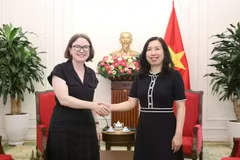
Deputy Minister of Foreign Affairs Le Thi Thu Hang (R) meets with Irish Ambassador to Vietnam Deirdre Ní Fhallúin in Hanoi on April 21. (Photo: baoquocte.vn)

Vietnam, Ireland seek ways to step up bilateral cooperation

Hang proposed the two sides further strengthen political trust, increase high-level and all-level exchanges, and organise youth, student and cultural activities to mark the upcoming anniversary. The Deputy Minister also called on Ireland to soon ratify the EU–Vietnam Investment Protection Agreement (EVIPA), which would create fresh momentum for economic cooperation.

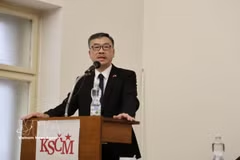
Vietnamese Ambassador to the Czech Republic Duong Hoai Nam speaks at the event. (Photo: VNA)

Foreign policy drives Vietnam’s development momentum in new era: Diplomat

The ambassador highlighted that after four decades of Doi Moi, Vietnam now ranks among the world’s 35 fastest-growing economies. The country has signed and implemented 17 free trade agreements, positioning itself as an important economic hub in the Asia-Pacific, while attracting 38.42 billion USD in registered foreign direct investment.