AI emerges as key driver for Vietnam’s F&B sector breakthrough

Businesses start with projects that deliver quick results within six to 12 months, like quality control systems, demand forecasting, or customer service chatbots. In the long run, F&B companies are advised to move toward with AI-driven operating models to keep up with fast-changing market demands.

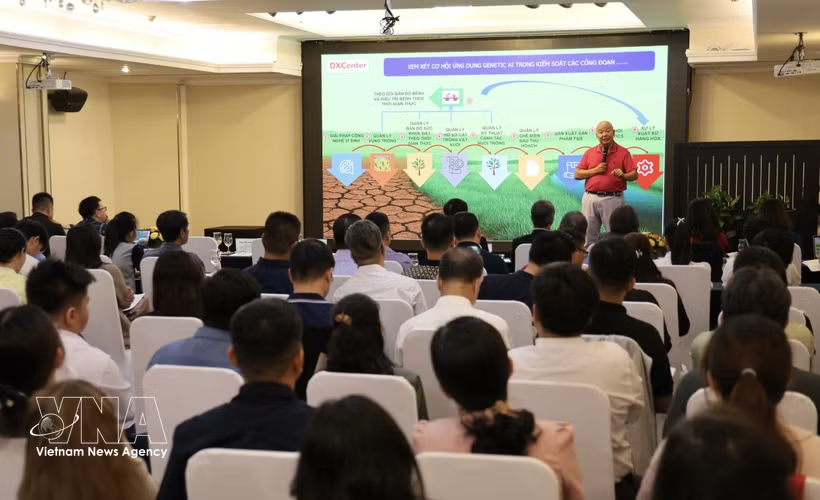
A view of the workshop on the application of AI and real-world data in food product research and development held in Ho Chi Minh City on April 22. (Photo: VNA)

Ho Chi Minh City (VNA) – Amid rapidly shifting global consumer preferences in the food and beverage (F&B) sector, Artificial Intelligence is increasingly viewed as a core “ingredient” in restructuring value chains and propelling Vietnamese F&B enterprises towards a breakthrough in the 2026–2030 period.

The assessment was made by experts at a workshop on the application of AI and real-world data in food product research and development, jointly organised by the Investment and Trade Promotion Centre (ITPC) and the Digital Transformation Consulting and Support Centre of Ho Chi Minh City on April 22.

Le Anh Hoang, Deputy Director of ITPC, highlighted that AI and data-driven applications have become critical to enhancing competitiveness, particularly in the food industry—one of the city’s four key industrial pillars. Beyond identifying risks and managing supply chains, AI enables demand forecasting, quality control, and in-depth analysis of consumer trends.

Dr Nguyen Ba Thanh, Director of the Institute of Biotechnology and Food Technology at the Industrial University of Ho Chi Minh City, noted that AI is delivering tangible advances in research and development (R&D). Traditional product development cycles of 18–36 months can now be reduced to just 3–9 months using generative AI models and sensory simulation technologies.

Beyond R&D, AI is reshaping the entire F&B operational chain. In supply chain management, predictive technologies help reduce food waste, while computer vision systems can detect production defects with accuracy exceeding 95%. On the market side, personalisation tools are enhancing order values by recommending products tailored to consumer behaviour and weather conditions.

Thanh stressed that: “The combination of food specialists and AI technology will deliver optimal outcomes, with humans retaining the coordinating role. AI is no longer a supplementary option but an essential technology driving competitiveness and economic restructuring.”

Vietnam’s introduction of an AI Law, effective from March 2026, is seen as a significant step in establishing a legal framework for technology deployment. However, challenges persist, including a shortage of in-house AI talent and insufficient data infrastructure, with nearly half of enterprises yet to meet requirements.

The scholar suggested that businesses start with projects that deliver quick results within six to 12 months, like quality control systems, demand forecasting, or customer service chatbots. In the long run, F&B companies are advised to move toward with AI-driven operating models to keep up with fast-changing market demands.

From an operational perspective, Phi Anh Tuan, a lead consultant on digital transformation at DXCentre, noted that integrating computer vision with autonomous decision-making systems can create intelligent management mechanisms that adjust machinery to mitigate risks early in the supply chain.

Addressing green consumption trends, Nguyen Minh Duc, Vice Secretary General of the Vietnam E-commerce Association, said e-commerce platforms are becoming valuable data repositories. Through platform analytics and social media insights, businesses can better understand demand patterns, pricing expectations, customer feedback, and packaging trends.

He added that while some firms hesitate due to perceived costs, adopting AI does not necessarily require significant upfront investment. Companies can begin with low-cost or free tools before gradually moving towards automated data collection, advanced analytics, and fully integrated management systems.

Experts concluded that consumers are no longer waiting for large corporations but favour businesses that respond precisely to their needs. In this context, leveraging AI and big data is no longer merely a competitive advantage; it is fast becoming a prerequisite for sustainable growth in Vietnam’s F&B sector./.

VNA

See more

Experts speak at the workshop (Photo: VNA)

Vietnam’s pet care market emerges as lucrative investment opportunity

​ Across the Asia-Pacific, 60% of respondents own pets, while Vietnam’s pet ownership rate stands at 79%, among the highest in the region. Notably, 55% of Vietnamese pet owners have two or more pets, signalling that pet ownership has evolved from a hobby into a modern lifestyle choice.

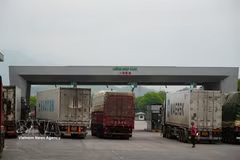
Trucks carrying imports enter Vietnam through Lao Cai International Border Gate. (Photo: VNA)

Smart border gates power growth in northern border provinces

With a borderline of about 182 km, Lao Cai aims to turn its border gate economic zone into a key growth engine by adopting a smart border gate model, viewing this as a breakthrough measure for improving management efficiency, reducing logistics expenses, and enhancing customs clearance capacity.

Ken Chau (right), Chairman of the Vietnam Canada Business Association, presents flowers to the organising committee of the Vietnamese Entrepreneurs Awards in Canada 2026 at the event. (Photo: Award organising board)

Vietnamese awards in Canada spotlight community strength

The gala brought together nearly 200 participants, including community leaders, entrepreneurs and guests from across the country, highlighting both the achievements of Vietnamese businesses and the community’s growing role in the socio-economic fabric of Vancouver and other Canadian cities.

Passenger numbers are expected to peak at the start of each break, particularly from the afternoon of April 24 to April 25, with a return wave on April 27 following the Hung Kings Commemoration Day. (Photo: VNA)

Transport sector ramps up capacity for holiday travel surge

Transport experts said the back-to-back holidays will create travel patterns different from previous years. While some people are expected to combine the two breaks into a longer holiday, others will travel during either period depending on personal plans. Passenger flows are therefore likely to be more evenly distributed, helping ease pressure on transport systems.

A worker at the factory of the TNG Investment and Trading Joint Stock Company in the Song Cong I Industrial Park, Thai Nguyen province. (Photo: VNA)

Imports accelerate, powering exports, public revenues

Previous years show that Vietnam typically runs a trade deficit in the first quarter before shifting to a surplus in the latter half of the year. The current deficit, therefore, is considered both normal and indicative of an economy “recharging” for growth.

Vietnamese Minister of Construction Tran Hong Minh and Korean Minister of Land, Infrastructure and Transport Kim Yun-duk hold talks on April 21 in Hanoi. (Photo: The Courtesy of the Ministry of Construction)

Vietnam, RoK step up cooperation in transport infrastructure

Minh noted that in transport, the RoK is currently Vietnam’s second-largest bilateral donor. Since 1996, the Korean Government has provided significant capital for Vietnam’s transport infrastructure, with nine projects completed to date, totalling over 1 billion USD, and six others underway worth nearly 600 million USD.

Illustrative image (Photo: VNA)

Technology bolsters growth confidence among Vietnam’s small businesses

The survey also indicates that this growth is expected to continue into 2026, with 89% of Vietnamese small businesses planning to expand operations. This outlook is fueled by a strong emphasis on embracing technology, expanding e-commerce, and enhancing corporate governance capabilities.

Fuel prices see a sharp decline in the latest adjustment. (Photo: VNA)

Fuel prices continue sharp drop in latest adjustment

The price of E5RON92 biofuel is capped at 21,934 VND (0.83 USD) per litre, down 658 VND per litre from the previous level, while RON95-III gasoline now costs no more than 23,042 VND per litre, a decrease of 719 VND per litre.

1st floor, No. 05 Ly Thuong Kiet Street

Notice of Office Auction in Hanoi

The Office of the Vietnam News Agency will conduct an auction for office leasing at No. 05 Ly Thuong Kiet street, No. 79 Ly Thuong Kiet street, No. 33 Le Thanh Tong street, and No. 11 Tran Hung Dao street in Cua Nam ward, Hanoi.

The opening ceremony of the Mining & Construction Vietnam 2026 exhibition. (Photo: VNA)

Expo promotes smart mining and green construction solutions in Vietnam

Mining & Construction Vietnam 2026 showcases a wide range of new technologies and trends, including advanced mining equipment, modern mineral processing technologies, sustainable and energy-efficient infrastructure solutions, as well as automation and digital transformation in management and operations.