Imports accelerate, powering exports, public revenues

Previous years show that Vietnam typically runs a trade deficit in the first quarter before shifting to a surplus in the latter half of the year. The current deficit, therefore, is considered both normal and indicative of an economy “recharging” for growth.

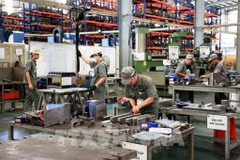
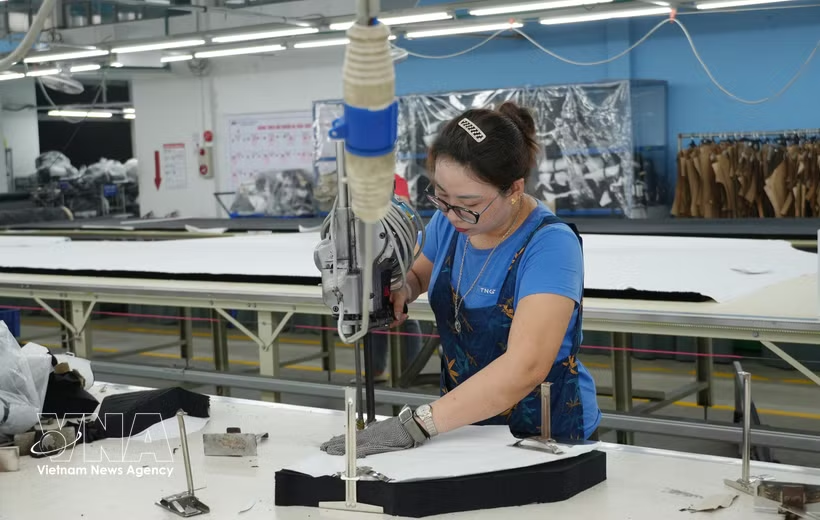
A worker at the factory of the TNG Investment and Trading Joint Stock Company in the Song Cong I Industrial Park, Thai Nguyen province. (Photo: VNA)

Hanoi (VNA) – Vietnam’s trade performance in the first quarter of 2026 presents a notably upbeat picture, with total turnover reaching 249.5 billion USD, up 23% year-on-year.

Exports rose 19% to 122.93 billion USD while imports climbed 27% to 126.57 billion USD. This robust expansion is laying the groundwork for stronger export growth and higher budget revenues in the quarters ahead.

Rising imports underscore production momentum

According to the Department of Vietnam Customs, the country recorded a trade deficit of 677 million USD in March, bringing the cumulative deficit in the first three months to 3.64 billion USD, compared to a surplus of 3.68 billion USD a year earlier. However, this shift is widely viewed not as a negative signal but as a reflection of the economy’s position in the early phase of a new growth cycle.

Tran Thi Kim Ha, an official from the department, noted that approximately 94% of import turnover comes from production inputs, including machinery, equipment and raw materials. This composition signals that businesses are proactively preparing resources to capture new orders as global demand recovers. Meanwhile, consumer goods account for a relatively small share, placing limited pressure on the trade balance.

Previous years show that Vietnam typically runs a trade deficit in the first quarter before shifting to a surplus in the latter half of the year. The current deficit, therefore, is considered both normal and indicative of an economy “recharging” for growth.

Several factors are driving this trend, including the recovery of international demand, accelerated public investment, and advances in logistics and e-commerce. At the same time, enterprises are stepping up efforts to upgrade and replace machinery and equipment. Foreign direct investment (FDI) inflows also remain strong, exceeding 54 billion USD in the first quarter, up 9.1% year-on-year, further boosting demand for imported inputs.

Revenue gains supported by trade structure

The vibrancy of trade activity has translated into solid gains in state budget revenues. In the first quarter, customs authorities collected over 117.1 trillion VND (4.45 billion USD), equivalent to 26% of the annual plan and up 14.4% year-on-year, according to Vietnam Customs.

This outcome reflects coordinated efforts to streamline administrative procedures, modernise customs operations, and proactively resolve bottlenecks for businesses. Stronger enforcement, improved trade facilitation and enhanced anti-revenue-loss measures have also contributed significantly to higher collections.
vnanet-phuong-tien-xuat-nhap-khau-qua-cua-khau-chi-ma-tinh-lang-son-anh-ttxvn.jpg
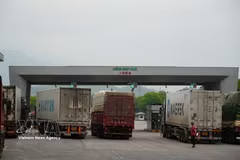
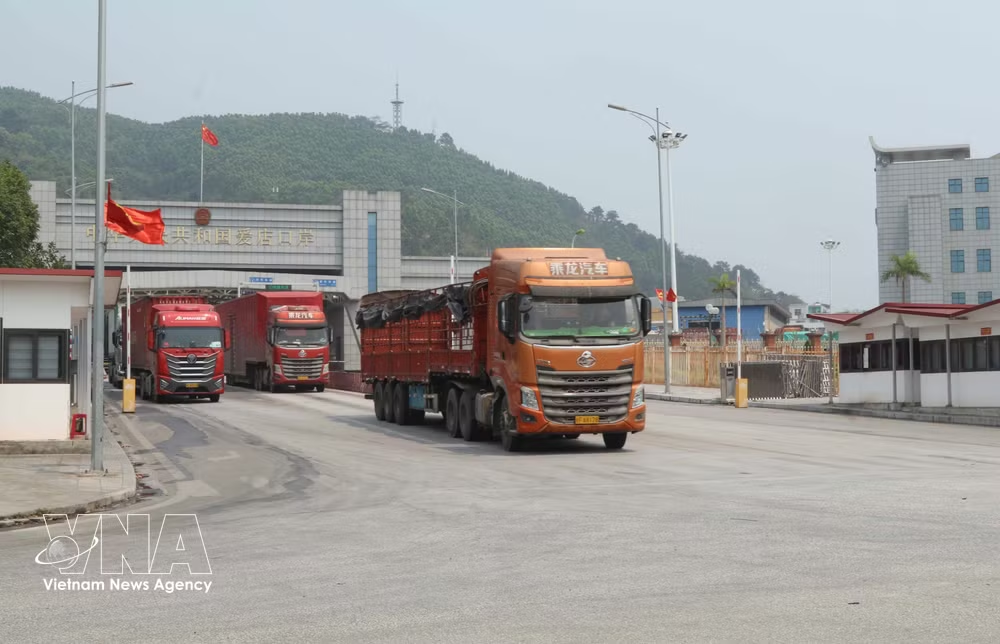
Vehicles carry imports and exports through Lang Son province's Chi Ma border gate. (Photo: VNA)

At the local level, the trend is evident. In the northern border province of Lang Son, trade turnover reached approximately 24 billion USD in the first quarter, generating 5.59 trillion VND in budget revenue, up 163% year-on-year and fulfilling roughly one-third of the annual target.

Nguyen Huu Vuong, deputy head of the Region 4 Customs Sub-department, attributed this surge to strong growth in imports of raw materials serving export production, alongside improved customs efficiency and stricter revenue management.

However, faster import growth relative to exports also highlights structural challenges, notably the low rate of locally made components. Heavy reliance on imported inputs limits domestic value addition and increases vulnerability to global supply chain disruptions. Developing supporting industries and strengthening domestic production capacity are therefore seen as urgent priorities.

In an increasingly uncertain global environment, the effective utilisation of free trade agreements (FTAs) remains a crucial lever. FTAs not only expand market access but also enable firms to tap into more material sources, advanced technologies and higher production standards. In parallel, diversifying export markets will help mitigate external risks and enhance adaptability.

Over the longer term, improving enterprise competitiveness, through higher productivity, technological adoption, cost optimisation and better product quality, will be decisive./.

VNA

See more

Experts speak at the workshop (Photo: VNA)

Vietnam’s pet care market emerges as lucrative investment opportunity

​ Across the Asia-Pacific, 60% of respondents own pets, while Vietnam’s pet ownership rate stands at 79%, among the highest in the region. Notably, 55% of Vietnamese pet owners have two or more pets, signalling that pet ownership has evolved from a hobby into a modern lifestyle choice.

A view of the workshop on the application of AI and real-world data in food product research and development held in Ho Chi Minh City on April 22. (Photo: VNA)

AI emerges as key driver for Vietnam’s F&B sector breakthrough

Businesses start with projects that deliver quick results within six to 12 months, like quality control systems, demand forecasting, or customer service chatbots. In the long run, F&B companies are advised to move toward with AI-driven operating models to keep up with fast-changing market demands.

Trucks carrying imports enter Vietnam through Lao Cai International Border Gate. (Photo: VNA)

Smart border gates power growth in northern border provinces

With a borderline of about 182 km, Lao Cai aims to turn its border gate economic zone into a key growth engine by adopting a smart border gate model, viewing this as a breakthrough measure for improving management efficiency, reducing logistics expenses, and enhancing customs clearance capacity.

Ken Chau (right), Chairman of the Vietnam Canada Business Association, presents flowers to the organising committee of the Vietnamese Entrepreneurs Awards in Canada 2026 at the event. (Photo: Award organising board)

Vietnamese awards in Canada spotlight community strength

The gala brought together nearly 200 participants, including community leaders, entrepreneurs and guests from across the country, highlighting both the achievements of Vietnamese businesses and the community’s growing role in the socio-economic fabric of Vancouver and other Canadian cities.

Passenger numbers are expected to peak at the start of each break, particularly from the afternoon of April 24 to April 25, with a return wave on April 27 following the Hung Kings Commemoration Day. (Photo: VNA)

Transport sector ramps up capacity for holiday travel surge

Transport experts said the back-to-back holidays will create travel patterns different from previous years. While some people are expected to combine the two breaks into a longer holiday, others will travel during either period depending on personal plans. Passenger flows are therefore likely to be more evenly distributed, helping ease pressure on transport systems.

Vietnamese Minister of Construction Tran Hong Minh and Korean Minister of Land, Infrastructure and Transport Kim Yun-duk hold talks on April 21 in Hanoi. (Photo: The Courtesy of the Ministry of Construction)

Vietnam, RoK step up cooperation in transport infrastructure

Minh noted that in transport, the RoK is currently Vietnam’s second-largest bilateral donor. Since 1996, the Korean Government has provided significant capital for Vietnam’s transport infrastructure, with nine projects completed to date, totalling over 1 billion USD, and six others underway worth nearly 600 million USD.

Illustrative image (Photo: VNA)

Technology bolsters growth confidence among Vietnam’s small businesses

The survey also indicates that this growth is expected to continue into 2026, with 89% of Vietnamese small businesses planning to expand operations. This outlook is fueled by a strong emphasis on embracing technology, expanding e-commerce, and enhancing corporate governance capabilities.

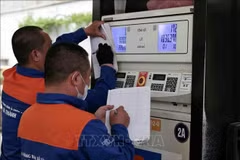
Fuel prices see a sharp decline in the latest adjustment. (Photo: VNA)

Fuel prices continue sharp drop in latest adjustment

The price of E5RON92 biofuel is capped at 21,934 VND (0.83 USD) per litre, down 658 VND per litre from the previous level, while RON95-III gasoline now costs no more than 23,042 VND per litre, a decrease of 719 VND per litre.

1st floor, No. 05 Ly Thuong Kiet Street

Notice of Office Auction in Hanoi

The Office of the Vietnam News Agency will conduct an auction for office leasing at No. 05 Ly Thuong Kiet street, No. 79 Ly Thuong Kiet street, No. 33 Le Thanh Tong street, and No. 11 Tran Hung Dao street in Cua Nam ward, Hanoi.

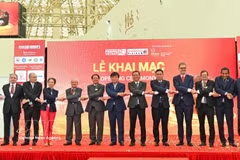
The opening ceremony of the Mining & Construction Vietnam 2026 exhibition. (Photo: VNA)

Expo promotes smart mining and green construction solutions in Vietnam

Mining & Construction Vietnam 2026 showcases a wide range of new technologies and trends, including advanced mining equipment, modern mineral processing technologies, sustainable and energy-efficient infrastructure solutions, as well as automation and digital transformation in management and operations.

An aircraft of Vietravel Airlines (Photo: VNA)

Vietravel Airlines moves to add nine aircraft

This aircraft marks the first in a plan to add nine more planes over the next six months. Continued induction of Airbus A321 aircraft throughout 2026 will allow the airline to optimise scheduling, improve efficiency and better meet growing market demand.

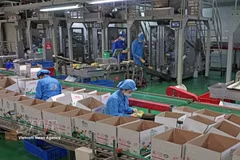
The Long Hai Co., Ltd., located in Industrial Cluster No. 1 in Thach Khoi ward, Hai Phong city, produces hundreds of tonnes of goods annually for both domestic consumption and export. (Photo: VNA)

State – private synergy key to Vietnam’s growth ambitions

Vice Chairman of the Ho Chi Minh City People’s Committee Nguyen Manh Cuong stressed the need for greater input from academia, experts and businesses to assess the feasibility of double-digit growth targets in the coming period. This will help the city identify new growth drivers and design policies to better tap its development potential.