Smart border gates power growth in northern border provinces

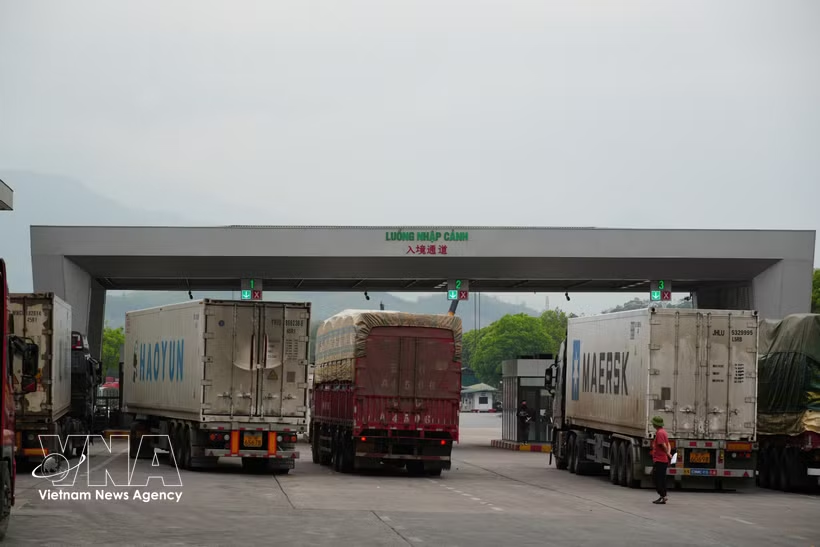
With a borderline of about 182 km, Lao Cai aims to turn its border gate economic zone into a key growth engine by adopting a smart border gate model, viewing this as a breakthrough measure for improving management efficiency, reducing logistics expenses, and enhancing customs clearance capacity.

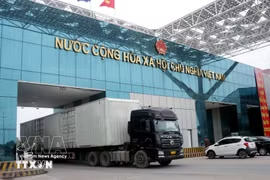
Trucks carrying imports enter Vietnam through Lao Cai International Border Gate. (Photo: VNA)

Hanoi (VNA) – As the border gate economy is increasingly affirming its role as a crucial growth driver for border localities, development in this sector in the new period requires not only resources, but also innovative thinking and decisive action.

In recent years, Cao Bang province has proactively implemented synchronous measures to promote its border gate economy. Despite global and regional uncertainties and challenges to international trade, the northern province recorded strong results in 2025, maintaining growth momentum and contributing significantly to socio-economic development.

Total foreign trade turnover through Cao Bang’s border gates reached 1.63 billion USD, up 84% year-on-year and exceeding the provincial target by 81%. State budget revenue from imports and exports approximated 2.26 trillion VND (85 million USD), surging 144% compared to 2024 and equivalent to 327% of the assigned target. These figures highlight the growing importance of the border gate economy in the province’s fiscal structure.

The results reflect strong political determination by the provincial Party Committee and authorities in effectively leveraging border advantages.

Identifying the border gate economy as a leading growth pillar, Cao Bang has issued a development programme for the 2025–2030 period, outlining clear tasks and objectives.

A key solution is the development of a digital border gate platform to automate the management of vehicles and goods, reduce manual procedures, and ensure data connectivity among relevant agencies. The roadmap includes the preparation phase through March 2026, pilot implementation at Ta Lung and Tra Linh border gates in April and May, and full-scale operation across the province from June 1. The platform is expected to significantly improve management efficiency and operational transparency.

Experience from Cao Bang shows that geographical advantages can only be fully translated into development gains when combined with new thinking, modern technology, and advanced governance methods.

Meanwhile, Lao Cai province is also accelerating efforts to develop its border gate economy. With a borderline of about 182 km, it aims to turn its border gate economic zone into a key growth engine by adopting a smart border gate model, viewing this as a breakthrough measure for improving management efficiency, reducing logistics expenses, and enhancing customs clearance capacity.

The province is implementing a project at the clearance points of Kim Thanh Bridge and Ban Vuoc under the Lao Cai International Border Gate. The project focuses on modernising management, inspection, and supervision through advanced technology and automated transport systems, with the goal of cutting logistics costs and facilitating trade.

By 2030, Lao Cai targets import – export turnover of around 9 billion USD, a doubling of cargo throughput at these two clearance points, and a 20–30% reduction in logistics costs.

Central to the project is the development of a smart border gate model based on synchronised data connectivity between Vietnam and China, along with the use of unmanned vehicles for cargo transport under bilateral agreements. The model integrates advanced technologies such as artificial intelligence, the Internet of Things, big data, 5G networks, and satellite positioning systems.

Linking smart border gate development with cross-border e-commerce is opening a new direction in line with digital economy trends. Provincial leaders consider this model an inevitable step in modernising border trade and implementing the Party’s policy of building a more efficient and competitive border gate economy./.

VNA
See more

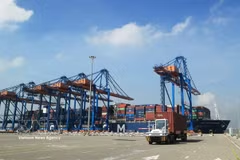
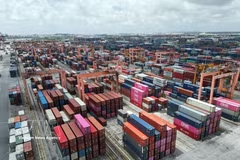
Containers loaded at Cai Mep International Terminal (Photo: VNA)

Vietnam ranks 18th among world’s top exporters in 2025

Vietnam’s exports reached about 470 billion USD for the first time last year, up more than 16% year on year, with a trade surplus of over 20 billion USD, contributing significantly to maintaining macroeconomic stability.

Experts speak at the workshop (Photo: VNA)

Vietnam’s pet care market emerges as lucrative investment opportunity

​ Across the Asia-Pacific, 60% of respondents own pets, while Vietnam’s pet ownership rate stands at 79%, among the highest in the region. Notably, 55% of Vietnamese pet owners have two or more pets, signalling that pet ownership has evolved from a hobby into a modern lifestyle choice.

A view of the workshop on the application of AI and real-world data in food product research and development held in Ho Chi Minh City on April 22. (Photo: VNA)

AI emerges as key driver for Vietnam’s F&B sector breakthrough

Businesses start with projects that deliver quick results within six to 12 months, like quality control systems, demand forecasting, or customer service chatbots. In the long run, F&B companies are advised to move toward with AI-driven operating models to keep up with fast-changing market demands.

Ken Chau (right), Chairman of the Vietnam Canada Business Association, presents flowers to the organising committee of the Vietnamese Entrepreneurs Awards in Canada 2026 at the event. (Photo: Award organising board)

Vietnamese awards in Canada spotlight community strength

The gala brought together nearly 200 participants, including community leaders, entrepreneurs and guests from across the country, highlighting both the achievements of Vietnamese businesses and the community’s growing role in the socio-economic fabric of Vancouver and other Canadian cities.

Passenger numbers are expected to peak at the start of each break, particularly from the afternoon of April 24 to April 25, with a return wave on April 27 following the Hung Kings Commemoration Day. (Photo: VNA)

Transport sector ramps up capacity for holiday travel surge

Transport experts said the back-to-back holidays will create travel patterns different from previous years. While some people are expected to combine the two breaks into a longer holiday, others will travel during either period depending on personal plans. Passenger flows are therefore likely to be more evenly distributed, helping ease pressure on transport systems.

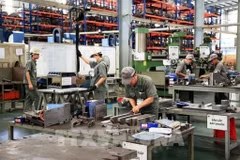
A worker at the factory of the TNG Investment and Trading Joint Stock Company in the Song Cong I Industrial Park, Thai Nguyen province. (Photo: VNA)

Imports accelerate, powering exports, public revenues

Previous years show that Vietnam typically runs a trade deficit in the first quarter before shifting to a surplus in the latter half of the year. The current deficit, therefore, is considered both normal and indicative of an economy “recharging” for growth.

Vietnamese Minister of Construction Tran Hong Minh and Korean Minister of Land, Infrastructure and Transport Kim Yun-duk hold talks on April 21 in Hanoi. (Photo: The Courtesy of the Ministry of Construction)

Vietnam, RoK step up cooperation in transport infrastructure

Minh noted that in transport, the RoK is currently Vietnam’s second-largest bilateral donor. Since 1996, the Korean Government has provided significant capital for Vietnam’s transport infrastructure, with nine projects completed to date, totalling over 1 billion USD, and six others underway worth nearly 600 million USD.

Illustrative image (Photo: VNA)

Technology bolsters growth confidence among Vietnam’s small businesses

The survey also indicates that this growth is expected to continue into 2026, with 89% of Vietnamese small businesses planning to expand operations. This outlook is fueled by a strong emphasis on embracing technology, expanding e-commerce, and enhancing corporate governance capabilities.

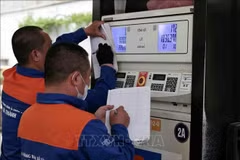
Fuel prices see a sharp decline in the latest adjustment. (Photo: VNA)

Fuel prices continue sharp drop in latest adjustment

The price of E5RON92 biofuel is capped at 21,934 VND (0.83 USD) per litre, down 658 VND per litre from the previous level, while RON95-III gasoline now costs no more than 23,042 VND per litre, a decrease of 719 VND per litre.

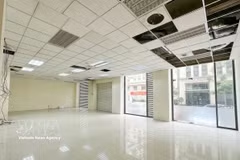
1st floor, No. 05 Ly Thuong Kiet Street

Notice of Office Auction in Hanoi

The Office of the Vietnam News Agency will conduct an auction for office leasing at No. 05 Ly Thuong Kiet street, No. 79 Ly Thuong Kiet street, No. 33 Le Thanh Tong street, and No. 11 Tran Hung Dao street in Cua Nam ward, Hanoi.