Vietnam’s pet care market emerges as lucrative investment opportunity

​ Across the Asia-Pacific, 60% of respondents own pets, while Vietnam’s pet ownership rate stands at 79%, among the highest in the region. Notably, 55% of Vietnamese pet owners have two or more pets, signalling that pet ownership has evolved from a hobby into a modern lifestyle choice.

Experts speak at the workshop (Photo: VNA)

Ho Chi Minh City (VNA) - No longer a niche segment, Vietnam’s pet care services ecosystem is emerging as a lucrative playground for investors, experts told a workshop run by Minh Vi Exhibition & Advertisement Services Company (VEAS) in Ho Chi Minh City on April 22.

Diep Ngoc Truc, Chairwoman of the Vietnam Small Animal Veterinary Association, said the domestic pet industry is entering a phase of robust growth, marked by positive indicators and fast-changing consumer behaviour. By 2027, the country is expected to have around 16 million pets, opening the door for a wide range of related services. The pet food market alone is forecast to surpass 222 million USD by 2029, growing at a compound annual growth rate of about 9.4%.

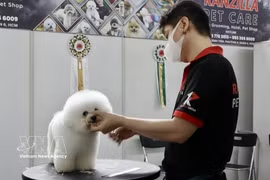
A notable shift is underway in how pet owners view their animals. Pets are increasingly treated as full family members rather than mere animals kept for basic needs. This change is fueling demand for comprehensive care services, including premium nutrition, healthcare, grooming, and lifestyle.

The trend is reshaping the retail landscape in the pet sector. Companies are moving beyond simple product sales to build integrated care ecosystems focused on customer experience. To succeed, they must adopt flexible omni-channel strategies and deliver personalised services to build trust and foster long-term customer loyalty.

Ho Mong Hai from the Department of Livestock Production and Animal Health under the Ministry of Agriculture and Environment noted that the sector’s potential remains largely untapped, particularly in pet food, accessories, and specialised veterinary services. These are poised for strong growth as rising incomes and higher quality-of-life expectations drive consumer spending.

According to him, authorities are refining the legal framework to support industry development, including stricter regulations on breeding, feed management, and pet-raising conditions. The goal is to improve disease control, enhance animal welfare, and reduce environmental impact.

At the same time, the State is encouraging enterprises to invest in modern technologies and develop internationally standardised pet food and services. This is expected to sharpen the competitiveness of local players and lay the groundwork for a more professional and sustainable pet industry.

Providing a broader market overview, Vu Ngoc Anh Thuyen, Marketing Director of TGM Research, said an online survey by the firm identified “pet humanisation” as the dominant trend shaping the market.

Across the Asia-Pacific, 60% of respondents own pets, while Vietnam’s pet ownership rate stands at 79%, among the highest in the region. Notably, 55% of Vietnamese pet owners have two or more pets, signalling that pet ownership has evolved from a hobby into a modern lifestyle choice. Around 45% of owners see their pets as family members, driving sweeping changes in care standards and spending habits.

Over the past five years, the market has seen strong growth in both products and services, including better veterinary care, eco-friendly items, pet insurance, and subscription-based models. This reflects a broader shift from reactive to proactive pet care.

In terms of spending, 55% of surveyed pet owners plan to increase their budgets over the next three years. Essential items such as food, accessories, and daily care products are now purchased monthly, becoming a regular household expense. Services like veterinary check-ups, professional grooming, and training are typically used every three to six months. Spending on health-related products and supplements leads the way, reflecting growing concern for pets’ long-term well-being. Pet food choices are also changing, with quality now prioritised over price.

Thuyen said the largest group of pet owners is aged 25–34. These busy young professionals are more inclined to adopt technology-driven solutions for pet care. Demand for regular care services and grooming accessories is also rising.

The growing prominence of independent pet stores as the main shopping channel highlights intensifying competition and market expansion, especially in metropolises such as Ho Chi Minh City.

Looking ahead, the market will be shaped by three major trends, including comprehensive healthcare services (routine check-ups, nutritional consulting, and professional care), lifestyle-support services (training, boarding, and pet walking), and the wider adoption of smart technologies such as surveillance cameras, automatic feeders, and intelligent litter boxes./.
VNA

See more

An unmanned aerial vehicle is used in rice cultivation in Vi Thanh 1 commune, Can Tho city. (Photo: VNA)

Shrinking farmland forces agriculture to go high-tech

Ministry of Finance data show that about 60% of companies have started using basic digital tech, while roughly 20% now have clear digital strategies. But only 5% has gone all the way with full-blown digital transformation.

SIAL Canada CEO Stéphane Thuillier (right) visits the Vietnam pavilion and speaks with a representative of the Vietnam Trade Office. (Photo: VNA)

Vietnamese exports expand foothold in Canada

The Vietnam Trade Office in Canada organised a national pavilion this year, supporting 15 companies in product displays while helping connect five others operating independent booths. The initiative is designed to enhance product promotion, facilitate partnerships and broaden market access in North America, particularly in the processed food segment.

Core site (Vinh Truong hamlet, Phuoc Dinh commune) for the construction of the Ninh Thuan 1 nuclear power plant. (Photo: VNA)

All-out push to fast-track Vietnam’s first nuclear power plants

Khanh Hoa province has also intensified oversight, introduced housing support of 5 million VND (nearly 190 USD) per month for displaced residents awaiting resettlement, and clarified responsibilities for land inventory, measurement and site selection. Notably, more than 9.8 billion VND has been disbursed to relocate 570 graves, helping accelerate clearance for the Ninh Thuan 1 Plant.

Traditional handicraft products at the Vietnamese booth attract visitors at the Paris Fair (Photo: VNA)

Vietnamese products shine at Paris Fair

Amid deepening international integration, the presence of Vietnamese enterprises at the annual Foire de Paris continues to affirm the appeal of Vietnamese goods and culture in the French market. The event also provides an opportunity for Vietnamese businesses to directly engage with French and European consumers, thereby strengthening their foothold in this promising market.

Do Gia Thang, Secretary-General of the Vietnam Business Association in Australia (VBAA) and Chairman of the Vietnam–Australia Young Entrepreneurs Club (Photo: VNA)

International Financial Centre - Vietnam's strategic move in global race: Expert

Vietnam is pursuing a “one centre – two destinations” model. Ho Chi Minh City is envisioned as a comprehensive financial hub linked with a free trade zone, while Da Nang will focus on innovation, fintech, digital assets and serve as a testing ground for new financial models. This complementary structure allows Vietnam to develop a tailored approach rather than replicate existing financial centres.

Financial buildings in central Ho Chi Minh City along the Saigon River, facing the Thu Thiem peninsula in An Khanh ward. (Photo: VNA)

Ho Chi Minh City attracts significant investment from France

Ho Chi Minh City is emerging as an attractive destination for French investors, particularly in infrastructure, sustainable urban development and green transition. French investment of more than 2.2 billion USD is contributing to economic growth and opening up broader prospects for long-term cooperation.

An aerial view of a crossroads in Hanoi (Photo: VNA)

Hanoi pushes SOEs to lead breakthrough growth

According to experts, Resolution 79-NQ/TW reaffirms the state economic sector’s leading role in the socialist-oriented market economy. The real shift, however, is moving SOEs from simply “holding” assets to actively “leading” development, and from traditional “management” to enabling growth across the board.

A representative of the Coast Guard speaks at the meeting. (Photo: VNA)

Ho Chi Minh City steps up decisive action to lift IUU “yellow card”

The city will fast-track eCDT implementation, study the feasibility of a fishing port in Can Gio, and propose granting accounts to border guard stations to strengthen oversight of vessel movements. Enhanced inter-provincial coordination, particularly with Lam Dong, Da Nang, Quang Tri and Ninh Binh, was also emphasised to tighten control and strictly handle violations, especially those related to VMS.

An overview of Prime Minister Le Minh Hung's working session with the Ministry of Finance on April 29 (Photo: VNA)

PM emphasises need for governance shift to drive growth

Ministries and agencies must enhance forecasting capacity, adopt more responsive policy tools, and fundamentally rethink how policies are designed and executed in a rapidly evolving environment, said PM Le Minh Hung.

Long Thanh International Airport is currently under construction and is expected to be put into operation by the end of 2026. (Photo: VNA)

Dong Nai rolls out 4.3 billion USD plan for key transport links

Dong Nai will implement three major transport projects with a total capital exceeding 110 trillion VND (4.3 billion USD), aimed at strengthening connectivity between Dong Nai, Ho Chi Minh City, and key economic regions in the Central Highlands, central, and southwestern regions.