Vietnam’s property market buoyed by domestic strength, infrastructure push

Improvements in macroeconomic fundamentals, coupled with a renewed inflow of investment capital, are laying the groundwork for a new growth cycle.

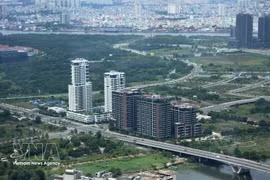
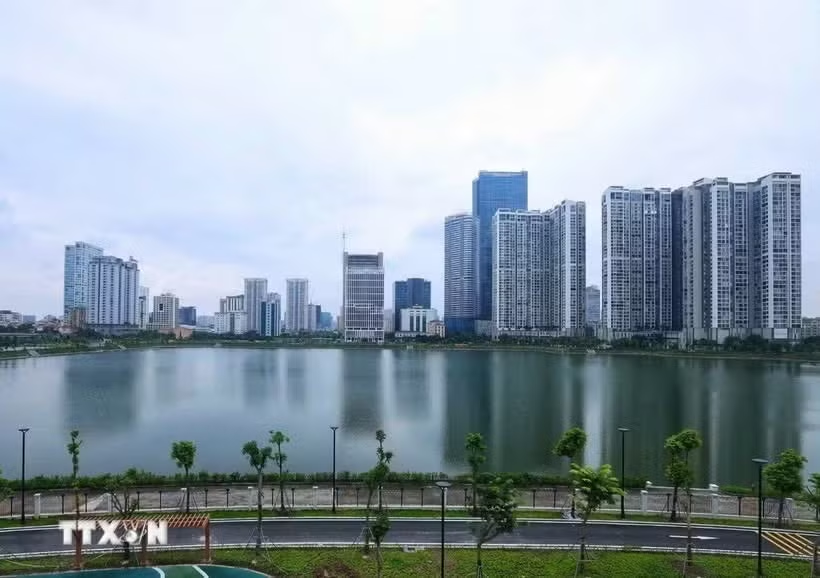
Illustrative image (Photo: VNA)

Hanoi (VNA) – Vietnam’s real estate market is showing encouraging signs in 2026, as the Asia–Pacific region gradually recovers following a year marked by volatility and supply chain restructuring.

Improvements in macroeconomic fundamentals, coupled with a renewed inflow of investment capital, are laying the groundwork for a new growth cycle.

Experts from Savills noted that last year, Vietnam maintained macroeconomic stability, with GDP growth reaching approximately 8.02%, while total realised investment rose by 12.1% year-on-year. Foreign direct investment (FDI) remained a bright spot, with total registered capital nearing 38.4 billion USD and disbursed capital reaching around 27.6 billion USD, the highest level recorded in five years.

Investment flows were driven largely by Asian investors, particularly from Singapore, China, Hong Kong (China), and Japan, reflecting the ongoing shift in manufacturing and supply chains towards Vietnam.

Momentum has carried into 2026, with GDP expanding by approximately 7.8% in the first quarter, while newly registered FDI reached 15.2 billion USD, up 43% year-on-year. The processing and manufacturing sector continued to dominate, accounting for roughly 69% of total investment.

Domestic consumption and tourism have also rebounded markedly. Total retail sales of goods and services reached an estimated 1.9 quadrillion VND (72.2 billion USD), while international arrivals approached 6.8 million, boosting the commercial and resort property segments.

According to analysts, infrastructure is emerging as a decisive driver of the market’s next phase. Around 234 large-scale projects, with total investment estimated at 3.4 quadrillion VND, are currently underway nationwide.

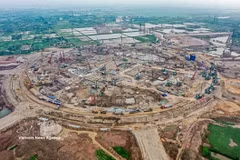
Key developments such as Long Thanh International Airport, metro systems in Hanoi and Ho Chi Minh City, along with more than 380 kilometres of newly operational sections of the North–South expressway, are helping to shape new economic corridors.

Su Ngoc Khuong, Senior Director of Investment at Savills Vietnam, observed that infrastructure will be the most significant catalyst for the market in the coming period, providing a foundation for sustainable development.

In practice, expanded infrastructure not only supports the growth of industrial real estate through integrated supply chain models but also drives the emergence of new urban areas and growth poles in satellite regions.

Investment has begun to regain momentum, becoming more diverse and selective, particularly in high-quality segments. In the fourth quarter of 2025, Ho Chi Minh City recorded a major transaction at the Can Gio tourism urban area project, valued at approximately 664.5 million USD, signalling long-term confidence in infrastructure and tourism potential.

In Hanoi, capital flows are increasingly shifting towards retail and commercial assets in prime urban locations, with notable deals including Vincom Centre Nguyen Chi Thanh at nearly 138 million USD, and the VP1 plot within the An Binh City complex in Phu Dien ward at 108.4 million USD.

Experts suggest the market is transitioning from a phase driven largely by potential to one characterised by selective investment, where high-quality projects capable of delivering tangible value will lead the way.

Against this backdrop, Vietnam’s property sector is expected to continue attracting both domestic and foreign capital, positioning itself for a more sustainable new growth cycle./.

VNA

See more

Vietnam will host the 21st Asian-Australasian Association of Animal Production Societies (AAAP) Animal Science Congress (AAAP 21) from October 28 - 31 in Hanoi. (Photo: aaap2026.org)

Vietnam to host 21st AAAP animal science congress

According to the Animal Husbandry Association of Vietnam (AHAV), the event is expected to gather between 1,300 - 1,500 delegates, including around 500 leading international scientists, experts and businesses in the livestock sector.

Yen Huong Xua company introduces solutions to combat counterfeit and imitation goods (Photo: VNA)

Fight against counterfeit goods fostered amid rising digital-era fraud

Dr. Bui Van Quyen, Director of the Anti-Commercial Fraud and Counterfeiting Institute, warned that counterfeit goods have become a global challenge, exacerbated by the rise of online platforms and digital technologies. While these innovations drive economic growth, they also create fertile ground for fraudulent activities.

The fuel storage tank area of the Nghi Son Refinery and Petrochemical Plant is located in the Nghi Son Economic Zone in Nghi Son ward, Thanh Hoa province. (Photo: VNA)

Nghi Son refinery receives over 950,000 barrels of Congo crude oil

Diversifying crude oil supply sources is considered crucial for Nghi Son Refinery and Petrochemical LLC (NSRP) in ensuring stable feedstock supplies and safeguarding domestic fuel supply, particularly as traditional crude imports from Kuwait have been affected by tensions in the Middle East.

Production of electronic components at Star Engineers Vietnam Co., Ltd. in Binh Xuyen I Industrial Park, Phu Tho province (Photo: VNA)

Vietnam looks to expand fiscal space to support double-digit growth

Experts emphasise that fiscal policy should move beyond a supportive role to actively lead growth. Continued and selectively expanded tax and fee reductions could directly ease cost pressures on businesses, enabling them to sustain operations and expand investment.

Ngo Quang Hung, representative of the Vietnam Trade Office in Malaysia, introduces Vietnamese products at the Melaka International Halal Fair, held from May 16-19, 2026. (Photo: VNA)

Vietnam, Malaysia promote smart business connectivity

Malaysia is paying close attention to Vietnam’s Doi Moi (Renewal) reforms, particularly in land policies, rice production technologies and seafood industry development, as both sides seek to expand practical cooperation.

The exchange of greenhouse gas emission quotas and carbon credits is conducted on the domestic carbon credit exchange through the carbon trading system, which is interconnected with the national registration system. (Photo congly.vn)

Ministry establishes monitoring framework for carbon market

Under a new circular, the exchange of greenhouse gas emission quotas and carbon credits is conducted on the domestic carbon credit exchange through the carbon trading system, which is interconnected with the national registration system.

Le Son Phong, Deputy Director of the Da Nang Department of Science and Technology, speaks at the press conference announcing the Da Nang Venture and Angel Summit 2026. (Photo: VNA)

Da Nang to host international venture capital forum later this month

Le Son Phong, Deputy Director of the Da Nang Department of Science and Technology, said DAVAS 2026 is not merely an investment-matching event for startups, but also demonstrates the city’s commitment to promoting innovation, developing the knowledge-based economy and creating a favourable environment for technology enterprises and startups.

Visitors explore southern Vietnam's products (Photo: vNA)

Vietnam, Cambodia boost supply chain connectivity

Total two-way trade neared 10.1 billion USD in 2024, up 17.5% year-on-year and jumping to more than 11 billion USD in 2025. Vietnam’s key exports to Cambodia include apparel, iron and steel, petroleum, machinery and equipment, chemicals, and processed food. Its main imports are cashew nuts, rubber, farm produce, and industrial raw materials.

Cao Thanh Dinh, founder and CEO of ANPz Co., Ltd (All Nippon Partners) in Japan (Photo: VNA)

Resolution 68 boosts investor confidence in Vietnam’s long-term outlook

Cao Thanh Dinh, Founder and CEO of ANPz Co., Ltd (All Nippon Partners) in Japan, said that after one year of implementation, Resolution No. 68-NQ/TW of the Politburo on private sector development has sent a positive signal to investors by affirming the private sector as a key driver of sustainable and long-term development.