Mini supermarkets and convenience stores on the rise

There are currently about 7,483 convenience stores and minimarts nationwide, accounting for more than 93% of all modern retail outlets, reflecting the growing popularity of the 'bringing supermarkets closer to home' model among consumers.

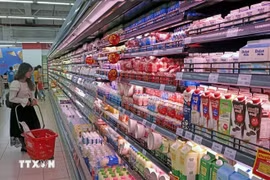
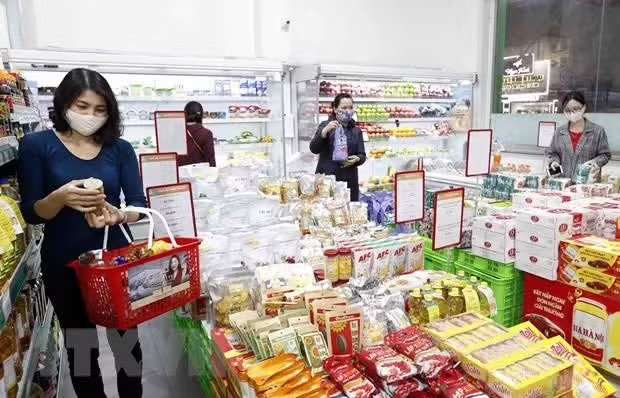
A 2025 report shows that the retail market for goods and services reached 269 billion USD, with pure retail accounting for more than 70%. (Photo: VNA)

Hanoi (VNS/VNA) – Convenience stores, mini supermarket chains and small to medium-sized supermarkets are seeing strong growth amid shifting consumer trends as retailers race to bring shopping closer to home in a rapidly expanding modern retail market.

According to market analysis data from VNDIRECT Securities Corporation, economic experts said the retail market has recovered strongly since the COVID-19 pandemic.

Notably, the pace of opening new mini supermarkets and convenience stores has accelerated in recent times.

There are currently about 7,483 convenience stores and minimarts nationwide, accounting for more than 93% of all modern retail outlets, reflecting the growing popularity of the 'bringing supermarkets closer to home' model among consumers.

For example, the mini-mart chain Bach Haa Xanh (BHX), owned by Mobile World Investment Corporation (MWG), plans to open around 1,000 new stores this year, focusing on northern regions, with Ninh Binh province piloting 20 stores.

Meanwhile, WinMart+, the mini supermarket chain operated by WinCommerce under Masan Group, also plans to open 1,000 new stores in 2026, including more than 300 launched in the first quarter.

The expansion will focus on the northern and central regions, where it already has a strong operational base and solid market share.

Convenience store chains are also joining the expansion race following a recovery phase.

GS25 from the Republic of Korea plans to continue expanding in northern Vietnam this year, targeting strategic provinces and cities.

The chain had opened its 50th store in Hanoi alone by the end of last year. GS25 is seen as posting strong growth in both key markets, the North and the South, and already operates more than 400 stores in the South.

In Hanoi, the convenience store market is heating up as 7-Eleven and GS25 compete aggressively with Circle K, which has long dominated the market with more than 190 stores.

A 2025 report from the Agency for Domestic Market Surveillance and Development under the Ministry of Industry and Trade shows that the retail market for goods and services reached 269 billion USD, with pure retail accounting for more than 70%.

Growth remains stable at around 8–9% annually. Experts forecast that revenue from modern retail channels could account for about 40% of total retail sales by 2030, equivalent to a market size of nearly 180 billion USD.

The Dai Doan Ket Newspaper quoted Tran Huu Linh, Director of the Agency for Domestic Market Surveillance and Development, as saying the agency will prioritise improving the institutional framework.

The focus will be on drafting the Law on Market Management and the Law on Commodity Derivatives Trading, expected to be submitted to the National Assembly this year. This legal framework will help ensure the market operates more transparently, professionally and efficiently.

In addition, the agency will promote measures to stimulate domestic consumption and support the distribution of Vietnamese-branded products. Developing commercial infrastructure and enhancing market management efficiency will also be prioritised to create a sustainable foundation for the retail sector and contribute to long-term economic growth./.

VNA
See more

Vietnamese and Cambodian businesses sign an MoU during a thematic discussion on cooperation and investment opportunities in the healthcare sector. (Photo: VNA)

Vietnam, Cambodia seek stronger economic, investment cooperation

A Cambodian official underlined his country's openness to Vietnamese firms, calling on them to expand investment in digital transformation, renewable energy, advanced agro-processing, and services and, together, build sustainable partnerships towards shared development and prosperity.

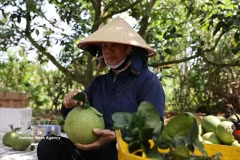
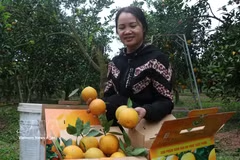
A farmer inspects quality of green-skin pomelos in an orchard. (Photo: VNA)

Vietnamese pomelos gain broader access to Australian market

The update by Australia’s Department of Agriculture, Fisheries and Forestry to its Biosecurity Import Conditions system (BICON) on April 10, officially setting out import conditions for Vietnamese pomelos, is regarded as a major milestone in market access efforts.

Vietnamese Trade Counsellor to India Bui Trung Thuong addresses the online seminar. (Photo: VNA)

Vietnam, India boost connectivity in textile, footwear sectors

As global supply chains are being restructured towards diversification, sustainability and digital transformation, Vietnamese Trade Counsellor to India Bui Trung Thuong noted that this is an opportune time for both countries to deepen cooperation towards building integrated value chains and enhancing product value.

A passenger poses for a photo besides a Vietjet aircraft (Photo: VNA)

Vietjet leads Southeast Asia in emissions efficiency

Under comparable operating conditions, Vietjet’s leading position highlights its ability to optimise performance across its entire operational chain, including aircraft configuration, route network design and load management.

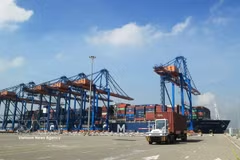
Containers loaded at Cai Mep International Terminal (Photo: VNA)

Vietnam ranks 18th among world’s top exporters in 2025

Vietnam’s exports reached about 470 billion USD for the first time last year, up more than 16% year on year, with a trade surplus of over 20 billion USD, contributing significantly to maintaining macroeconomic stability.

Experts speak at the workshop (Photo: VNA)

Vietnam’s pet care market emerges as lucrative investment opportunity

​ Across the Asia-Pacific, 60% of respondents own pets, while Vietnam’s pet ownership rate stands at 79%, among the highest in the region. Notably, 55% of Vietnamese pet owners have two or more pets, signalling that pet ownership has evolved from a hobby into a modern lifestyle choice.

A view of the workshop on the application of AI and real-world data in food product research and development held in Ho Chi Minh City on April 22. (Photo: VNA)

AI emerges as key driver for Vietnam’s F&B sector breakthrough

Businesses start with projects that deliver quick results within six to 12 months, like quality control systems, demand forecasting, or customer service chatbots. In the long run, F&B companies are advised to move toward with AI-driven operating models to keep up with fast-changing market demands.

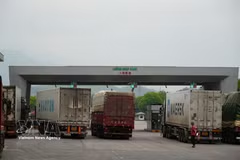
Trucks carrying imports enter Vietnam through Lao Cai International Border Gate. (Photo: VNA)

Smart border gates power growth in northern border provinces

With a borderline of about 182 km, Lao Cai aims to turn its border gate economic zone into a key growth engine by adopting a smart border gate model, viewing this as a breakthrough measure for improving management efficiency, reducing logistics expenses, and enhancing customs clearance capacity.

Ken Chau (right), Chairman of the Vietnam Canada Business Association, presents flowers to the organising committee of the Vietnamese Entrepreneurs Awards in Canada 2026 at the event. (Photo: Award organising board)

Vietnamese awards in Canada spotlight community strength

The gala brought together nearly 200 participants, including community leaders, entrepreneurs and guests from across the country, highlighting both the achievements of Vietnamese businesses and the community’s growing role in the socio-economic fabric of Vancouver and other Canadian cities.

Passenger numbers are expected to peak at the start of each break, particularly from the afternoon of April 24 to April 25, with a return wave on April 27 following the Hung Kings Commemoration Day. (Photo: VNA)

Transport sector ramps up capacity for holiday travel surge

Transport experts said the back-to-back holidays will create travel patterns different from previous years. While some people are expected to combine the two breaks into a longer holiday, others will travel during either period depending on personal plans. Passenger flows are therefore likely to be more evenly distributed, helping ease pressure on transport systems.