Hanoi (VNA) – Australia has officially announced its import requirements for Vietnamese pomelos, marking the conclusion of a lengthy technical negotiation process and opening up significant opportunities for one of Vietnam’s key fruit exports to penetrate more demanding markets, enhance value, and strengthen the international standing of Vietnamese agricultural produce.
Technical negotiations completed, a new market opens
The update by Australia’s Department of Agriculture, Fisheries and Forestry to its Biosecurity Import Conditions system (BICON) on April 10, officially setting out import conditions for Vietnamese pomelos, is regarded as a major milestone in market access efforts.
According to the Plant Production and Protection Department under the Ministry of Agriculture and Environment of Vietnam, this serves as the legal basis confirming that risk assessments and technical requirements between the two sides have been fully agreed upon, paving the way for practical export implementation.
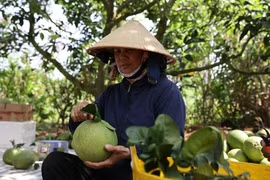
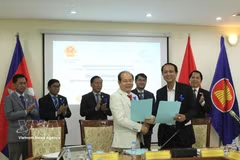
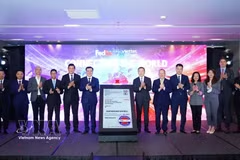
Notably, on April 13, the People’s Committee of Dong Thap province, in coordination with the Blue Ocean Import Export JSC, held a ceremony to mark the export of local pomelos – the first shipment of the fruit from Vietnam to the Australian market.
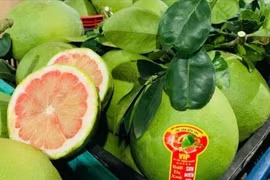
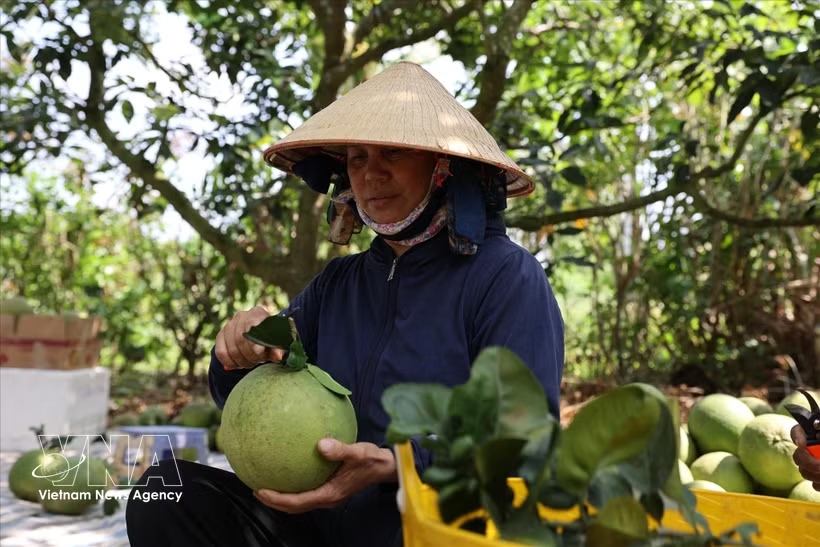
According to Le Chi Thien, Deputy Director of the provincial Department of Agriculture and Environment, the Mekong Delta locality currently has around 4,364 hectares of pomelo cultivation, with an annual output of more than 65,000 tonnes.
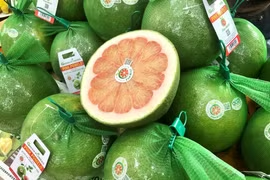
Dong Thap has been granted 23 pomelo growing areas with 31 codes, covering a total of 470.85 hectares. Of these, 16 areas with 22 codes, spanning 249.4 hectares, are already approved for exports to the US and the Republic of Korea. This provides an important foundation for further market expansion, including Australia.
At the event, Pham Thi Ngoc Thach, general director of Blue Ocean, stressed that Australia is well known for its strict regulations on plant quarantine, biosecurity, and traceability. Vietnamese pomelos gaining access to this market demonstrates the growing capacity of local producers to meet international standards.
Standardising production to enhance competitiveness
Speaking about the first shipment to Australia, Huynh Tan Dat, Director General of Plant Production and Protection Department, said Australia’s market opening for Vietnamese pomelos is the result of thorough preparation from establishing compliant growing areas to finalising quarantine procedures and post-harvest treatment processes.
He noted that this also presents an opportunity for the pomelo industry to elevate production standards and move towards full compliance with international requirements.
According to him, to make the most of this opportunity, local authorities, enterprises, and cooperatives must urgently study Australia’s import requirements and the technical guidance already issued. Priority should be given to completing requirements related to cultivation area codes, packing facilities, and treatment centres, while developing appropriate production processes and effectively controlling pests in accordance with the importing country’s regulations.
At the same time, close coordination with plant quarantine authorities remains crucial. From cultivation and harvesting to treatment, packaging, and transportation, every stage must be subject to strict supervision to ensure full compliance with technical standards.
Comprehensive preparation from the outset will help minimise risks, improve shipment quality, and establish a solid foundation for maintaining and expanding market access in the future.
In practice, pomelo cultivation is increasingly asserting its position in Vietnam’s agricultural structure. By 2025, its growing area had exceeded 100,000 hectares, double that of 2015, with output reaching nearly one million tonnes. Major cultivation areas are concentrated in the Mekong Delta, the Red River Delta, and the northern midland and mountainous regions.
Before entering the Australian market, Vietnamese pomelos had already been officially exported to New Zealand since December 2022 and to the Republic of Korea since August 2024./.
VNA