Deputy PM orders crackdown on unjustified price hikes as inflation watch tightens

Thang urged stronger monitoring and analysis of supply-demand balances and prices of essential goods to maintain tight control and prevent profiteering, especially in fuel-sensitive sectors such as transport, logistics, construction materials and food.

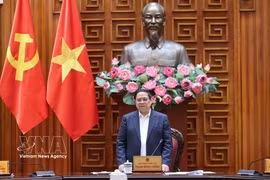
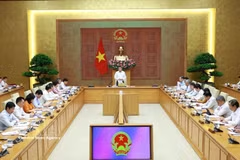
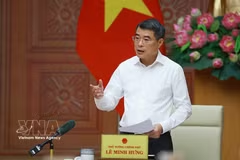
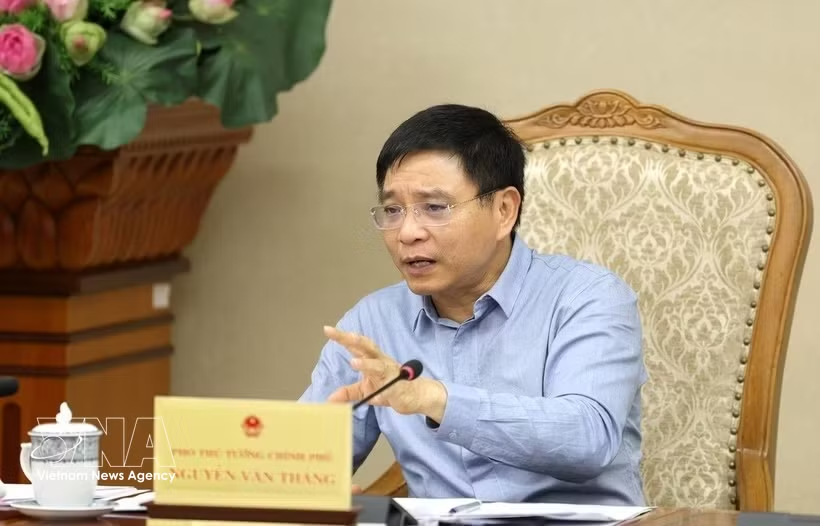
Deputy Prime Minister Nguyen Van Thang speaks at the meeting of the Steering Committee for Price Management in Hanoi on April 23. (Photo: VNA)

Hanoi (VNA) - Ministries and agencies, within their respective mandates, must request enterprises to strictly follow rules on price declaration and listing, and stop exploiting cost swings to push up prices unreasonably, Deputy Prime Minister Nguyen Van Thang has said.

Chairing a meeting of the Steering Committee for Price Management in Hanoi on April 23, Thang called for a flexible approach to price oversight. He urged stronger monitoring and analysis of supply-demand balances and prices of essential goods to maintain tight control and prevent profiteering, especially in fuel-sensitive sectors such as transport, logistics, construction materials and food.

It is essential to balance supply and demand, especially for key commodities, including petroleum, electricity, food and critical production inputs, he said, adding that timely coordination of supplies across regions, while factoring in export needs, will be required to stabilise market prices. The People’s Committees of provinces and centrally-run cities must actively roll out market stabilisation programmes tailored to local conditions, Thang noted.

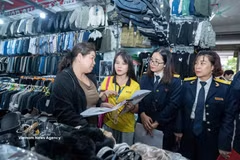
At the same time, authorities were told to ramp up inspections, examinations and market surveillance to enforce pricing rules, quickly detect and tackle speculation, hoarding, price manipulation, and failures to cut prices when input costs fall. Strict action was also demanded against violations in cross-border fuel trading that exploit price gaps.

Efforts to improve public communication and transparency on pricing and price management must continue, with timely information released on major commodities that affect production and daily livelihoods.

The Deputy PM suggested that ministries, agencies and localities issue pricing decisions within their authority and fully shoulder price management responsibilities under the revised Law on Prices and related guidelines.

Ministries, agencies and localities were assigned to track supply-demand and price movements of goods under their purview, then adopting appropriate pricing measures, particularly for items directly hit household budgets such as food, electricity, construction materials, education and healthcare. They must also keep a close watch on indirectly influential sectors like gold, foreign exchange and real estate.

For state-priced goods and services under review for adjustment, they must carefully examine cost factors and evaluate impacts on both local and national price levels, avoiding rushed hikes. Enterprises were ordered to control input costs, cut production expenses, boost efficiency and share responsibility to balance interests among the State, businesses and consumers. Price cuts should be made promptly when input costs decline, and any adjustments must be timed and calibrated to preserve market stability and keep inflation targets in check.

The Ministry of Industry and Trade was tasked with partnering with relevant agencies to ensure a sufficient domestic supply of petroleum and liquefied petroleum gas (LPG) under all circumstances, while managing fuel prices according to regulations.​

It will also explore ways to diversify supply sources and build petrol reserves to allow flexible intervention and stabilisation during market swings or disruptions. At the same time, the ministry must simultaneously strengthen market inspections, crack down on violations, and prevent any fuel shortages or disruptions.​

The Deputy PM also assigned other specific tasks to relevant ministries and local authorities./.
VNA

See more

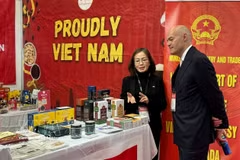
SIAL Canada CEO Stéphane Thuillier (right) visits the Vietnam pavilion and speaks with a representative of the Vietnam Trade Office. (Photo: VNA)

Vietnamese exports expand foothold in Canada

The Vietnam Trade Office in Canada organised a national pavilion this year, supporting 15 companies in product displays while helping connect five others operating independent booths. The initiative is designed to enhance product promotion, facilitate partnerships and broaden market access in North America, particularly in the processed food segment.

Core site (Vinh Truong hamlet, Phuoc Dinh commune) for the construction of the Ninh Thuan 1 nuclear power plant. (Photo: VNA)

All-out push to fast-track Vietnam’s first nuclear power plants

Khanh Hoa province has also intensified oversight, introduced housing support of 5 million VND (nearly 190 USD) per month for displaced residents awaiting resettlement, and clarified responsibilities for land inventory, measurement and site selection. Notably, more than 9.8 billion VND has been disbursed to relocate 570 graves, helping accelerate clearance for the Ninh Thuan 1 Plant.

Traditional handicraft products at the Vietnamese booth attract visitors at the Paris Fair (Photo: VNA)

Vietnamese products shine at Paris Fair

Amid deepening international integration, the presence of Vietnamese enterprises at the annual Foire de Paris continues to affirm the appeal of Vietnamese goods and culture in the French market. The event also provides an opportunity for Vietnamese businesses to directly engage with French and European consumers, thereby strengthening their foothold in this promising market.

Do Gia Thang, Secretary-General of the Vietnam Business Association in Australia (VBAA) and Chairman of the Vietnam–Australia Young Entrepreneurs Club (Photo: VNA)

International Financial Centre - Vietnam's strategic move in global race: Expert

Vietnam is pursuing a “one centre – two destinations” model. Ho Chi Minh City is envisioned as a comprehensive financial hub linked with a free trade zone, while Da Nang will focus on innovation, fintech, digital assets and serve as a testing ground for new financial models. This complementary structure allows Vietnam to develop a tailored approach rather than replicate existing financial centres.

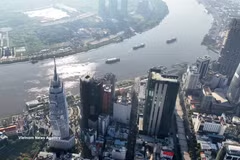
Financial buildings in central Ho Chi Minh City along the Saigon River, facing the Thu Thiem peninsula in An Khanh ward. (Photo: VNA)

Ho Chi Minh City attracts significant investment from France

Ho Chi Minh City is emerging as an attractive destination for French investors, particularly in infrastructure, sustainable urban development and green transition. French investment of more than 2.2 billion USD is contributing to economic growth and opening up broader prospects for long-term cooperation.

An aerial view of a crossroads in Hanoi (Photo: VNA)

Hanoi pushes SOEs to lead breakthrough growth

According to experts, Resolution 79-NQ/TW reaffirms the state economic sector’s leading role in the socialist-oriented market economy. The real shift, however, is moving SOEs from simply “holding” assets to actively “leading” development, and from traditional “management” to enabling growth across the board.

A representative of the Coast Guard speaks at the meeting. (Photo: VNA)

Ho Chi Minh City steps up decisive action to lift IUU “yellow card”

The city will fast-track eCDT implementation, study the feasibility of a fishing port in Can Gio, and propose granting accounts to border guard stations to strengthen oversight of vessel movements. Enhanced inter-provincial coordination, particularly with Lam Dong, Da Nang, Quang Tri and Ninh Binh, was also emphasised to tighten control and strictly handle violations, especially those related to VMS.

An overview of Prime Minister Le Minh Hung's working session with the Ministry of Finance on April 29 (Photo: VNA)

PM emphasises need for governance shift to drive growth

Ministries and agencies must enhance forecasting capacity, adopt more responsive policy tools, and fundamentally rethink how policies are designed and executed in a rapidly evolving environment, said PM Le Minh Hung.

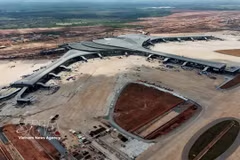
Long Thanh International Airport is currently under construction and is expected to be put into operation by the end of 2026. (Photo: VNA)

Dong Nai rolls out 4.3 billion USD plan for key transport links

Dong Nai will implement three major transport projects with a total capital exceeding 110 trillion VND (4.3 billion USD), aimed at strengthening connectivity between Dong Nai, Ho Chi Minh City, and key economic regions in the Central Highlands, central, and southwestern regions.