Ministry proposes advance mechanism for fuel price stabilisation fund

Vietnam plans State-budget advances to its fuel price stabilisation fund, aiming to cushion domestic fuel price swings amid global market volatility and rising energy costs.

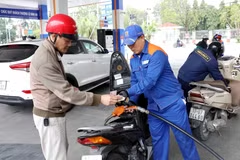
A petrol station in Hanoi (Photo: VNA)

Hanoi (VNS/VNA) - The Ministry of Industry and Trade has proposed a mechanism to allow advances from the State budget to the fuel price stabilisation fund, aiming to cushion volatility in domestic fuel prices, according to a draft decree.

The move follows a government resolution issued on March 27 approving advances from the surplus of the State budget in 2025 to the fuel price stabilisation fund.

The draft decree emphasises transparency and accountability in the use, contribution and reimbursement of the fuel price stabilisation fund.

Under the draft, the Ministry of Industry and Trade’s Domestic Markets Department would be in charge of overseeing usage and providing advances to fuel wholesalers to support price management.

For the first disbursement, traders would request advances based on projected consumption over seven days. The advances would be calculated at fixed rates of 5,000 VND per litre for diesel and 4,000 VND per litre for other fuels.

The advances would then be transferred into escrow accounts held by designated firms.

In subsequent pricing cycles, traders must report on the use of the advances, balances and additional funding needs ahead of each adjustment period for review and approval of any further disbursements.

If the advance proves insufficient for a seven-day cycle, the Domestic Markets Department would propose that the Ministry of Industry and Trade coordinate with the Ministry of Finance to seek additional budget allocations.

The fund must be used to supply each litre and kilogramme of fuel only once at the wholesale level. Traders would be required to open accounts dedicated solely for fund-related transactions.

After each pricing cycle, firms would calculate actual spending based on real consumption and withdraw corresponding amounts from the escrow accounts. Any interest accrued would be added back to the fund.

Within five days of each adjustment, traders must also transfer contributions into the fund based on actual sales volumes.

Regarding repayment, once the fund reaches at least 8 trillion VND, the ministry would require independent audits to determine total spending and contributions, which would serve as the base to calculate the amount to be returned to the State budget.

Prime Minister Pham Minh Chinh on March 27 signed a decision to allocate 8 trillion VND from surplus 2025 budget revenues to the fuel price stabilisation fund.

The move comes as ongoing tensions in the Middle East have driven volatility in global energy markets, affecting domestic fuel prices.

Since late February, Vietnam has adjusted retail fuel prices 11 times. Authorities have tapped the fuel price stabilisation fund nine times, disbursing nearly 5.3 trillion VND, leaving a balance of roughly 320 billion VND.

The Government has also cut environmental, value-added and special consumption taxes on petrol to cushion the increases./.

VNA
See more

Delegates at the opening ceremony of the Made in Da Nang Expo 2026 (Photo: VNA)

Nearly 300 firms join Made in Da Nang Expo 2026

Speaking at the opening ceremony, Vice Chairman of the Da Nang People’s Committee Tran Chi Cuong said the exhibition is a large-scale trade promotion event aimed at showcasing products, connecting markets, and helping businesses enhance competitiveness while expanding domestic and export markets.

 Green production, standardised value chains key to fruit, vegetable sector growth

Green production, standardised value chains key to fruit, vegetable sector growth

Facing mounting pressure from increasingly stringent domestic and international standards, Vietnam’s fruit and vegetable sector is accelerating its shift toward green, safe, and sustainable production models. Beyond changing farming practices, localities and businesses are stepping up efforts to standardise value chains and build brands to achieve growth targets for 2026.

The launch of the Vietnam National Brand Week 2026 on April 16 (Photo: VNA)

Vietnam National Brand Week 2026 opens

Running from April 16 to 23 nationwide, the Vietnam National Brand Week 2026 marks the 18th anniversary of Vietnam Brand Day (April 20, 2008 – 2026).

Ca Mau is currently home to more than 5,200 fishing vessels, including nearly 1,900 boats measuring over 15 metres in length, and all have been equipped with vessel monitoring systems. (Illustrative photo: VNA)

Ca Mau drives changes among fishermen to tackle IUU fishing

Ca Mau is stepping up communication campaigns to disseminate legal regulations on IUU fishing, highlight recent enforcement results, and convey recommendations from the European Commission (EC)’s fifth inspection mission to fishing communities and relevant stakeholders.

The new infrastructure system will not only meet immediate needs but also create new growth poles, helping reshape the economic landscape. (Photo: VNA)

Construction sector striving for high-growth target

The construction sector faces mounting pressure to keep major projects on schedule while managing costs and stabilising markets. Yet, with gains from institutional reform, infrastructure investment, and growth model transformation, it remains well positioned to serve as a key growth engine.

Fuel taxes are slashed to 0% from April 16 under a National Assembly resolution. (Illustrative photo: VNA)

Fuel taxes cut to 0% from April 16

Accordingly, the environmental protection tax on petrol (excluding ethanol), diesel, kerosene, mazut, and aviation fuel has been cut to 0 VND per litre. These products are also exempt from VAT declaration and payment, while still eligible for input VAT credit.