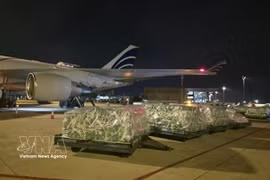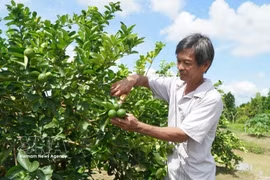
Hanoi (VNA) – Domestic agricultural enterprises are exerting efforts to maintain their standing in key export markets to avoid dependence on certain markets, especially the US.
In the first quarter of 2026, the US remained Vietnam’s second-largest export market for agro-forestry-fishery products, accounting for 18.3% of total export value, though this marked a 5.2% decline compared to the same period last year.
Despite its large scale and strong purchasing power, the market is becoming increasingly challenging due to fierce competition, stringent standards and rapidly shifting policies, requiring exporters to stay highly adaptable amid global geopolitical uncertainties and supply chain disruptions.
The Vietnam Association of Seafood Exporters and Producers (VASEP) reported that aquatic exports to the US fell by over 10% in the first quarter, continuing to be a major bottleneck for the sector.
VASEP Deputy Secretary General Le Hang attributed the decline to weaker demand as well as mounting technical and tariff barriers.
Notably, new import regulations under the Marine Mammal Protection Act (MMPA), including mandatory certificates of admissibility (COA) effective from January 1, 2026, have increased compliance pressure. Anti-dumping duties on shrimp have also weighed heavily, with shrimp exports to the US dropping sharply, by 61% year-on-year, to 16 million USD in February. In the first two months, shrimp exports to this market reached nearly 60 million USD, down 22%.
Looking ahead, shrimp exports are expected to remain under pressure in Q2 as the US tightens controls on antibiotic residues, food safety, traceability and import alerts, raising risks for customs clearance, delivery and costs.
Timber and wood product exports have also declined. In the first two months of 2026, Vietnam was still the largest supplier of wooden furniture to the US, with turnover of 1.3 billion USD, but this was down 21.3% year-on-year due to weaker demand, higher logistics costs and global economic uncertainty. The share of Vietnamese kitchen furniture also fell from 42.3% to 39.4%.
In contrast, cashew nuts have emerged as a bright spot, with exports to this North American market rising 1.6% in volume and 0.6% in value, lifting Vietnam’s market share from 88.19% to 88.68%. However, demand is shifting towards processed and branded products with full traceability.
At the same time, ensuring origin transparency, particularly for imported raw materials, has become essential to benefit from tariff preferences and overcome technical barriers.
From a trade promotion perspective, Trade Counsellor and head of the Vietnam Trade Office in the US Do Ngoc Hung noted that after years of market expansion, the biggest challenge now is no longer how to enter the US market but how to maintain a foothold, retain customers and expand market share under increasingly competition and demanding conditions. This requires enterprises to invest more systematically in internal governance, supply chain control, raw material data management, origin documentation, and compliance with labour, environmental and regulatory standards.
In addition to trade-specific challenges, exporters must also take into account broader global factors, including geopolitical tensions in the Middle East and fluctuations in energy and logistics markets.
Businesses are therefore advised to proactively develop flexible strategies for pricing, contract negotiation and delivery planning while factoring in freight costs and potential supply chain disruptions to mitigate risks and sustain exports in the time ahead./.
See more
Smart border gates power growth in northern border provinces
With a borderline of about 182 km, Lao Cai aims to turn its border gate economic zone into a key growth engine by adopting a smart border gate model, viewing this as a breakthrough measure for improving management efficiency, reducing logistics expenses, and enhancing customs clearance capacity.
Vietnamese awards in Canada spotlight community strength
The gala brought together nearly 200 participants, including community leaders, entrepreneurs and guests from across the country, highlighting both the achievements of Vietnamese businesses and the community’s growing role in the socio-economic fabric of Vancouver and other Canadian cities.
Transport sector ramps up capacity for holiday travel surge
Transport experts said the back-to-back holidays will create travel patterns different from previous years. While some people are expected to combine the two breaks into a longer holiday, others will travel during either period depending on personal plans. Passenger flows are therefore likely to be more evenly distributed, helping ease pressure on transport systems.
Imports accelerate, powering exports, public revenues
Previous years show that Vietnam typically runs a trade deficit in the first quarter before shifting to a surplus in the latter half of the year. The current deficit, therefore, is considered both normal and indicative of an economy “recharging” for growth.
Reference exchange rate drops 2 VND on April 22
With the current trading band of +/- 5%, the ceiling rate applicable for commercial banks during the day is 26,355 VND/USD, and the floor rate 23,845 VND/USD.
Vietnam’s property market buoyed by domestic strength, infrastructure push
Improvements in macroeconomic fundamentals, coupled with a renewed inflow of investment capital, are laying the groundwork for a new growth cycle.
Electronic fishing logbooks boost transparency, modernise fisheries management in Ho Chi Minh City
Electronic logbooks improve the traceability of seafood and strengthen oversight of fishing activities, helping authorities monitor catches more effectively.
Hai Phong waives port infrastructure fees for liquid cargo through end-2026
Hai Phong sets the fee for the use of port infrastructure, service facilities and public utilities at seaport border gates at zero for liquid cargo comprising petrol, oil and gas.
Vietnam, RoK step up cooperation in transport infrastructure
Minh noted that in transport, the RoK is currently Vietnam’s second-largest bilateral donor. Since 1996, the Korean Government has provided significant capital for Vietnam’s transport infrastructure, with nine projects completed to date, totalling over 1 billion USD, and six others underway worth nearly 600 million USD.
Technology bolsters growth confidence among Vietnam’s small businesses
The survey also indicates that this growth is expected to continue into 2026, with 89% of Vietnamese small businesses planning to expand operations. This outlook is fueled by a strong emphasis on embracing technology, expanding e-commerce, and enhancing corporate governance capabilities.
Fuel prices continue sharp drop in latest adjustment
The price of E5RON92 biofuel is capped at 21,934 VND (0.83 USD) per litre, down 658 VND per litre from the previous level, while RON95-III gasoline now costs no more than 23,042 VND per litre, a decrease of 719 VND per litre.
Vietnam, UNIDO deepen cooperation toward green industry transition
Since Vietnam joined the United Nations Industrial Development Organisation (UNIDO) in 1985, the two sides have implemented around 170 cooperation projects.
Notice of Office Auction in Hanoi
The Office of the Vietnam News Agency will conduct an auction for office leasing at No. 05 Ly Thuong Kiet street, No. 79 Ly Thuong Kiet street, No. 33 Le Thanh Tong street, and No. 11 Tran Hung Dao street in Cua Nam ward, Hanoi.
Expo promotes smart mining and green construction solutions in Vietnam
Mining & Construction Vietnam 2026 showcases a wide range of new technologies and trends, including advanced mining equipment, modern mineral processing technologies, sustainable and energy-efficient infrastructure solutions, as well as automation and digital transformation in management and operations.
Vietravel Airlines moves to add nine aircraft
This aircraft marks the first in a plan to add nine more planes over the next six months. Continued induction of Airbus A321 aircraft throughout 2026 will allow the airline to optimise scheduling, improve efficiency and better meet growing market demand.
State – private synergy key to Vietnam’s growth ambitions
Vice Chairman of the Ho Chi Minh City People’s Committee Nguyen Manh Cuong stressed the need for greater input from academia, experts and businesses to assess the feasibility of double-digit growth targets in the coming period. This will help the city identify new growth drivers and design policies to better tap its development potential.
Achieving double-digit growth challenging but essential: Minister
Since 1946, only 13 economies worldwide have sustained double-digit growth for over a decade to transition from low-income and developing to developed status. During Vietnam’s 40 years of renewal, growth has exceeded 9% only twice and has never reached double digits.
Domestic conglomerates needed to drive export value growth: Experts
Statistics showed that accounting for over 70% of Vietnam’s total export turnover, the foreign-invested (FDI) sector continues to expand its dominance, underscoring the need for stronger leadership from domestic economic groups to rebalance growth.
Vietnam’s fruit sector reaches new milestones
In the first quarter of 2026, Vietnam’s fruit and vegetable exports rose 31.4% year-on-year to 1.53 billion USD, driven by strong demand in China and growing shipments to major markets including the US, Japan, and Europe.
Most international traffic to shift from Tan Son Nhat to Long Thanh by 2027
Structured in two steps and three phases, the roadmap envisions a gradual shift from partial to full relocation of international flights, aligned with infrastructure readiness and the long-term ambition of building a regional aviation hub.