Seafood exports up 8% in Q1

Export turnover in March alone was estimated at around 927 million USD, increasing more than 5% compared to the same period last year.

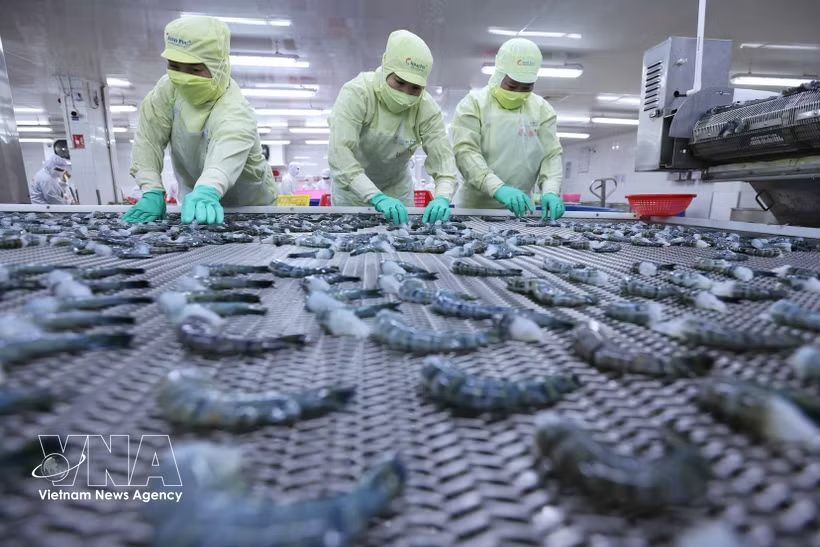
Freezing black tiger shrimp for export at a processing plant of the Minh Phu Seafood Corporation. (Photo: VNA)

Hanoi (VNA) – Vietnam’s seafood exports posted steady growth in the first quarter of 2026, reaching an estimated 2.64 billion USD, up nearly 8% year-on-year, supported largely by strong demand from China despite mixed performance across major markets.

Export turnover in March alone was estimated at around 927 million USD, increasing more than 5% compared to the same period last year. However, the Vietnam Association of Seafood Exporters and Producers (VASEP) noted that growth slowed considerably from the roughly 20% expansion recorded in the first two months, reflecting rising volatility in global seafood demand.

China remained Vietnam’s largest seafood importer during the quarter, with export value reaching approximately 764 million USD, surging nearly 45% year-on-year. In March alone, shipments to the market exceeded 250 million USD, marking growth of more than 50%.

The strong performance in China played a decisive role in maintaining overall sectoral growth as exports to several traditional markets, including the US, Japan and the Republic of Korea (RoK), declined.

According to Le Hang, Deputy Secretary General of VASEP, China emerged as the main growth driver thanks to seasonal consumption, stable demand and favourable logistics conditions. Lunar New Year consumption boosted imports of whole shrimp, live seafood and premium products from late 2025 through early 2026, contributing to sharp increases in high-value items such as lobster.

Demand in China’s mid- and high-end segments also remained resilient. Shrimp imports rose by about 18% in the first two months of the year, while tariff changes and supply disruptions affecting Canadian lobster created opportunities for alternative suppliers, including Vietnam.

Vietnamese exporters also benefited from geographic proximity and flexible supply chains, enabling them to respond quickly to short-term demand surges during peak consumption periods.

However, Hang cautioned that part of the strong growth reflected seasonal factors rather than long-term structural recovery. Increased exports were partly driven by stockpiling and festive demand, meaning growth could moderate in the coming months.

China’s growing influence also reshaped the industry’s export structure. In the shrimp segment, growth was largely driven by lobster, while whiteleg shrimp, Vietnam’s key product in the US and EU markets, remained largely flat, highlighting uneven recovery among product segments. Pangasius exports also relied heavily on China, which continued to serve as the largest consumption market for the product.

Other seafood categories, including crab, swimming crab and molluscs, benefited from rising demand across Asian markets. Meanwhile, tilapia exports maintained strong momentum following gains in 2025, with Q1 export value estimated at 35 million USD, soaring about 190% year-on-year.

Despite positive results, VASEP warned that heavy reliance on a single market carries risks. Changes in China’s import policies, border controls or quality regulations could quickly affect trade flows and lead to short-term export fluctuations. In addition, the market’s strong seasonality means demand may slow after the early-year peak, particularly if inventories rise.

Competitive pressure is also intensifying, especially from major suppliers such as Ecuador, reinforcing the need for Vietnam’s seafood industry to diversify export markets to ensure sustainable growth.

Meanwhile, recovery in other major markets remained limited. Seafood exports to the US fell by more than 10% in Q1, continuing to face weak demand and technical barriers, including Certificates of Analysis (COA) requirements under the Marine Mammal Protection Act (MMPA) and anti-dumping duties on shrimp. Exports to Japan and the RoK also declined by around 10%, reflecting subdued consumption.

Exports to the EU were largely unchanged, indicating stable but insufficient demand to drive growth, although opportunities remain for whitefish and sustainably certified products. On a positive note, ASEAN, Australia and several emerging markets maintained growth momentum, helping diversify export destinations.

VASEP forecasts seafood exports will continue to expand in the second quarter, though growth is expected to vary across markets and product categories. Shrimp and pangasius are likely to remain key growth pillars, while China, including Hong Kong, is expected to continue contributing significantly to export expansion.

In the context of persistent challenges in traditional markets, exporters are encouraged to diversify customers, prioritise nearby markets with logistical advantages, and maximise tariff incentives from free trade agreements (FTAs) to sustain growth momentum./.
VNA

See more

Household businesses and individual entrepreneurs with annual revenue of 500 million VND or less are not subject to personal income tax and are only required to declare their actual revenue. (Photo: VNA)

Expanding personal income tax exemptions to drive knowledge economy

The Ministry of Finance has recently released the draft for public feedback, with the decree expected to take effect from July 1. The draft specifies 21 categories of tax-exempt income, adding five, aimed at encouraging individuals working in priority sectors aligned with national development strategies.​

A woman in Ninh Bình province is livestreaming to sell local products. (Photo: VNA)

Cross-border e-commerce potential remains largely untapped

Despite the domestic e-commerce market reaching an estimated 31 billion USD in 2025, placing Vietnam among the world’s top 10 and top three in ASEAN, total import-export turnover via e-commerce stood at just 4.45 billion USD.

A filling station of Petrolimex. Increasing energy prices have pushed up production and logistics expenses, spreading cost pressures across multiple goods and service categories (Photo: VNA)

Fuel price surge puts mounting pressure on CPI: NSO

An official stressed the need for close monitoring, proactive responses, ensuring stable fuel supply, as well as stronger market surveillance to prevent unjustified price hikes following fuel increases.

Visitors to Vietnam Expo 2026, which opened at the Vietnam Exposition Centre (VEC) in Hanoi on April 8. (Photo: VNA)

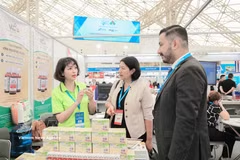
Vietnam Expo 2026 opens in Hanoi

A highlight of Vietnam Expo 2026 is the presence of numerous international pavilions, gathering trade promotion organisations, industry associations and enterprises from various countries and territories.

Delegates at the opening ceremony (Photo: VNA)

Textile industry expo gathers over 1,000 firms

Participating companies are showcasing a wide range of products and technologies across the textile and garment value chain, including machinery, equipment, fabrics, yarn, cotton, accessories and garment materials.

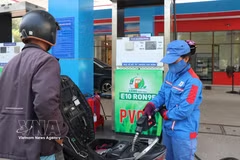
Tran Phu petrol station in Nghia Lo ward, Quang Ngai province, sells E10 petrol to local residents. (Photo: VNA)

Vietnam advised to build sustainable linkages for bioethanol production

According to the Vietnam Biofuels Association, the country currently operates six fuel ethanol plants with a combined designed capacity of approximately 600,000 cubic metres per year. At full capacity, these facilities could meet around 40% of the demand for E10 RON95 blending. However, securing sufficient feedstock to operate at full capacity continues to face considerable difficulties.

Delegates at the forum (Photo: VNA)

Vietnam–Russia Economic Forum highlights internal strength in new context

The Vietnam–Russia Economic Forum 2026 (VREF 2026), themed “Unleashing internal strength in the new era,” took place in Hanoi on April 8 in a hybrid format, bringing together scholars, policymakers, experts and business representatives to discuss economic development and strengthen bilateral cooperation in the evolving global landscape.

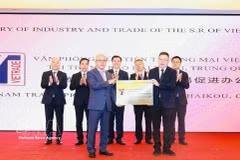
Representatives from Vietnam and China's Hainan province pose for a group photo at the inauguration ceremony (Photo: VNA)

Vietnam Trade Promotion Office inaugurated in China’s Haikou city

Leaders of the Vietnamese Ministry of Industry and Trade described the office as a concrete outcome of cooperation with the People’s Government of Hainan Province, following the Memoranda of Understanding signed a year earlier, enhancing economic and trade ties and establishing the Haikou office.

Product showcase area at AI Day 2026. (Photo: VNA)

Vietnam sees ample opportunities in AI-powered economy

The “Vietnam AI Economy 2025” report, released by the National Innovation Centre, Japan International Cooperation Agency (JICA), and Boston Consulting Group, puts hard numbers on the opportunity for the first time. It forecasts that AI could add up to 130 billion USD to Vietnam’s GDP by 2040, equivalent to roughly 25% of the country’s current economy.

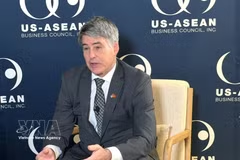
USABC President and CEO Brian McFeeters (Photo: VNA)

US businesses look to advance long-term investment in Vietnam

Despite ongoing global economic uncertainties, the size of the coming delegation reflects strong US business interest in expanding trade, investment, and long-term partnerships in Vietnam, as well as confidence in the country’s economic growth prospects.

The access road leading to the bridge on the Thieu Quang commune side under the Xuan Quang Bridge sub-project, part of the road project linking National Highway 1 with National Highway 45. (Photo: VNA)

Faster public investment disbursement crucial to growth targets

Public investment was a major contributor to the economy’s 7.83% GDP growth in the first quarter, achieved despite global uncertainties and rising input costs. Nonetheless, the figure fell short of the 9.1% growth scenario outlined in the Government’s Resolution No. 01/NQ-CP.

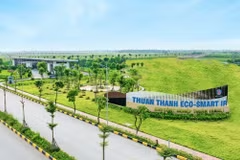
Thuan Thanh Eco-Smart IP is Viglacera’s first green, smart industrial park. (Photo: Viglacera)

Green industrial parks drive next-generation FDI

Ho Chi Minh City needs to strengthen investment in supply chain data systems, smart warehouses, regional logistics centres and inland container depots, while promoting stronger linkages between FDI firms, large domestic companies and small and medium-sized enterprises to support technology transfer and workforce development.