Hanoi (VNA) – Amid continued volatility in global energy prices, inflationary pressure is predicted to persist in the coming months, requiring closer coordination between regulators and businesses to stabilise prices while sustaining economic growth momentum.
Fuel prices drive CPI hike
Data from the National Statistics Office (NSO) under the Ministry of Finance show that the consumer price index (CPI) in March 2026 rose 1.23% month-on-month, 2.44% compared with December 2025 and 4.65% year-on-year – the highest March increase recorded in the past five years, signalling intensifying inflationary pressure.
The rise was mainly driven by domestic fuel prices following global market trends, alongside higher material and transportation costs. Increasing energy prices have pushed up production and logistics expenses, spreading cost pressures across multiple goods and service categories, the NSO said.
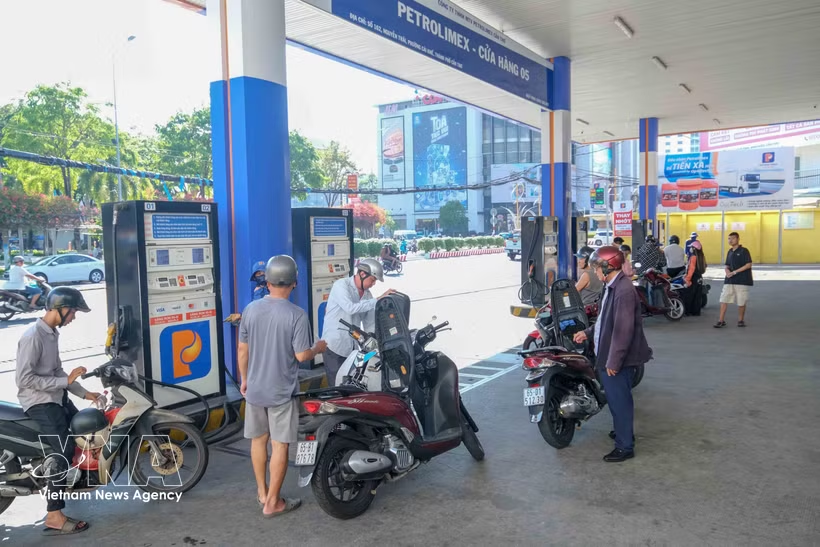
Among the 11 major categories of consumer goods and services, nine recorded price increases, led by transportation, which surged 12.85%. Petrol prices climbed 29.72% while diesel prices jumped 57.03% amid global energy supply disruptions linked to tensions in the Middle East.
Higher fuel costs also drove transport service prices sharply upward, with airfares rising more than 23%, rail transport nearly 14%, and waterway transport over 6%, exerting broad spillover effects on overall price levels.
Housing, electricity, water, fuel and construction materials rose 0.77%, with strong increases in kerosene prices (over 62%), gas prices (5.56%) and construction materials. Meanwhile, medicine and healthcare services edged up 0.38% due to higher imported input costs and service price adjustments in several localities.
In contrast, food and catering services declined 0.59%, with food prices falling 1.41%, helping to moderate CPI growth. Culture, entertainment and tourism prices also eased slightly as post-Tet consumer demand weakened.
Maintaining price stability
In the first quarter of 2026, CPI went up 3.51% year-on-year while core inflation rose 3.63%, indicating persistent underlying price pressures that require close monitoring.
According to the NSO, CPI growth was largely fuelled by essential goods. Housing and construction materials rose 5.69%, contributing 1.29 percentage points to overall CPI expansion, mainly due to a 6.55% increase in house rental prices and a 12.26% surge in construction materials amid stronger repair and building demand and rising input costs. Household electricity prices also climbed 5.55%, adding to living expenses.
Food and catering services rose 4.55%, contributing the largest share, 1.63 percentage points, to CPI. Pork prices increased 7.14% due to limited supply and higher farming costs, while poultry prices and dining-out services also rose amid higher input expenses.
Other groups such as education, beverages, household appliances, garments and tourism recorded modest increases in Q1, while transportation rebounded following the fuel price surge in March. Meanwhile, the information and communications group fell 0.2% thanks to declined technology equipment prices, partially offsetting inflation.
The NSO warned that if oil prices continue hiking due to geopolitical tensions, particularly in the Middle East, CPI could increase by an additional 1–2 percentage points, making the National Assembly’s inflation target of below 4.5% for 2026 more challenging.
Nguyen Thu Oanh, head of the NSO’s Price and Services Statistics Department, stressed the need for close monitoring and proactive responses. Tracking global and domestic fuel price movements and ensuring stable fuel supply are key to limiting price shocks. She also called for stronger market surveillance to prevent unjustified price hikes following fuel increases.
Based on the monitoring of input costs and essential goods supply, the statistics authority recommended that the Government consider support measures for businesses, including flexible fuel price governance, transport cost adjustments and reductions in logistics-related fees to ease inflationary pressure./.
See more
Reference exchange rate edges up on April 13
With the current trading band of +/- 5%, the ceiling rate applicable for commercial banks during the day is 26,361 VND/USD, and the floor rate 23,851 VND/USD.
Vietnam promotes tourism at travel expo in Canada
The Vietnamese Embassy in Canada joined the exhibition to promote Vietnam as an attractive travel destination. With support from domestic tourism companies and tour operators, the Vietnam booth attracted attention thanks to its well-designed displays and informative materials.
Phu Quoc set for a global spotlight with Sun Group–Dragone flagship show
The agreement signed on April 10 represents Dragone’s first formal entry into Vietnam through a strategic partnership, underscoring the country’s growing appeal to leading global creative companies. It also reinforces Sun Group’s role as a pioneer in bringing world-class performing arts experiences to Vietnamese audiences.
Work starts on Hanoi–Quang Ninh high-speed railway
Prime Minister Le Minh Hung attended a groundbreaking ceremony for the Hanoi - Quang Ninh high-speed railway line, Vietnam's first inter-regional high-speed railway, held in Quang Ninh province on April 12.
VinFast EV sales jump 127%, cementing market dominance
According to its report, all models in VinFast’s EV lineup recorded strong growth in March. Notably, on March 28 alone, the company completed 3,520 orders, the highest number ever recorded in a single day by an automotive brand in Vietnam.
Vietnam set to capitalise on global trade shifts
Vietnam ranks eighth worldwide in electronics exports and hosts more than 170 foreign-invested semiconductor projects, primarily in chip design, assembly, testing and packaging.
POSCO to invest over 400 million USD in battery materials plant in Thai Nguyen
Once completed, POSCO Future M's battery materials plant in Thai Nguyen province will have a designed capacity of 55,000 tonnes per year, serving as a key supplier of battery materials for leading electric vehicle manufacturers in the US, the EU and the Republic of Korea.
Ho Chi Minh City: Investment licences granted within 15 days under special mechanism
According to Deputy Head of HEPZA Le Van Thinh, the new policy comes as the city intensifies administrative reform, digital transformation, and efforts to enhance competitiveness in attracting investment into its export processing and industrial zones.
Investment deal signed for Ca Na LNG power plant, wharf projects
An investment agreement for the Ca Na LNG-fired power plant and a credit agreement for Ca Na Wharf Complex - Phase 1 in the south central province of Khanh Hoa, worth more than 60 trillion VND (2.3 billion USD) in total, were signed on April 10.
Australia announces import conditions for Vietnamese pomelos
Australia’s formal publication provides an important legal basis, marking the completion of the review, assessment and agreement on technical requirements for fresh Vietnamese pomelos. This represents a significant step forward in market access, creating favourable conditions for relevant agencies, localities and businesses to prepare for export activities in the coming time.
Can Tho cooperates with Japanese firms to develop clean energy project
Under the adjusted Power Development Plan VIII, the total rooftop solar power capacity in Can Tho is expected to reach 462 MW by 2030 and 1,405 MW by 2050.
First “green lane” durian shipment exported to China
Under the “green lane” process, quality control begins at the cultivation stage, including soil sampling and monitoring, and continues through harvesting and processing, with traceability labels attached to trees and applied to fruit at the time of picking. It also allows plant quarantine procedures and the issuance of certificates of origin (C/O) directly in the localities where the orchards are located.
Vietnam pushes for deeper auto supply chain ties with RoK
The RoK stood as Vietnam’s largest foreign investor with more than 95.2 billion USD in registered capital as of February 2026, or about 18% of all foreign cash flowing in, with thousands of active projects. In January-February alone, the RoK led the pack with nearly 2 billion USD in pledges, grabbing a whopping 32.7% of total registered capital and showing no signs of slowing down.
Energy security seen as future cornerstone of Vietnam’s growth drive
For Vietnam, the goal should extend beyond self-sufficiency. With the right approach, the country could position itself as a regional hub for energy production and storage, underpinning its long-term growth ambitions.
Digital transformation key to elevating Vietnam’s tourism: official
Speaking at the opening of the Vietnam International Travel Mart (VITM) 2026 in Hanoi on April 10, Deputy Minister of Culture, Sports and Tourism Ho An Phong noted that despite challenges in 2025, Vietnam largely fulfilled its socio-economic development goals. Tourism remained a bright spot, recording 21.5 million foreign arrivals and 135.5 million domestic visitors, with total revenue exceeding 1 quadrillion VND (37.9 billion USD).
Vietnam on track for FTSE upgrade, set to attract global capital inflows
The March review was largely procedural, confirming progress rather than introducing new decisions. However, it holds long-term structural significance, potentially unlocking 5–6 billion USD in passive inflows from exchange-traded funds (ETFs) tracking FTSE indices.
Public investment disbursement picks up pace in Q1
The first-quarter disbursement rate was 1.2 percentage points higher than in Q1 2025, while the total disbursed value jumped by roughly 30 trillion VND year-on-year.
Policy push enhances private sector’s role in economic growth
An official has highlighted improved conditions enabling private enterprises to take on a greater role in major national projects as a central outcome of Resolution No. 68.
Forum highlights cooperative–private sector linkages for sustainable growth
With an increasingly transparent and open institutional framework, cooperative-enterprise linkages will not only enhance production efficiency and value chains but also contribute to sustainable development, improved livelihoods and a more resilient national economy.
Vietnam, India step up cooperation to build sustainable footwear value chain
The two economies are highly complementary, with India holding advantages in raw materials while Vietnam excels in manufacturing and exports, creating ample opportunities for deeper integration into global value chains.