Vietnam, RoK team up on sci-tech, innovation at Hanoi forum

The event focused on matching demand, forging partnerships and accelerating concrete joint projects to deliver actual results for both economies.

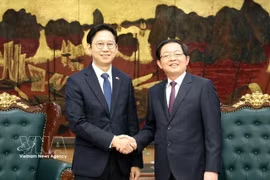
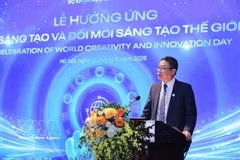
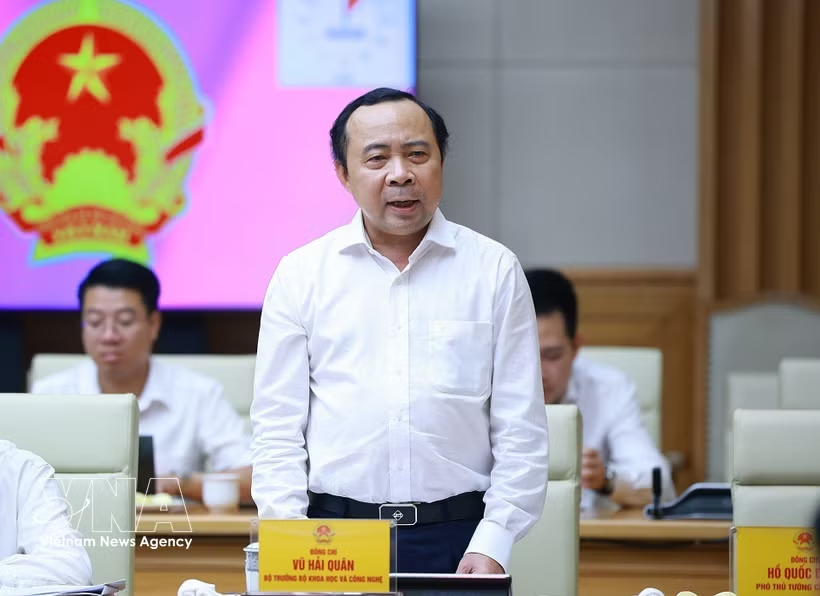
Minister of Science and Technology Vu Hai Quan (Photo: VNA)

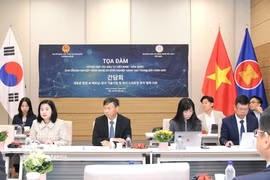
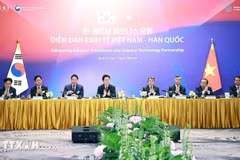
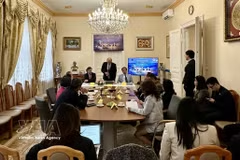
Hanoi (VNA) – The Vietnam – Republic of Korea (RoK) forum on science, technology and innovation, part of the state visit to Vietnam by RoK President Lee Jae Myung, took place in Hanoi on April 24.

Co-chaired by Vietnamese Minister of Science and Technology Vu Hai Quan and RoK Deputy Prime Minister and Minister of Science and ICT Bae Kyung Hoon, the event focused on matching demand, forging partnerships and accelerating concrete joint projects to deliver actual results for both economies.

Advancing strategic technology development

In his opening speech, Quan said science, technology, innovation, and digital transformation have been designated as one of the top pillars of bilateral cooperation in the time ahead. Both sides agreed to deepen collaboration, with a focus on delivering concrete products.

The two ministries will increase the sharing of experience in building and rolling out strategic technology portfolios, thus maximising similar development goals, he noted.

At the same time, the Korea Institute of Science and Technology (KIST) and the Vietnam – Korea Institute of Science and Technology (VKIST) will beef up cooperation. VKIST is expected to pilot breakthrough policies in science – technology and innovation, while KIST will lend a hand on strategy development and policymaking to turn VKIST into a flagship symbol of bilateral teamwork in these fields, he said.

Manpower training in science and technology was highlighted as a top priority to produce skilled experts and scientists capable of mastering and integrating advanced technologies. The minister noted that both sides have largely agreed on these priorities, setting a strong foundation for future collaboration.

Echoing these views, Bae said both sides will push harder on strategic cooperation, develop VKIST into a central hub, and expand the collaboration network nationwide to promote such areas as artificial intelligence, semiconductors, and high technology while accelerating the commercialisation of research outcomes.

Expanding cooperation mechanisms

Prof. Dr Tran Hong Thai, President of the Vietnam Academy of Science and Technology (VAST), said the academy isn’t just about pure scientific research; it has engaged in developing core technologies, setting technology priorities, linking innovation ecosystems, and advising on policy.

VAST has already teamed up with several Korean partners, including Chungnam National University, Seoul National University, Wonkwang University, KIST and the Korea Research Institute of Chemical Technology, creating a strong base for joint research and training.

In hydrogen technology, while VAST has conducted initial studies on storage materials and carriers, mainly at laboratory scale, the RoK has developed a relatively complete ecosystem from research to real-world application. This provides a basis for expanded cooperation linking research with technology development and pilot projects.

Similarly, in biopharmaceuticals and cosmetics, VAST boasts strengths in natural compounds, organic synthesis, microbiology, and cell technology, but it still lags in deep processing, formulation, and bringing products up to international standards, exactly where the RoK has serious expertise.

Based on these strengths, VAST is ready to connect research institutes, universities and companies; launch joint studies, labs and manpower training; and make better use of existing cooperation mechanisms like the Korea International Cooperation Agency (KOICA) and the VKIST model, he said.

At the event, participants highlighted the importance of introducing new ways to collaborate such as joint postgraduate programmes in advanced technologies, increasing scientist exchanges between institutes and businesses, attracting foreign experts, and encouraging companies to invest directly in university labs and training facilities.

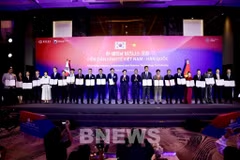
On the occasion, the Vietnamese Ministry of Science and Technology and KOICA signed a record of discussion on the VKIST project, kicking off its second phase. The project will roll out under the framework agreement on non-refundable aid signed between the two governments on May 29, 2009. The second phase is expected to use about 30 million USD in grant aid from the Korean Government and run through 2033./.

VNA

See more

Vietnamese Prime Minister Le Minh Hung and the Republic of Korea's President Lee Jae Myung attend an economic forum in Hanoi on April 23. (Photo: VNA)

SK Group partners to build AI ecosystem in Vietnam

SK Innovation and SK Telecom signed MoUs with Nghe An province and the National Innovation Centre of Vietnam to advance AI ecosystem development and support the country’s long-term growth strategy.

CMC signs an AI cooperation deal with Korean partner FuriosaAI (Photo: CMC)

CMC signs AI cooperation deal with Korean partner

Under the agreement, CMC Global - a member of CMC Corporation - and FuriosaAI will collaborate on developing AI application software, leveraging their respective technological strengths and customer ecosystems to roll out joint projects in the coming period.

Deputy Minister of Science and Technology Le Xuan Dinh delivers opening remarks at the launching ceremony of the Scientific Innovation Competition 2026 on April 21. (Photo: VNA)

Scientific Innovation Competition opens to OVs, boosting global talent linkages

In response to World Creativity and Innovation Day 2026, the contest provides a platform for individuals and teams nationwide who are passionate about research, creativity, and practical application of science, while promoting a movement of scientific inquiry within the community, particularly among young people.

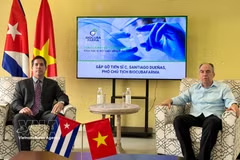
Dr. Santiago Dueñas Carrera (left), Vice President of Cuba’s BioCubaFarma group, and Cuban Ambassador to Vietnam Rogelio Polanco Fuentes at the press briefing in Hanoi on April 21 (Photo: VNA)

Biotechnology cooperation – new driver of Vietnam - Cuba relations

A representative from BioCubaFarma emphasised that the longstanding Vietnam – Cuba friendship provides a solid foundation for further advancing comprehensive cooperation, especially in science and technology – a key driver of socio-economic development and national healthcare sovereignty.

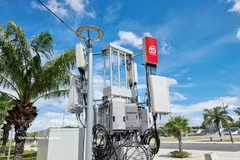
A Viettel 5G base station in Dong Hai ward, Khanh Hoa province (Photo: VNA)

Vietnam develops digital infrastructure aligned with demands of AI era

The data centre and cloud computing sector is entering a phase of redefinition. Infrastructure is no longer merely a backbone for data storage and processing, but is evolving into a foundational platform powering complex digital ecosystems—from AI and advanced analytics to real-time applications.

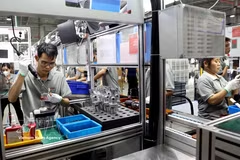
Workers manufacture products at Keystone Electrical Vietnam Co., Ltd. in the Lien Ha Thai industrial park. (Photo: VNA)

Vietnam turning ideas into value, aspirations into reality

Resolution No. 57 of the Politburo on breakthroughs in science-technology development, innovation, and national digital transformation is being vigorously implemented nationwide. Within this framework, innovation is increasingly recognised as a key engine for rapid and sustainable growth.

MK Smart achieves Common Criteria EAL5+ Certification, expanding opportunities in global digital identity

MK Smart achieves Common Criteria EAL5+ Certification, expanding opportunities in global digital identity

As countries accelerate the development of digital governments, electronic identification (eID) and electronic passports (ePassport) are becoming essential infrastructure. At the same time, security requirements are becoming increasingly stringent security requirements, particularly for systems that store sensitive data such as citizens’ identity and biometric information.

Sorting fish prior to transport for distribution. (Photo: VNA)

Fishermen keep pace with digital technology

Across central coastal provinces, authorities have introduced policies to restructure fleets, reduce vessel numbers, and support fishermen in transitioning to more sustainable livelihoods. Provinces such as Dak Lak and Gia Lai have earmarked nearly 1 trillion VND to support occupational changes and decommission inefficient vessels, while others including Nghe An, Quang Tri, Hue, and Quang Ngai are implementing roadmaps to phase out thousands of underqualified boats.

Phuc Loi ward in Hanoi has launched the “Digital Literacy for All” movement, forming support teams to help residents install applications such as iHanoi and eTax. (Photo: VNA)

Hanoi advances technological innovation in key economic sectors

The municipal People's Committee recently issued Plan No. 109/KH-UBND on technological innovation in key economic sectors through 2035, which serves as both a catalyst and a strategic move to systematise, elevate and reinforce the capital’s leading role in the digital era.

General Secretary of the Communist Party of Vietnam (CPV) Central Committee and State President To Lam (first, right, front row) listens to a presentation about the China-ASEAN AI Application Cooperation Centre (Photo: VNA)

Top Vietnamese leader visits China–ASEAN AI Application Cooperation Centre

The China–ASEAN AI Application Cooperation Centre, jointly established by the Guangxi Zhuang Autonomous Region and ASEAN countries, aims to promote inclusive and mutually beneficial development of AI globally. It is regarded as a flagship project in advancing the “Digital Silk Road” initiative in Nanning.

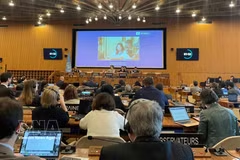
A view of the 224th session of the UNESCO Executive Board in Paris. (Photo: VNA)

UNESCO extends recognition of 2 Category II science centres in Vietnam

The continued operation and enhancement of the two Category II centres under UNESCO’s auspices reflect Vietnam’s policy of positioning science, technology and innovation as key drivers of development, while closely linking scientific advancement with deeper and more substantive international integration in the current context.

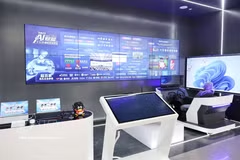
China–ASEAN Artificial Intelligence Application Cooperation Centre deeply integrates future technologies with distinctive ASEAN cultural characteristics. (Photo: VNA)

China–ASEAN AI cooperation centre drives regional tech cooperation

With strong policy support and growing participation from businesses and research institutions, the China–ASEAN Artificial Intelligence (AI) Application Cooperation Centre is expected to act as a digital bridge, promoting technological integration and opening new avenues for Vietnam–China cooperation in the digital era.

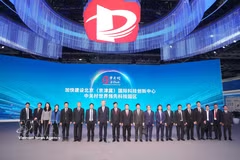
Politburo member and Chairman of the Party Central Committee’s Organisation Commission Nguyen Duy Ngoc (ninth, left) and the Vietnamese delegation pose for a group photo with leaders of the Zhongguancun Science Park and Beijing city. (Photo: VNA)

Vietnam, China step up cooperation in science, technology, innovation

Politburo member and Chairman of the Party Central Committee’s Organisation Commission Nguyen Duy Ngoc, who also serves as Standing Deputy Head of the Central Steering Committee for the Development of Science, Technology, Innovation and Digital Transformation, toured the park’s exhibition area and was briefed on the formation and development of Zhongguancun, along with Beijing’s achievements in science, technology and innovation.