Hanoi gears up for tourism boom during national holidays

For Hanoi tourism sector, the national holidays to commemorate Hung Kings (April 25-27), along with the national reunification celebration (April 30) and the Labour Day (May 1) are not only a peak time for welcoming visitors but also a test of its operational capacity, service organisation, and destination quality in the context of a volatile market.

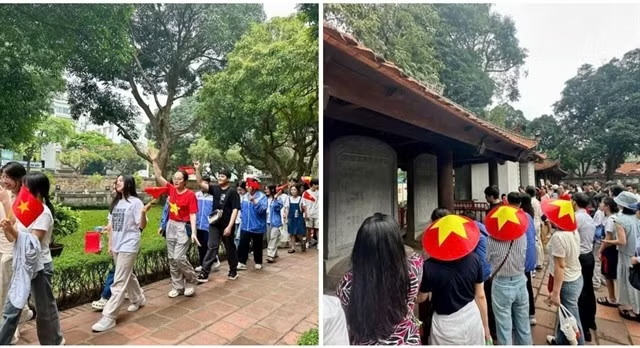
Visitors at Van Mieu - Quoc Tu Giam (The Temple of Literature) in central Hanoi. (Photo: hanoi.gov.vn)

Hanoi (VNS/VNA) - Hanoi’s tourism sector is expecting a sharp rise in holiday revenue as it rolls out a clearer growth strategy focused not just on visitor numbers but on the “depth of value”.

Dang Huong Giang, Director of the city’s Department of Tourism, said the strategy aims not only to attract more visitors during the holidays but also to extend their stays, increase spending and enhance overall visitor experience.

A scenario has been built based on the strong results from the first quarter of this year, with 8.82 million visitors and total revenue reaching nearly 37 trillion VND (over 1.4 billion USD).

The national holidays to commemorate Hung Kings (April 25-27), along with the national reunification celebration (April 30) and the Labour Day (May 1), have long been a "golden period" for the tourism industry.

For Hanoi tourism sector, this is not only a peak time for welcoming visitors but also a test of its operational capacity, service organisation, and destination quality in the context of a volatile market.

According to the city official, annual holidays always promise a great opportunity for the tourism sector to accelerate its growth.

However, in the context of increasingly fierce competition between destinations, Hanoi should not target only increasing the number of tourists, but also extending the length of visitors' stay and increasing their spending.

One of the biggest challenges for tourism industry is the travel costs, especially the high price of air tickets due to global fuel price rise.

According to a recent tourism analysis, airfare currently accounts for about 30-40 per cent of tour prices, directly impacting tourists' travel plans.

Quality over quantity

The sector is implementing a series of measures to strengthen management, enhance service quality, and tighten market oversight, according to Giang.

The department has issued official directives requesting tourism areas, attractions, accommodation establishments, restaurants and travel enterprises to proactively develop service plans, diversify tourism products and introduce additional experiential activities to meet the expected surge in demand during the peak holiday period.

The focus is placed on improving service quality, ensuring security and safety and fostering a friendly destination image for visitors to Hanoi.

Tourism businesses are required to publicly list prices, strictly sell at posted rates, and are prohibited from practices such as customer solicitation or price gouging. Inspection and supervision activities have also been intensified, particularly at crowded tourist sites, to promptly detect and address violations, thereby protecting tourists’ rights and interests.

Accommodation facilities and restaurants are encouraged to upgrade their premises, create distinctive experiential highlights, and further enhance service quality to improve overall visitor satisfaction during the holiday peak.

The city has also launched around 80 new tourism products focusing on programmes such as Con Duong Dao Hoc (The Scholarly Path) and the night tour themed Hao Khi Thanh Giong (The Heroic Spirit of Saint Giong).

A variety of cultural, festival and entertainment activities are also being organised at Van Mieu-Quoc Tu Giam (The Temple of Literature), the Vietnam National Village for Ethnic Culture and Tourism, as well as pedestrian streets and food spaces, helping to extend visitors’ length of stay and enhance overall travel experiences.

These products have a common goal of helping visitors experience the depth of local culture and history, while also attracting them to stay longer.

In the long term, Hanoi is focusing on expanding tourism space to suburban areas such as Ba Vi, Soc Son and Son Tay and developing ecological, resort and community-based tourism products to reduce pressure on the city centre.

The city is also promoting digital transformation and building a smart tourism ecosystem, gradually improving competitiveness and moving toward modern sustainable tourism development.

As the holiday season approaches, Hanoi is making clear that its tourism growth will be measured not just in numbers, but in value./.

VNA
See more

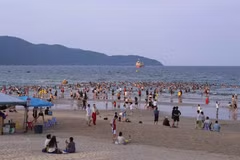
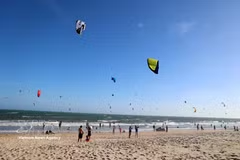
Da Nang beach attracts a large number of visitors (Photo: VNA)

Da Nang draws visitors with vibrant lineup of beach festivals, cultural events

Since mid-April, the city has rolled out a series of cultural and artistic programmes across various venues. Among the highlights are the exhibitions “Sac mau Dat Quang,” held from April 15 to May 5 at the Da Nang Fine Arts Museum, and “Giao diem Viet Nam,” running from April 17 to May 17 at the Da Nang Museum. These exhibitions offer multi-dimensional perspectives on culture, people and contemporary life.

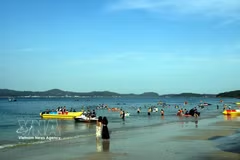
A beach in Co To (Photo: VNA)

Quang Ninh gears up for peak summer tourism surge

Quang Ninh has already hosted a string of large-scale concerts this year, attracting hundreds of thousands of attendees. It is set to stage the Summer Culture, Sports and Tourism Week from April 25-May 3, featuring music, sports, and food events. The centerpiece Ha Long Carnaval 2026, themed “Wonders Shining in a New Era”, is expected to pull in more than 80,000 visitors.

At Noi Bai International Airport in Hanoi (Photo: VNA)

Air travel demand holds steady during Hung Kings, April 30-May 1 holidays

Despite volatility in aviation fuel prices triggered by tensions in the Middle East, flexible Government policies, particularly measures by the Ministry of Construction to cut fuel-related taxes, fees and infrastructure costs, helped maintain stable operations across the sector. As a result, no broad ticket shortages emerged.

A representative of Anex Tour Vietnam presents a conical hat to the first passengers arriving in Da Nang from Vladivostok. (Photo: VNA)

Da Nang welcomes first flight from Vladivostok

According to the plan, the programme will run from April 16 to October 23, connecting eight cities across Russia, the CIS, and Belarus with Da Nang. The total number of visitors is expected to reach approximately 25,500, with a maximum frequency of 36 flights per month, equivalent to around 4,800 passengers monthly.

Visitors explore and experience the cultural space of Lo Lo Chai village in Lung Cu commune, Tuyen Quang province. (Photo: qdnd.vn)

Administrative expansion unlocks new momentum for tourism development

Nguyen Thi Hoai, Deputy Director of the Department of Culture, Sports and Tourism of Tuyen Quang, said the expansion of administrative boundaries has opened up new development space for the province, with key tourism products including cultural-historical tourism, ethnic cultural experiences, community-based tourism linked to scenic sites, spiritual tourism, and other distinctive experiential offerings.

At Thung Nham ecological tourism site in Ninh Binh province. (Photo: VNA)

Vietnam’s tourism defies fuel price shock with record Q1 “hat-trick”

According to data released by the National Statistics Office, foreign arrivals in March reached nearly 2.1 million, up 1.3% year-on-year. In total, Vietnam welcomed an estimated 6.76 million foreign tourists in the first quarter, a more than 12% jump from the same period in 2025 and the highest Q1 figure ever recorded.

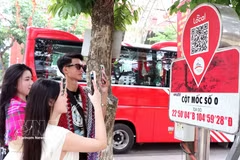
Visitors scan QR codes at Km0 Ha Giang to access tourism information. (Photo: VNA)

Technology powers tourism growth in mountainous province

Last year, Tuyen Quang welcomed over 3.9 million visitors, and is aiming to attract around 4.1 million arrivals, including around 600,000 foreigners, this year. Tourism continues to be identified as a key economic sector, with development oriented toward sustainability, green growth, and enhanced competitiveness through digitalisation.

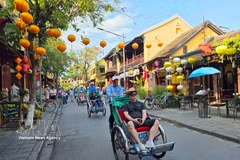
Tourists enjoy a rickshaw tour of Hoi An Ancient Town, Da Nang city. (Photo: VNA)

ITE HCMC 2026 to promote Vietnam’s tourism on global map

With its large scale, the ITE HCMC 2026 aims to promote tourism cooperation between Vietnam and priority markets such as Northeast Asia, Western Europe, North America, Southeast Asia, and Oceania while also boosting visitor arrivals from the Indian market

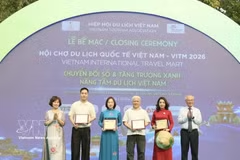
The organisers of VITM 2026 honour sponsors. ( Photo: VNA)

VITM 2026 boosts tourism demand ahead of peak season

According to the organisers, around 4,500 representatives from Vietnamese and international tourism enterprises attended the event, generating more than 25,000 business meetings and partnership exchanges. Approximately 15,000 discounted tours and travel products were offered to visitors.

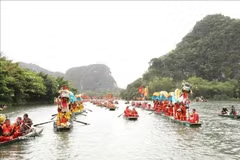
Traditional dragon procession held on the river in Ninh Binh. (Photo: VNA)

Cultural heritage drives sustainable tourism growth in Ninh Binh

In the first two months of 2026, Ninh Binh welcomed over 5.4 million visitors, up 9.9% year-on-year, generating nearly 5.84 trillion VND (221 million USD) in tourism revenue, up 15.9%. During the 2026 Lunar New Year holiday alone, the province received 2.38 million visitors, an 81.4% increase from the previous year, ranking second nationwide.

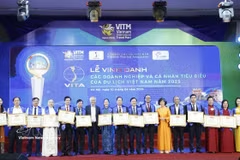
Outstanding individuals and firms honoured at VITM 2026 (Photo: VNA)

Outstanding individuals, firms honoured at Vietnam International Travel Mart 2026

In 2025, Vietnam’s tourism sector recorded its highest-ever number of visitors, welcoming more than 21.5 million international arrivals, up more than 20% from 2024, and serving over 135.5 million domestic travellers. Tourism revenue also surpassed 1 quadrillion VND (nearly 38 billion USD). The sector has become a bright spot of the economy, with Vietnam ranking among the world’s fastest-growing tourism destinations.

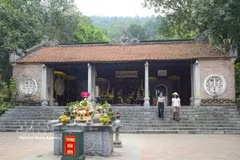
The Ba Trieu Temple in Thanh Hoa province (Photo: VNA)

Thanh Hoa taps digital transformation to boost heritage tourism

With 28 nationally-recognised intangible cultural heritage elements, Thanh Hoa province has prioritised integrating conservation with tourism development. Digital transformation, in particular, is seen as a crucial bridge connecting tradition with innovation, helping heritage sites become more accessible and engaging.