Cultural export: a lever to elevate Vietnamese brands

When products become cultural ambassadors, Vietnamese goods can travel further and leave a lasting imprint on international consumers.

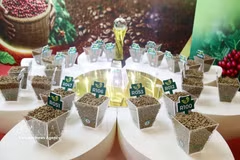
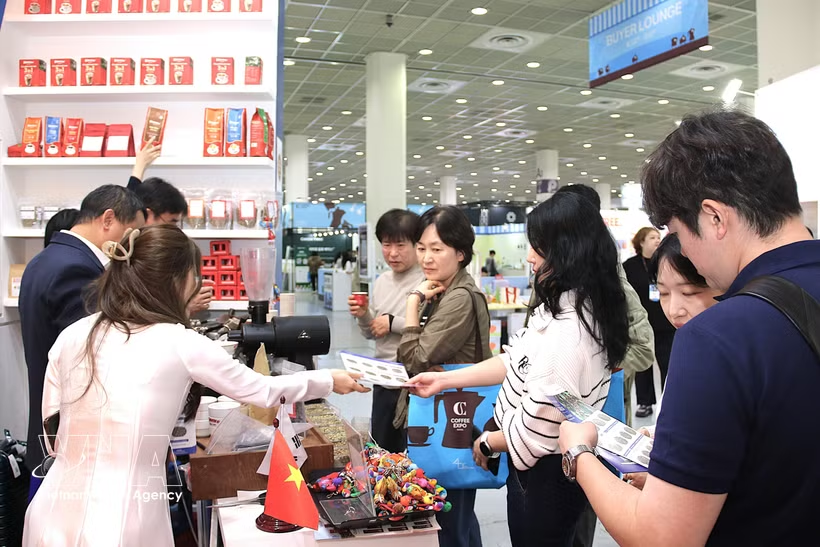
Vietnamese coffee showcase at Coffee Expo Seoul 2026. (Photo: VNA)

Hanoi (VNA) – As global competition shifts from price to value, embedding cultural identity into products is emerging as a strategic pathway for Vietnamese goods to stand out, positioning the country to transform its rich cultural assets into commercial strength in line with the Politburo’s Resolution 80-NQ/TW on cultural development.

The resolution charts a clear course to integrate culture into economic, trade and external activities, thereby expanding markets while strengthening national competitiveness. It reflects a fundamental shift towards exporting products that deliver distinctive value. In this strategy, culture is not only a spiritual foundation but also a “language” through which Vietnamese products tell their stories to the world.

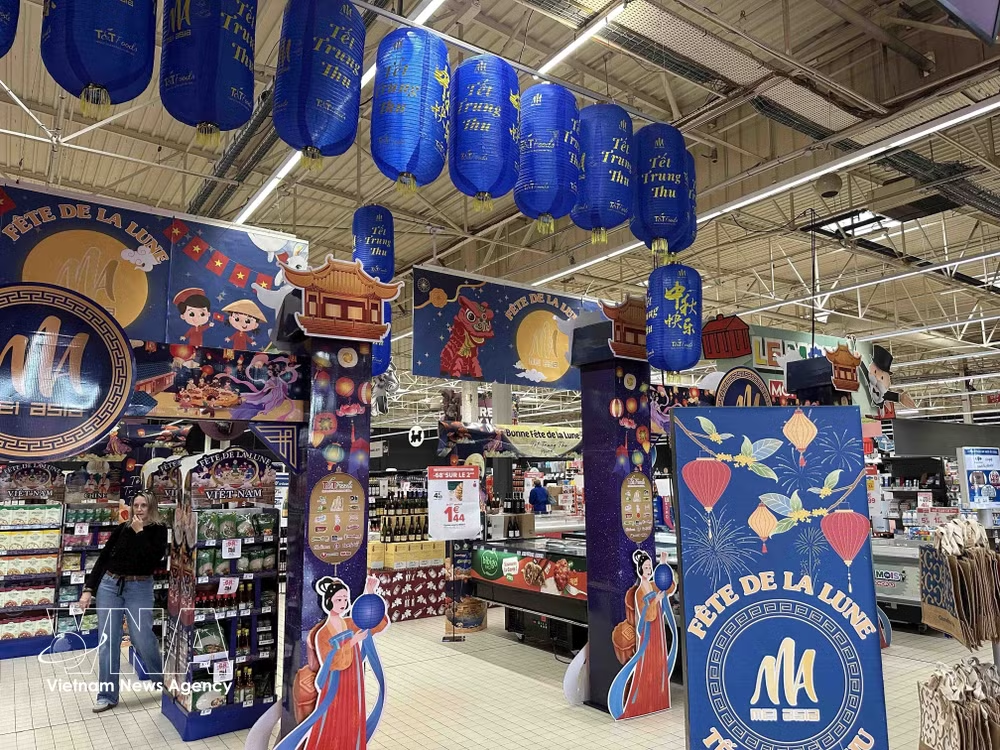
In practice, Vietnam’s trade offices abroad are increasingly acting as “dual ambassadors”, promoting commerce while disseminating culture. Promotional activities have evolved from simple supply – demand matching into immersive cultural experiences. Vietnamese goods weeks at major distribution networks in Europe, particularly in France, have moved beyond product displays to become vibrant showcases of Vietnamese culture.

These events transform retail spaces into experiential venues, where symbols such as lotus flowers, conical hats, traditional Tet celebrations and Vietnamese cuisine forge emotional connections with consumers. The shift from material consumption to experiential engagement is helping to sustainably elevate the value of Vietnamese products.

In Cambodia, a different approach is being adopted, with culture conveyed through knowledge-based products such as publications on Vietnam’s investment environment, contributing to a dynamic and open national image while expanding outreach to international partners.

Meanwhile, businesses are also innovating by embedding cultural elements into their products. Nonla Vietnam Global, for instance, has turned coffee into a cultural statement through conical hat-inspired designs, ao dai-themed packaging and distinctive flavours such as durian, salted and egg coffee, boosting brand recognition in international markets. Its products are now available across major retail systems and global e-commerce platforms such as AEON, Amazon and Shopify.
vnanet-potal-khai-truong-tuan-le-hang-viet-nam-lan-dau-tien-tai-vung-dai-dong-nuoc-phap-8311152.jpg
Display space for Vietnamese products at Carrefour Verdun supermarket in France. (Photo: VNA)

The integration of cultural industries with trade, alongside the development of creative content such as mascots and animation, is enabling brands to maintain deeper engagement with consumers. More broadly, cultural elements are creating hard-to-replicate differentiation, offering Vietnamese goods a sustainable competitive edge in increasingly demanding markets.

However, turning cultural export into an effective strategy will require coordinated efforts. Stronger cooperation is needed among regulators, trade offices and businesses to build a unified national message, ensuring that products and promotional activities contribute to a cohesive Vietnam brand rather than fragmented narratives.

At the same time, companies must invest more systematically in design, creativity and market research to ensure cultural stories resonate with specific audiences. Culture cannot be imposed; it must be translated into forms that global consumers can understand and relate to. This presents both a challenge and an opportunity to enhance the creative capacity of Vietnamese enterprises.

Furthermore, cultural industries should be positioned as a pillar of the export strategy. When cultural products, from cuisine and fashion to digital content, are properly developed, they not only support goods exports but also emerge as high-value economic sectors in their own right.

In the new era of globalisation, a national brand is defined not only by export figures but also by its ability to connect with the emotions and perceptions of global consumers. Cultural export, therefore, is not just an economic strategy but a journey to affirm Vietnam’s identity and standing on the world stage. When products become cultural ambassadors, Vietnamese goods can travel further and leave a lasting imprint on international consumers./.
VNA

See more

An Ao Dai performance at the event. (Photo: VNA)

Vietnamese cultural spirit shines through Ao Dai festival in Europe

Themed “the essence of Vietnamese Ao Dai", the event featured 19 performances and cultural activities, including ao dai showcases, musical performances, art exhibitions and interactive cultural spaces, offering audiences a vivid glimpse into Vietnamese culture in the heart of Europe.

A performance at the show (Photo: VNA)

Vietnamese water puppetry draws crowds in Laos

Following two sold-out shows in Vientiane, Vietnam’s traditional water puppetry continued to pull in strong audiences. The 700-seat auditorium of the Savannakhet provincial cultural house was filled to capacity on both floors well before the show began.

Meritorious Artisan Nguyen Thi Oanh (Photo: VNA)

Couple saves 500-year-old Dong Ho painting art from extinction

Born in Bac Ninh province’s Dong Khe residential area half a millennium ago, Dong Ho painting hit its roaring peak in the 1940s, when 17 family clans churned out vividly coloured, all-natural works for spiritual, festive and daily rituals, especially the Lunar New Year

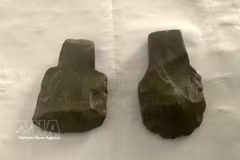
Soldier Tran Thanh, a member of the Hoang Dieu Citadel National Salvation Youth Union, carries a lunge mine to destroy enemy tank on the streets of Hanoi on December 23, 1946, during the early days of the nationwide resistance war. (File photo: VNA)

Nghe An to host exhibition featuring President Ho Chi Minh’s call for national resistance

This is an important political and cultural event that celebrates the lasting historical significance of President Ho Chi Minh's call for national resistance, while highlighting the vision, determination, and intellectual strength of the Party and the Vietnamese people during a pivotal moment in history. The exhibition also aims to celebrate the late President’s 136th birth anniversary (May 19, 1890 - 2026).

Tthe DIFF 2026 stage has been designed around the concept of convergence, inspired by the image of converging horizons where cultures, time, and emotions meet (Source: DIFF)

DIFF 2026 set to mark breakthrough in stage scale, performance technology

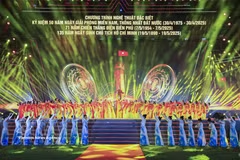
The DIFF 2026 stage has been designed around the concept of convergence, inspired by the image of converging horizons where cultures, time, and emotions meet. With a width of up to 100 metres and a total area of nearly 1,200sq.m, the stage is considered the largest in the history of DIFF.

Vietnam's national U17 football team defeat United Arab Emirates national U17 football team 3-2 in the final Group C match of the AFC U17 Asian Cup 2026 in Saudi Arabia on early May 14. (Photo: VFF)

Vietnam secure berth at FIFA U17 World Cup 2026 for first time

Vietnam national U17 football team secured a place at the FIFA U17 World Cup 2026 for the first time after defeating United Arab Emirates national U17 football team 3-2 on in the final Group C match of the AFC U17 Asian Cup 2026 in Saudi Arabia on early May 14 (Vietnam time).

Vietnamese Minister of Culture, Sports and Tourism Lam Thi Phuong Thanh and Lao Minister of Culture and Tourism Suonsavan Vignaket exchange the signed culture and tourism cooperation scheme for 2026–2030. (Photo: VNA)

Vietnam, Laos ink 2026–2030 culture-tourism cooperation plan

Both sides pointed to substantive, positive outcomes in cultural and tourism cooperation from 2021-2025, citing successful cultural weeks in each country, cultural and art activities marking important occasions of the two Parties and countries, and the effective delivery of agreements reached by leaders that further fostered the special Vietnam–Laos relationship.

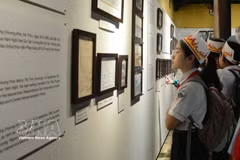
Students visit the photo exhibition. (Photo: VNA)

Vietnam, RoK photo exhibition highlights cultural connections

Among the displayed works, 60 photographs introduce the modern RoK with its rich cultural depth and spectacular natural landscapes, while 40 others vividly portray the beauty, cultural identity and ongoing development of Dak Lak and Vietnam’s Central Highlands region.