Ngoc Lang Nam Hai in Ho Chi Minh City highlights deep-rooted whale worship

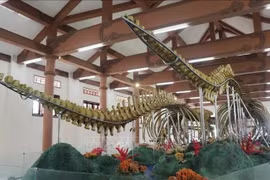
Ngoc Lang Nam Hai in Ho Chi Minh City, widely known as the whale cemetery, has become a distinctive spiritual and cultural landmark for coastal residents, reflecting a long-standing belief system deeply intertwined with the lives of fishing communities.

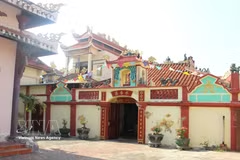
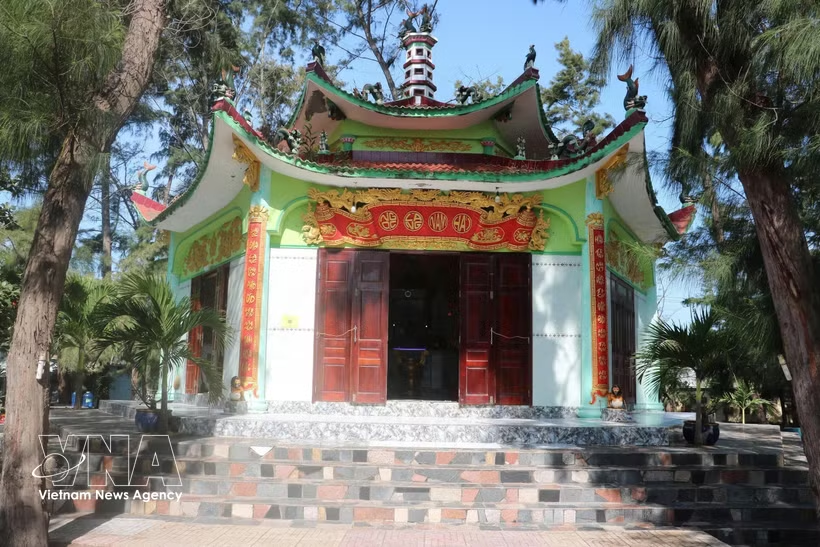
The Whale God temple is a place of worship located within Ngoc Lang Nam Hai in Ho Chi Minh City. (Photo: VNA)

Ho Chi Minh City (VNA) – Ngoc Lang Nam Hai in Ho Chi Minh City, widely known as the whale cemetery, has become a distinctive spiritual and cultural landmark for coastal residents, reflecting a long-standing belief system deeply intertwined with the lives of fishing communities.

Nestled beneath rows of casuarina trees along the breezy coastline of Phuoc Hai commune, the site serves as the resting place of whales—revered by fishermen as “Ong” (the Whale God) or “Nam Hai Deity.” For generations, whales have been regarded as sacred beings believed to rescue fishermen in distress at sea.

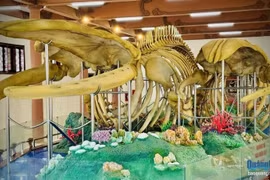
The cemetery was established in 1991 on an area of about 6,000 sq m near the fishing village. Recognised in 2011 as the largest whale cemetery in Vietnam, it is now home to around 50 whale graves. Each burial follows solemn rituals conducted by fishermen whenever a whale is found stranded ashore or caught in fishing nets offshore.

Le Van Khoi, caretaker of the cemetery, said local fishermen promptly notify the fishing community upon discovering a stranded whale so that proper funeral rites can be held. Whales are honoured like family members, with ceremonies expressing gratitude and prayers for safe voyages and abundant catches. According to tradition, after three years, the remains are exhumed and transferred to the nearby Nam Hai Temple for continued worship.

For local fishermen such as Nguyen Van Hai, spiritual practices remain an integral part of daily life. Before heading out to sea, he visits Ngoc Lang Nam Hai to offer incense and pray for favourable weather and a safe journey.

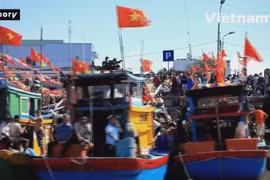
Each year, on the 15th, 16th and 17th days of the second lunar month, fishermen in Phuoc Hai fishing village hold the Nghinh Ong (whale worshipping) Festival — the locality’s largest event—praying for peace and good fortune while reflecting the close bond between spiritual life and the livelihoods of coastal communities.

Beyond its spiritual significance, the whale cemetery reflects the cultural depth of coastal communities. Researchers note that the whale worship ritual originated from the Cham people’s culture before being integrated into the coastal life of Vietnamese people, becoming a defining feature of many fishing villages nationwide. Each year, about 15 - 20 whales are brought ashore and buried at the site by local fishermen.

According to Nguyen Hong Phuc, Vice Chairman of the Phuoc Hai communal People’s Committee, the whale cemetery and the Nghinh Ong Festival represent a distinctive spiritual space and a powerful cultural symbol tied to the history and development of the local fishing village. These values, he said, hold strong tourism appeal.

Efforts are underway to preserve and promote the site in tandem with tourism development. Local authorities are upgrading a traditional fisheries exhibition house, enhancing display spaces, and creating experiential areas showcasing fishing tools and practices. Digital technologies and communication campaigns are also being expanded to promote the cemetery and the festival to visitors./.
VNA

See more

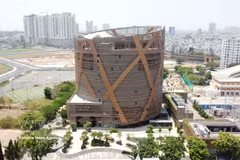
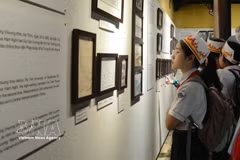
The display space of the archival photo exhibition “Echoes of a New Era” at the Imperial Citadel of Thang Long. (Photo: VNA)

Exhibition traces Vietnam’s post-reunification journey

Showcasing more than 70 documentary images, the exhibition highlights Vietnam’s journey from the 1975 Spring Victory through the early years of recovery and reconstruction, with a spotlight on the nationwide general election on April 25, 1976.

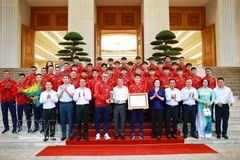
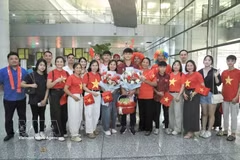
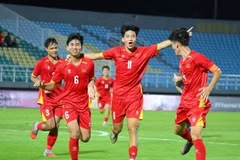
Prime Minister Le Minh Hung and members of Vietnam’s national U17 men’s football team pose for a group photo. (Photo: VNA)

PM hails U17 football team’s ASEAN triumph, sets sights higher

Presenting a certificate of merit to the team, the PM praised their championship run as a compelling and remarkable journey marked by resilience, determination, and a strong competitive spirit. The team remained unbeaten throughout the tournament, recording four wins and one draw while scoring 19 goals.

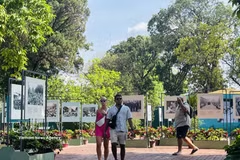
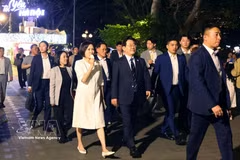
President of the Republic of Korea Lee Jae Myung and his spouse take a stroll around Hoan Kiem Lake in Hanoi during a visit to Vietnam in April 2026. (Photo: VNA)

Vietnamese cuisine gains global spotlight through leaders’ street food moments

In recent years, Vietnamese dishes have gained wider global recognition through travellers and international rankings. A social media group named “Vietnam Banh Mi Appreciation Society,” with nearly 200,000 foreign members, is dedicated to reviewing banh mi from street stalls to established shops, reflecting growing international enthusiasm for the dish.

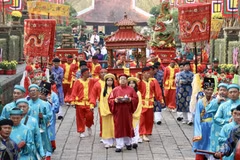
Offering of cylindrical glutinous rice cakes to Hung Kings at Thuong Temple in Ho Chi Minh City (Photo: VNA)

Vietnam Culture Day: Rendezvous of identity, internal strength

Culture has long been described as the spiritual foundation of society, an internal strength, and a driver of development; yet for that idea to truly take root in everyday life, it must be translated into concrete, visible, and tangible policies.

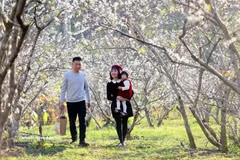
Visitors explore blooming plum orchards in Hom hamlet, Chieng Coi ward, Son La province. (Photo: VNA)

Northwest cultural showcase to open in Son La in May

Conceived as an integrated cultural space, the Huong sac vung cao (Highland Hues) exhibition will bring together archival and artistic images alongside artefacts to depict the cultural and social life of ethnic communities, underscore the Party and State’s focus on upland areas, and reflect local development progress.

Van Thuy Tu temple in Phan Thiet ward, a well-known destination offering insight into the unique whale worship (Photo: VNA)

Historic coastal communal houses keep folk fishing traditions alive

Stretching along the coastal belt of Lam Dong province, centuries-old communal houses and temples worshipping the “Ong” (Whale God) stand as quiet custodians of history, embodying the distinctive cultural and spiritual life of Vietnamese coastal communities, while increasingly emerging as compelling cultural tourism attractions.

A special art programme is held in Dien Bien province in 2025 to celebrate the 50th anniversary of the Liberation of the South and the national reunification, the 71st anniversary of the Dien Bien Phu Victory, and the 135th anniversary of the birth of President Ho Chi Minh. (Photo: VNA)

Boosting traditional arts talents key to preserving cultural heritage

Politburo’s Resolution No. 80 on developing Vietnamese culture places a stronger emphasis on nurturing talent in traditional arts. It is expected to breathe fresh life into Vietnam’s cultural heritage, as these art forms face mounting challenges in the modern entertainment landscape.

Internationally acclaimed pianist Kevin Kenner (Photo: VCMA)

World-renowned pianist Kevin Kenner to perform in Vietnam

Organised by the Vietnam Classical Music Association (VCMA) with support from Impressivo Production & Enterprise, the concerts are scheduled for May 22 at Ho Guom Opera House in Hanoi and May 24 at the Ho Chi Minh City Opera House, the Vietnam Classical Music Association announced on April 26.

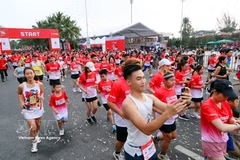
Nearly 8,000 runners join AirAsia RedRun Da Nang 2026 (Photo: VNA)

Nearly 8,000 runners join AirAsia RedRun Da Nang 2026

Jointly organised by the Ministry of Culture, Sports and Tourism, the municipal People’s Committee and related agencies at East Sea Park, the two-day event featured 5km, 10km and 21km races, with runners competing along scenic routes in the city. The main race day was April 26, following activities launched a day earlier.

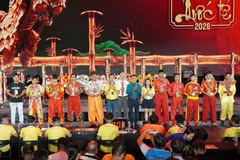
Organisers award commemorative medals to participating Vietnamese lion dance troupes. (Photo: VNA)

International Lion Dance Tournament 2026 gathers 15 strong teams

More than a sporting competition, the event serves as a vibrant cultural festival, fostering exchanges and strengthening ties among domestic and international troupes, particularly from regions with strong lion dance traditions such as China, Malaysia and Hong Kong (China).