Hanoi shifts tourism promotion towards sustainable, high-value markets

A series of famtrip programmes organised in May reflects the capital city’s more market-oriented approach and efforts to implement the Government’s Resolution 82/NQ-CP on tourism recovery and sustainable development.

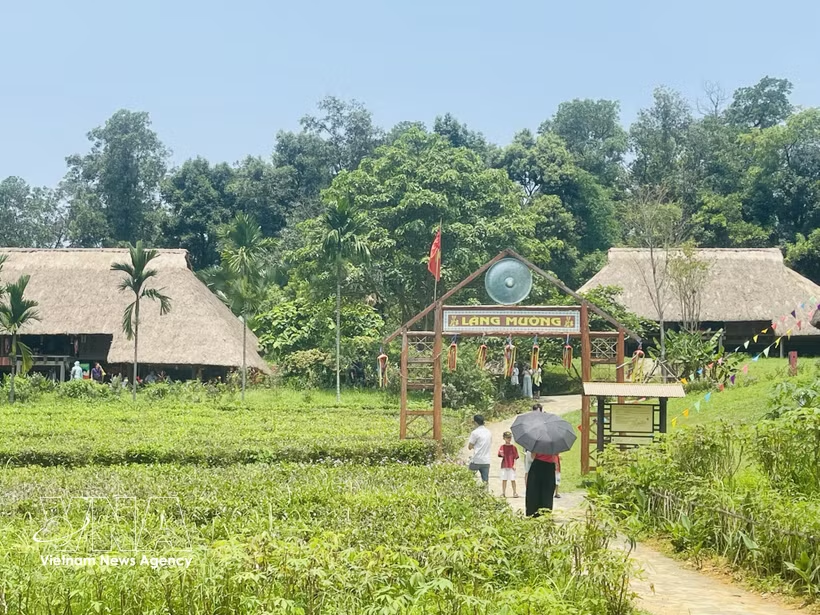
People visit the Muong village within the Vietnam National Village for Ethnic Culture and Tourism in Hanoi. (Photo: VNA)

Hanoi (VNA) – Hanoi is reshaping its tourism promotion strategy with a focus on sustainability, regional connectivity and high-spending visitors instead of mass tourism and short-term growth.

A series of famtrip programmes organised in May reflects the capital city’s more market-oriented approach and efforts to implement the Government’s Resolution 82/NQ-CP on tourism recovery and sustainable development.

During the month, Hanoi welcomed two international famtrip delegations from Australia and Japan to survey tourism products in the capital and several northern localities. Unlike traditional promotion activities centred on trade fairs and destination branding, the new model allows outbound tour operators to directly experience tourism products, inspect services and connect with local partners at destinations.

The Australian delegation explored tourism routes linking Hanoi, Ninh Binh, Quang Ninh and Yen Tu. Meanwhile, more than 20 Japanese travel executives from Tokyo, Osaka, Kansai, Hyogo and Fukuoka joined a survey tour covering Hanoi, Ninh Binh and Ha Long.
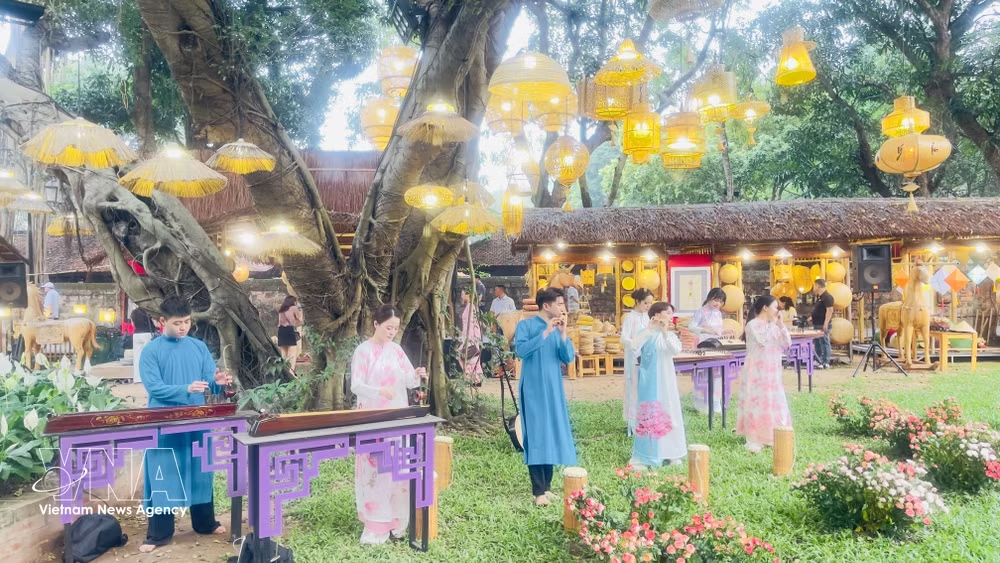
vnanet-khong-gian-trai-nghiem-chuong-trinh-nghe-thuat-vuon-anh-sang-tai-van-mieu-quoc-tu-giam-anh-ttxvn.jpg
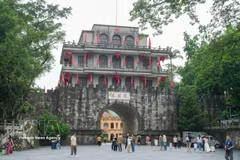
As part of events marking the 950th anniversary of the Imperial Academy (1076-2026), Vietnam’s first national university, the “Garden of Light” programme offers visitors a distinctive cultural experience at the Temple of Literature. (Photo: VNA)

Australian businesses experienced Hanoi’s Old Quarter, the Imperial Citadel of Thang Long, the Hanoi Museum, local cuisine and fine dining services, while also exploring wellness and healing tourism products in Yen Tu, Tam Coc’s ripe-rice season landscape and luxury overnight cruises in Ha Long Bay.

The Japanese delegation focused more on cultural experiences, including city tours, cyclo rides in the Old Quarter and the “Train No.6 – Hanoi Street Museum” route, alongside business networking activities.

The itineraries highlighted Hanoi not as a standalone destination but as a regional tourism hub connected with neighbouring provinces. The strategy aims to extend visitors’ length of stay and increase tourism spending through inter-provincial travel experiences.

The approach mirrors broader tourism trends in Southeast Asia, where countries such as Thailand, Singapore and Malaysia are increasingly shifting towards experiential tourism, thematic travel and integrated tourism ecosystems instead of relying solely on natural attractions.

For years, Vietnam has faced the challenge of rising international arrivals without corresponding increases in visitor spending or length of stay. Many destinations still depend on short tours and similar tourism products while lacking attractive night-time services.

To address the issue, Hanoi and northern localities are accelerating the development of regional tourism products linked to heritage, wellness tourism, golf and night-time entertainment to attract high-value travellers from Northeast Asia, particularly China.

China remains Vietnam’s largest source market. In the first quarter of 2026, more than 1.4 million Chinese visitors travelled to Vietnam, accounting for over 20% of total international arrivals. In 2025, the market contributed nearly 5.3 million visitors, or around one quarter of all foreign arrivals.

Industry experts noted that Chinese tourists are increasingly willing to spend more on high-quality resorts, shopping, cuisine and personalised cultural experiences instead of low-cost package tours.

Hanoi is also placing greater emphasis on developing the night-time economy. The municipal People’s Committee recently approved a project on night-time economic development for 2026-2030, with a vision to 2045.

Under the plan, the city will establish six to eight key night-time economic zones and 15-20 streets and entertainment areas operating beyond midnight. At least three areas are expected to meet regional standards for night cultural and tourism experiences.

West Lake, the Old Quarter and the Red River corridor are expected to become centres for festivals, art performances, night cruises and cultural activities designed to encourage visitors to stay longer.

Experts said sustainable tourism growth will require not only attractive destinations but also better infrastructure, convenient transport, professional services, digital transformation and stronger connectivity between aviation, rail and road tourism.

With closer regional cooperation, improved tourism products and more targeted promotion strategies, Hanoi and Vietnam’s tourism sector are expected to gradually shift from growth in visitor numbers to higher-quality and more sustainable development./.

VNA

See more

Representatives of participating organisations pose for a group photo at the exchange programme marking China Tourism Day on May 19, 2026. (Photo: VNA)

Vietnam, China eye stronger tourism ties through cultural exchanges

Tourism exchanges between the two countries have expanded steadily in recent years, with a growing number of Vietnamese travellers to Chinese destinations such as Guilin, Lijiang, Zhangjiajie and Tianchi Lake, and Chinese tourists continuing to favour Vietnamese destinations including Hanoi, Ho Chi Minh City, Ha Long Bay, Da Nang and Nha Trang.

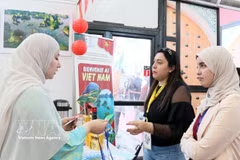
Several Vietnamese tourism products are introduced to visitors at the fair. (Photo: VNA)

Vietnam captivates visitors at Algeria tourism fair

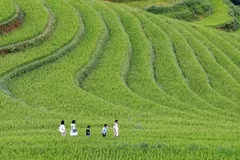
Vietnam displays large photographs of renowned destinations such as Hoan Kiem Lake, Trang An Landscape Complex, Phong Nha-Ke Bang National Park, Hoi An Ancient Town, Ban Gioc Waterfall and the terraced rice fields of Mu Cang Chai at the International Tourism and Travel Fair (SITEV 2026) in Algeria.

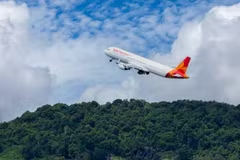
Sun PhuQuoc Airways opens the gateway for the world to experience the paradise Phu Quoc. (Photo: Sun Group)

US media outlines what makes Phu Quoc Southeast Asia’s most sought-after destination

According to TTW, Phu Quoc is emerging as "one of the most desired destinations in Southeast Asia" due to a rare convergence of pristine natural beauty and a heavily invested, modern tourism ecosystem. From sweeping white sands and turquoise waters to global-class resort and entertainment complexes, the island is drawing an increasing number of international travelers seeking an experience that seamlessly balances luxury with a rich local identity.

Local culture makes Vietnamese destinations appealing. (Photo: VNA)

Vietnam targets tourism breakthrough by filling gaps

Industry officials said advances in sci-tech, innovation and digital transformation are already wrenching tourism away from a bulk-volume model toward one built on data, customised experiences and smart governance. Deeper global integration is further widening market access, tightening value chain links and sharpening Vietnam’s destination brand.

The 7 Wonders Day will be held on July 7 to celebrate Ha Long Bay as one of the best known world natural heritage site. (Photo: courtesy of Ha Long Bay - Yen Tu World Heritage Management Department)

7 Wonders Day to spotlight UNESCO heritage jewel Ha Long Bay

A special event entitled 7 Wonders Day with a series of attractions and experiences for both residents and visitors will be held in Ha Long city, Quang Ninh province, on July 7 to honour the elected New 7 Wonders of the World and Nature.

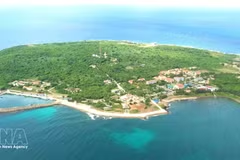
Con Co “steel island”: a green gem in the open sea. (Photo: VNA)

Con Co “steel island”: a green gem in the open sea

Unlike well-established destinations, this small island quietly preserves its layered heritage: tens-of-thousands-year-old basalt formations, pristine tropical forests and enduring wartime memories. Together, they create a distinctive “green gem” in the open sea, subtle yet captivating enough to hold any visitor.

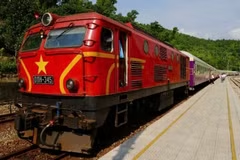
The Hue–Da Nang “Central Heritage Connection” train takes passengers along one of Vietnam’s most spectacular coastal railway routes. (Photo: nhandan.vn)

Heritage rail journey brings new identity to central Vietnam tourism

The heritage train offers passengers not only a means of transport, but also a sense of connection linking destinations across central Vietnam, tourism with transport, and nostalgic memories with contemporary experiences. While older travellers are reminded of journeys from decades ago, younger passengers and international visitors are discovering a greener, culture-rich way to explore the region.

Many Vietnamese travellers love to plan the trip by themselves even when it requires a lot of time. (Photo courtesy of Booking.com)

Vietnamese travellers enjoy planning for trips

The Booking.com’s Travel Trends 2026 data revealed that a growing number of Vietnamese travellers, about 74% of respondents, are channelling “Main Character Planning Energy”, where planning and booking is just as enjoyable as the trip itself.

Hai Tac Island in An Giang province is increasingly attractive to visitors. (Photo: VNA)

Slow travel increases connections, reshapes tourism trends

Rather than rushing to “check in” at as many attractions as possible, slow travel allows visitors to immerse themselves in local life. Travellers may spend time wandering through a highland market, learning to cook a traditional dish, cycling around a coastal fishing village, or simply enjoying the tranquil rhythm of life in the countryside.

Sunlight streams into the Dinosaur Eye while visitors join the Son Doong adventure tour (Photo: VNA published)

Quang Tri province boosts tourism promotion through international television, films

A special documentary on Son Doong Cave, the world’s largest cave, was aired on March 29 in the renowned “60 Minutes” programme of CBS News. The report retraced the discovery of Son Doong Cave and years of expeditions conducted by the British Cave Research Association, offering global audiences a comprehensive look at the cave through scientific, historical and human perspectives.