Hanoi details multi-billion-USD Red River scenic boulevard axis project

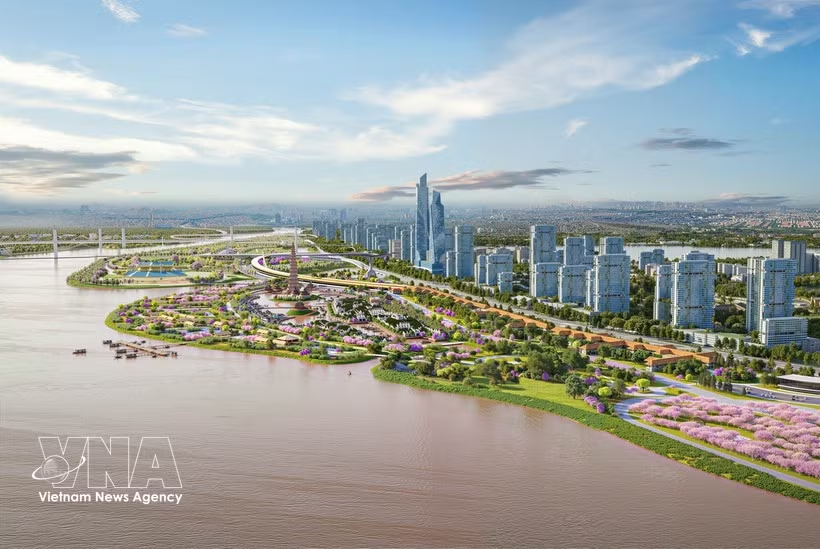
Under the capital’s master plan with a 100-year vision, the Red River Scenic Boulevard Axis is designated as one of nine key development corridors of Hanoi. It is envisioned as a central green spatial corridor, while also functioning as an economic, commercial, service, cultural, creative, and urban development axis along the Red River.

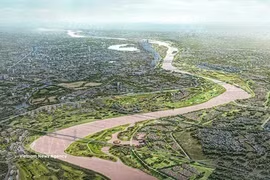
The Red River Scenic Boulevard Axis is designated as one of nine key development corridors of Hanoi. (Photo: VNA)

Hanoi (VNA) – The Hanoi People’s Committee on May 19 issued an official press release providing key details on the Red River Scenic Boulevard Axis project, which is identified as a strategic and long-term development orientation for the capital city in its new development phase.

The project is implemented in line with guidelines, resolutions, and conclusions from the Party Central Committee, the National Assembly, the Government, and the city authorities. Notably, the NA’s Resolution No. 258/NQ-QH15 dated December 11, 2025 allows the application of special mechanisms and policies for implementation. On May 11, 2026, the municipal People’s Council issued Resolution No. 18/NQ-HDND, giving in-principle approval to the project.

Under the capital’s master plan with a 100-year vision, the Red River Scenic Boulevard Axis is designated as one of nine key development corridors of Hanoi. It is envisioned as a central green spatial corridor, while also functioning as an economic, commercial, service, cultural, creative, and urban development axis along the Red River.

​Covering a total land area of approximately 11,418 ha, the project consists of five main project groups with 18 sub-projects. These include two scenic boulevards running along the sides of the Red River with a combined length of over 80 km; large-scale park complexes in riverside alluvial areas; river embankment and channel regulation works; resettlement and urban redevelopment zones; and independent land clearance projects.

It will be implemented across 16 wards and communes, including Hong Ha, O Dien, Thuong Cat, Dong Ngac, Phu Thuong, Linh Nam, Thanh Tri, Nam Phu, Hong Van, Me Linh, Thien Loc, Vinh Thanh, Dong Anh, Bo De, Long Bien, and Bat Trang. The project is scheduled for implementation from 2026 to 2038. In the first phase from 2026 to 2030, priority will be given to key infrastructure works, river embankment and channel regulation projects, major parks, resettlement urban areas, and site clearance activities.

The municipal People’s Committee said the preliminary total investment is estimated at around 736.96 trillion VND (27.95 billion USD). The proposed land fund for payment covers around 2,655.8 hectares, to be allocated in urban development areas within the project scope and partly from other land reserves across the city. The municipal authorities affirmed that the management and use of this land fund, as well as project implementation, will ensure transparency, efficiency, and the prevention of losses and waste of public assets.

​Regarding resettlement, the municipal People’s Committee noted that the current population within the project area is about 70,474 households with 247,431 people. The city’s consistent principle is to ensure the legitimate rights and interests of affected residents, while prioritising the implementation of resettlement and reconstruction projects before the synchronised rollout of other project components, it asserted.

​ Resettlement areas are planned in Long Bien, Linh Nam, and Bat Trang, with total number of resettlement units, including both land-based housing and high-rise apartments, projected to reach 79,000-85,000, broadly meeting the resettlement demands of affected residents.

The Red River Scenic Boulevard Axis is said to hold a strategic importance for Hanoi’s urban space, landscape, ecological environment, and development capacity, contributing to forming a new central landscape axis and gradually realising the vision of urban development along the banks of the Red River in a civilised, modern, ecological, and sustainable manner./.
VNA

See more

Hanoi approves 100-year master plan, with Red River as a hub. (Photo: VNA)

Hanoi shapes future city with AI, TOD, 1,153km metro network

According to the new master plan, Hanoi's study area spans all 126 wards and communes within Hanoi’s administrative boundary, covering roughly 3,359.84 sq.km. Its population is projected to reach around 14–15 million by 2035, 15–16 million by 2045, and 17–19 million by 2065, with a long-term cap of no more than 20 million residents.

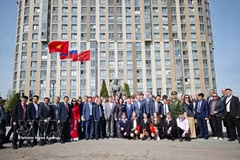
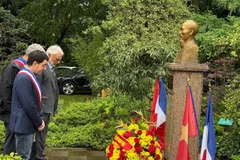
Vietnamese Ambassador to Russia Dang Minh Khoi, Chairman of the St. Petersburg Committee on External Relations Evgeny Grigoriev, Vice Chairman of the committee Vyacheslav Kalganov, and Deputy Chairman of the Legislative Assembly of the city Nikolay Bondarenko led a delegation in laying red carnations before the statue of President Ho Chi Minh (Photo: VNA)

President Ho Chi Minh’s 136th birthday observed in RoK, Russia

On the occasion of the 136th birthday of the late Vietnamese leader (May 19, 1890–2026), Professor Park Yeon Kwan, Head of the Department of Vietnamese Language at Hankuk University of Foreign Studies, described him as a great sage whose strategic decisions carried the vision of the times.

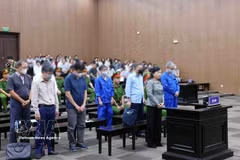
Defendants at the appellate trial in Hanoi on May 20 (Photo: VNA)

Appeal trial opens in food safety bribery case

The total amount of bribes received by the defendants in the case exceeded 94 billion VND, with former Director of the Vietnam Food Safety Authority (FSA) Nguyen Thanh Phong alone pocketing 43.9 billion VND.

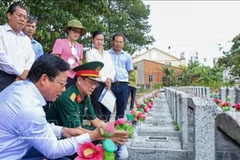
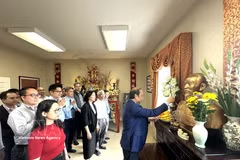
Vietnamese Ambassador to the US Nguyen Quoc Dung and others offer incense in tribute to President Ho Chi Minh in Washington DC on May 19, 2026. (Photo: VNA)

President Ho Chi Minh’s diplomatic legacy helps strengthen Vietnam – US friendship

Vietnamese Ambassador to the US Nguyen Quoc Dung stressed that among President Ho Chi Minh’s immense contributions, his forward-looking diplomatic vision became a solid foundation for Vietnam’s foreign policy of independence, self-reliance, peace, friendship and cooperation with all countries on the basis of mutual respect and mutual benefit.

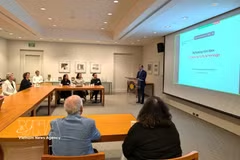
Vietnamese Ambassador to the US Nguyen Quoc Dung speaks at the seminar. (Photo: VNA)

Vietnam – US partnership expands in culture preservation, promotion

The May 18 seminar, themed “Reframing Vietnam,” at the National Museum of Asian Art (NMAA) under Smithsonian Institution in Washington, D.C., is expected to generate fresh momentum and frameworks for cooperation among cultural agencies, museums, art funds and experts from the two countries, helping bring Vietnam’s cultural image closer to American and international public in the time to come.

Visitors to an exhibition and test-drive programme for electric vehicles organised in Cau Giay ward, Hanoi, on May 16 by the municipal People's Commitee and relevant agencies. (Photo: VNA)

Hanoi proposes subsidies to accelerate shift to electric vehicles

Under a draft resolution currently open for public feedback by the municipal People’s Committee, residents with permanent or temporary residence registration in Hanoi for at least two consecutive years, who own petrol-powered motorbikes registered before the resolution takes effect, will be eligible for support when purchasing electric motorbikes priced at 10 million VND or more.

The copyright crackdown is broadly viewed as an inevitable step in Vietnam’s cultural industry development. (Illustrative photo: VNA)

Healthy digital content market in the making

The sharper crackdown is rapidly redrawing how online entertainment is distributed and consumed, while gradually reshaping public awareness and responsibility toward copyright protection.

A view of Place Ho Chi Minh in Persan, France. (Photo: VNA)

Place preserving memories of President Ho Chi Minh in France

Although there is little publicly available documentation confirming exactly when Place Ho Chi Minh was established, French urban historians suggest that most streets and public spaces named after the Vietnamese leader in France emerged between the 1960s and 1980s, during the height of anti-war movements and solidarity campaigns supporting Vietnam across working-class towns and left-leaning suburbs around Paris.