Healthy digital content market in the making

The sharper crackdown is rapidly redrawing how online entertainment is distributed and consumed, while gradually reshaping public awareness and responsibility toward copyright protection.

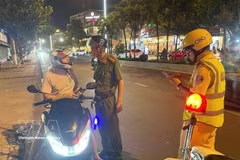
The copyright crackdown is broadly viewed as an inevitable step in Vietnam’s cultural industry development. (Illustrative photo: VNA)

Hanoi (VNA) – A wave of unauthorised movie, comic and music sites has gone dark in recent weeks, signaling a sudden escalation in Vietnam’s enforcement against intellectual property (IP) violations.

The sharper crackdown is rapidly redrawing how online entertainment is distributed and consumed, while gradually reshaping public awareness and responsibility toward copyright protection.

End of easy access to pirated content

In early May, Deputy Prime Minister Ho Quoc Dung signed an urgent prime ministerial dispatch demanding tougher action against IP infringements, directing agencies nationwide to pool resources and enforce violations under a “no exceptions” principle.

Almost immediately after the directive became public, scores of unlicensed streaming sites and fan translation groups for novels and comics posted closure notices or simply went offline.

What sets this clampdown apart is its expansive reach. Previously, shutdowns were quickly met with near-identical replacement domains, allowing users uninterrupted access. This time, many illegal platforms have vanished with no immediate substitutes in sight.

Frequent users of pirated films, music and translated stories are now asking where to turn. Some have begun paying for services like Netflix, FPT Play, VieON and Galaxy Play. Most, however, are still in transition, hunting for alternatives that fit their viewing habits and budgets.

Building legal digital entertainment habits

As audiences search for legitimate platforms, they are getting acquainted with more diverse models of digital content consumption.

Some licensed movie-streaming sites now offer free, ad-supported access, giving viewers a legal path that requires no upfront payment. Others deploy a freemium model, unlocking the first few episodes at no charge before requiring payment to continue.

In books and comics, Vietnamese readers long relied on free fan-translation forums. When many of those groups halted operations, disappointment followed. Yet, a new model is taking shape: independent translators buying overseas copyrights directly, producing Vietnamese versions, and releasing them chapter by chapter on domestic digital platforms.

The copyright crackdown is broadly viewed as an inevitable step in Vietnam’s cultural industry development. Over time, audiences and readers are expected to gradually shift toward legal consumption habits.

For producers and official distributors, the moment offers a clear opening to lift service quality, hold onto audiences, and convince consumers to pay for high-value products, which will ultimately build a healthier and more sustainable digital content market./.


VNA

See more

Visitors to an exhibition and test-drive programme for electric vehicles organised in Cau Giay ward, Hanoi, on May 16 by the municipal People's Commitee and relevant agencies. (Photo: VNA)

Hanoi proposes subsidies to accelerate shift to electric vehicles

Under a draft resolution currently open for public feedback by the municipal People’s Committee, residents with permanent or temporary residence registration in Hanoi for at least two consecutive years, who own petrol-powered motorbikes registered before the resolution takes effect, will be eligible for support when purchasing electric motorbikes priced at 10 million VND or more.

A view of Place Ho Chi Minh in Persan, France. (Photo: VNA)

Place preserving memories of President Ho Chi Minh in France

Although there is little publicly available documentation confirming exactly when Place Ho Chi Minh was established, French urban historians suggest that most streets and public spaces named after the Vietnamese leader in France emerged between the 1960s and 1980s, during the height of anti-war movements and solidarity campaigns supporting Vietnam across working-class towns and left-leaning suburbs around Paris.

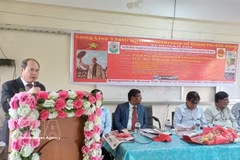
Vietnamese Ambassador to Bangladesh Nguyen Manh Cuong speaks at the seminar. (Photo: VNA)

President Ho Chi Minh’s thought on national unity remains relevant today

President Ho Chi Minh's ideology of national unity continues to carry profound significance amid growing global challenges, including conflicts, social divisions and economic instability. His message of solidarity, consensus and placing national interests above sectional differences remains a valuable lesson for many developing nations.

Assoc. Prof. Dr. Nguyen Duc Son presents the decision establishing the Vietnamese Language Proficiency Test Council in Japan to a representative of the Vietnam Studies Centre in Japan. (Photo: VNA)

Japan hosts first standardised Vietnamese language proficiency test

As bilateral ties between Vietnam and Japan continue to expand, demand for Vietnamese language learning in Japan has also grown rapidly among OVs, educational institutions, businesses and Japanese people interested in Vietnam. Against this backdrop, the introduction of a standardised proficiency test is expected to provide an official and widely recognised benchmark for Vietnamese language skills.

The “I Love My Fatherland" Journey 2026 kicks off in Nghe An province on May 16. (Photo: VNA)

"I Love My Fatherland” journey features diverse activities

The “I Love My Fatherland” journey will span seven stages across historical and cultural sites and “red addresses” nationwide. There will be a combination of education on traditions, field-based programmes, and digital communications.