Deputy PM demands full disbursement for sci-tech in 2026

As of May 12, total disbursed capital reached 7.95 trillion VND, equivalent to 14.78% of the Prime Minister’s plan. Of this, central budget disbursement hit 4.06 trillion VND, or 14.8% of the target, while local budget disbursement exceeded 3.88 trillion VND, or 14.75%.

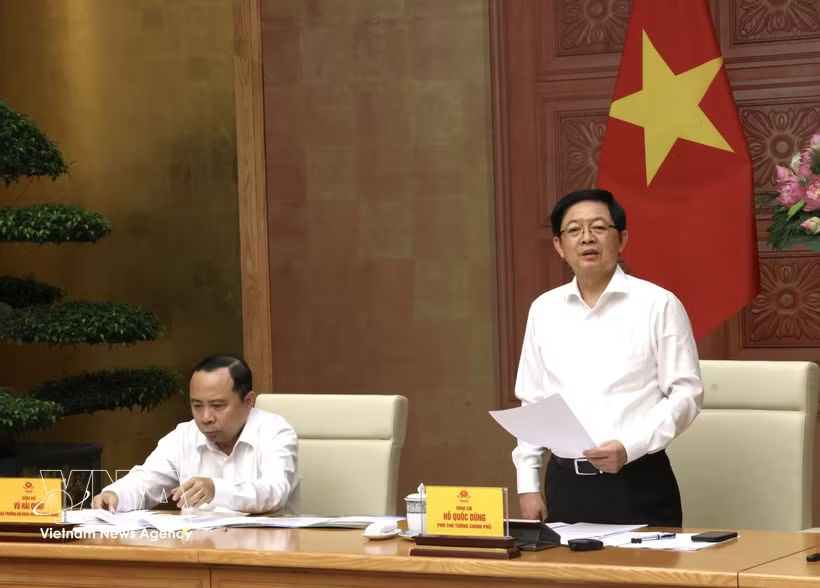
Deputy Prime Minister Ho Quoc Dung speaks at the meeting. (Photo: VNA)

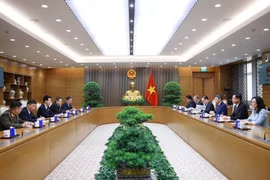
Hanoi (VNA) – Deputy Prime Minister Ho Quoc Dung chaired a hybrid meeting with ministries, agencies, and 10 localities in Hanoi on May 19, demanding the removal of financial bottlenecks and accelerated disbursement of 2026 public investment for sci-tech, innovation, and digital transformation.

Striving for 100% disbursement in 2026

Dung said the Party General Secretary and State President and Prime Minister have singled out sci-tech, innovation, and digital transformation as the new engines of national development and issued directives to push them forward. Yet, public investment disbursement for 2026 in these areas remains sluggish across many ministries, agencies, and localities.

He called on ministries, agencies, and local authorities to conduct a rigorous review of their responsibilities and pinpoint both subjective and objective causes behind the delays. He ordered them to directly oversee progress and treat disbursement as a key, urgent political task for 2026.

They were also assigned to review all sci-tech, innovation, and digital transformation projects and tasks, with priority given to those ready for immediate launch. When procedural or regulatory hurdles are beyond local authority, they must be reported promptly to the Government and PM for resolution. The overriding goal, he stressed, is to hit 100% disbursement of the 2026 capital plan.

“Capital allocation must be focused and efficient, giving priority to strategic, breakthrough tasks with wide spillover effects while avoiding fragmented, ineffective investment”, he said.

Priority areas include national databases, artificial intelligence, strategic technology products, innovation centres, and startup ecosystem. Projects must deliver measurable and tangible outcomes, he added.

The ministries of science and technology, finance, and justice were asked to fundamentally tackle regulatory and policy bottlenecks by June 2026, particularly in procurement, investment, and financial rules. They were instructed to overhaul the legal framework and quickly amend or supplement inconsistent circulars and decrees to prevent prolonged delays and lift disbursement from June onward.

Flagging two major near-term priorities, Dung called for upgrading and investing in national laboratory systems to support scientific research, and concentrated investment in strategic technology tasks and products able to show visible results this year. Local authorities were also urged to repurpose underused office space into innovation hubs and startup support spaces to spur research, collaboration, and technology application.

Disbursement reaches 14.78% as of May 12
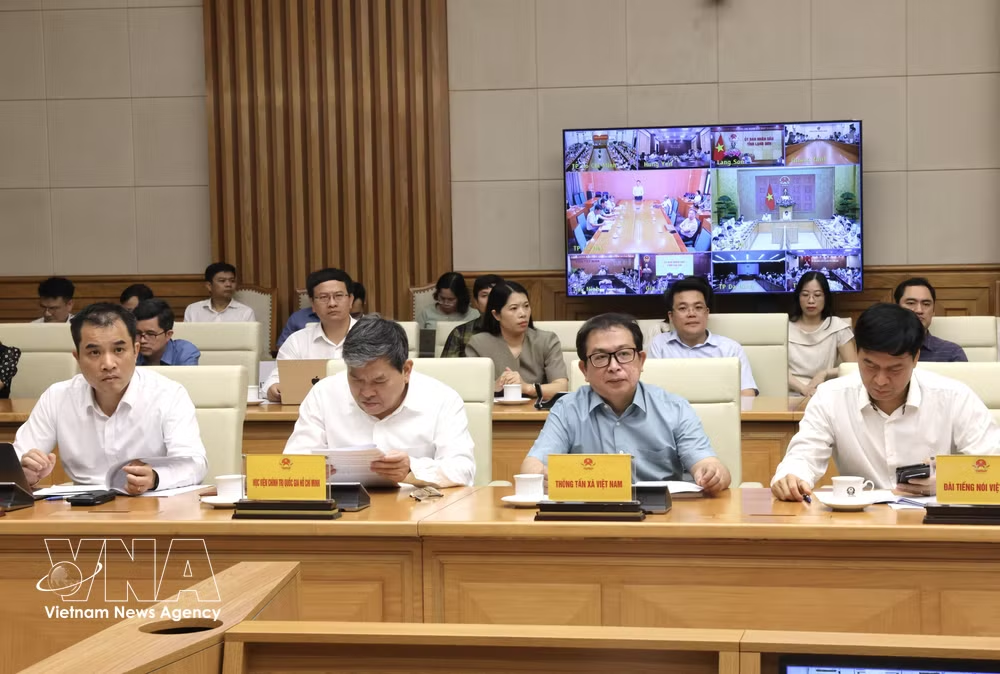
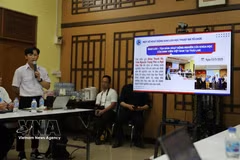
Participants in the meeting (Photo: VNA)

Participants in the meeting (Photo: VNA)

Minister of Science and Technology Vu Hai Quan reported that the sci-tech, innovation, and digital transformation budget carried over from 2025 to 2026 topped 8.42 trillion VND (323 million USD). Total funding for 2026 amounts to 103.44 trillion VND, including 73.44 trillion VND compiled by his ministry and 30 trillion VND for sci-tech expenditures in other sectors compiled by the Ministry of Finance (MoF).

The Ministry of Science and Technology (MoST) issued guidance on the 2026 plan worth more than 51.87 trillion VND, including 27.74 trillion VND from the central budget and more than 24.12 trillion VND from local budgets. An additional 20.36 trillion VND has yet to be allocated.

To date, the MoST, in coordination with the MoF, has fully allocated funding and approved dossiers for agencies with valid proposals, including 998.3 billion VND for 22 out of 46 digital platforms and administrative procedure information systems, and 2.48 trillion VND for 35 out of 52 registered databases.

As of May 12, total disbursed capital reached 7.95 trillion VND, equivalent to 14.78% of the PM’s plan. Of this, central budget disbursement hit 4.06 trillion VND, or 14.8% of the target, while local budget disbursement exceeded 3.88 trillion VND, or 14.75%.

To fine-tune the institutional framework, the MoST proposed that the PM revise several legal documents and decrees and, when necessary, issue special Government resolutions to clear obstacles facing ministries, agencies, and localities.

Participants suggested that the Government and ministries promptly issue detailed guidance on technical norms and project evaluation tools, further decentralise authority to local administrations for projects aligned with Vietnam’s Digital Government Architecture Framework, prioritise the development of shared platforms, and introduce “lease-purchase” mechanisms for digital assets to avoid fragmented and wasteful investment./.

VNA

See more

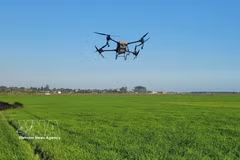
Using drones to spray pesticides in the An Nhut rice fields in Long Dien commune of Ho Chi Minh City. (Photo: VNA)

Solving technology challenge through the “three-party linkage”

According to Pham Duc Nghiem, Deputy Director of the Department of Startups and Technology Enterprises under the Ministry of Science and Technology, the “three party” linkage model involving the State, research institutes/universities and enterprises is becoming essential for developing strategic technologies. Enterprises provide practical problems, universities and research institutes develop technological solutions, while the State creates support mechanisms and policies to accelerate commercialisation.

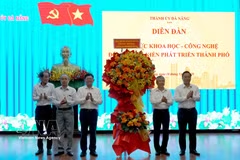
Da Nang city's leaders present flowers to congratulate the Union of Science and Technology Associations in Da Nang on Vietnam Science and Technology Day (May 18). (Photo: VNA)

Human capital key to Da Nang’s digital economy ambitions: experts

Vo Cong Tri, Chairman of the Union of Science and Technology Associations (VUSTA) in Da Nang, described high-quality human resources as a “key driver” in the city’s transformation. Da Nang is already regarded as one of Vietnam’s leading “university cities,” with 19 higher education institutions and a high concentration of students and skilled workers. The city is also home to a growing network of science and technology organisations that are helping to foster an innovation ecosystem.

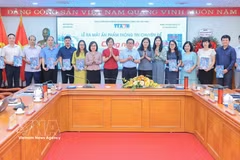
Delegates at the publication launching ceremony. (Photo: VNA)

Vietnam News Agency debuts monthly technology publication

Each 40-page issue is expected to pack 3-5 chapters, delivering a panoramic view of the global sci-tech landscape alongside in-depth analyses of emerging technology trends. The publication aims to explain strategic shifts that will shape the country’s development and examine the sci-tech, innovation and digital transformation policies of other nations.

A worker assembles ultra-precision micro-components used in semiconductor chip production. (Photo: VNA)

Vietnam prioritises 70 high technologies for strategic development

Issued under Decision No. 23/2026/QD-TTg dated May 15, 2026, the list covers a wide range of technologies, including artificial intelligence (AI), big data and data analytics, cloud and edge computing, distributed and high-performance computing, Internet of Things (IoT), blockchain, quantum technology, renewable and clean energy, advanced energy storage, AI-powered real-time disaster forecasting and warning systems, and next-generation microbiology technologies.

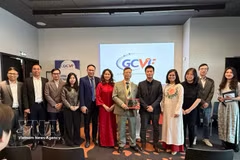
Vietnamese Ambassador to France Trinh Duc Hai (sixth from the right) and the leadership of Global Connect Vietnam France. (Photo: VNA)

Vietnamese association launched in France to foster technology, AI cooperation

In the context of the growing Comprehensive Strategic Partnership between Vietnam and France, Hai said GCVF should position itself as a bridge for knowledge and technology transfer, bringing scientific and technological achievements from France and Europe to support Vietnam’s practical development needs.

Party General Secretary and State President To Lam presents a statute of President Ho Chi Minh to VNU-Hanoi. (Photo: VNA)

Top Vietnamese leader’s vision puts scientists at core of growth drive

As the country enters a new era, the Party and State have designated sci-tech and and innovation as central priorities, Kiem said, adding that VNU-Hanoi, alongside other higher education establishments, must not only produce high-caliber talents but also function as a hub for knowledge transfer and groundbreaking innovation.

Illustrative image (Photo: VNA)

Korean robotics, AI firms interested in Vietnam

KOTRA said it is teaming up with the Korea Institute for Robot Industry Advancement to run the “K-Robot Pavilion"” at the 23rd Vietnam International Exhibition on Machinery, Equipment, Technology and Industrial Products (VINAMAC EXPO 2026) in Hanoi from May 14-16.

Party General Secretary and State President To Lam (left) and Sri Lankan President Anura Kumara Dissanayake come to lay flowers in tribute to late President Ho Chi Minh at the Colombo Public Library on May 8. (Photo: VNA)

Sri Lanka eyes breakthrough sci-tech cooperation with Vietnam

A Sri Lankan official has expressed confidence that science, technology and digital transformation will become a key driver in shifting bilateral ties from traditional friendship to a partnership grounded in innovation and inclusive economic growth.

Vietnam promotes cooperation with United Nations on crime prevention

Vietnam promotes cooperation with United Nations on crime prevention

Vietnam highly values the support of the United Nations Office on Drugs and Crime (UNODC) in strengthening national capacity in crime prevention and criminal justice, drug control, and addressing emerging challenges, particularly cybercrime, said Ambassador Vu Le Thai Hoang.

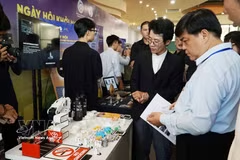
Visitors tour an exhibition showcasing technology and cultural products. (Photo: VNA)

VIPC Summit 2026 highlights Vietnam’s ambitions in strategic technologies

Through the VIPC Summit 2026, Vietnam aims to reaffirm its commitment to building a transparent, competitive and internationally integrated investment environment, while promoting new financial mechanisms and institutions to make science, technology, innovation and digital transformation strategic growth motivation in the coming years.

At the “Digital Trust in Finance 2026” forum (Photo: VNA)

Forum discusses digital trust in finance during AI era

Deputy Minister of Public Security Sen. Lieut. Gen Pham The Tung told the forum that Vietnam’s financial and banking industry is racing through a digital overhaul, creating major opportunities as the country aims for double-digit growth in 2026 and beyond.

Citizens obtain queue numbers for administrative procedures at the Public Service Center of Hanoi's Hoan Kiem ward (Photo: VNA)

All citizen-government transactions to go fully digital by 2035

Looking ahead to 2035, Vietnam envisions becoming a comprehensive and sustainable digital nation where all transactions between citizens and government agencies are conducted online. National databases, with population data at the core, will be interconnected and efficiently utilised to support smart governance and real-time decision-making.