Human capital key to Da Nang’s digital economy ambitions: experts

Vo Cong Tri, Chairman of the Union of Science and Technology Associations (VUSTA) in Da Nang, described high-quality human resources as a “key driver” in the city’s transformation. Da Nang is already regarded as one of Vietnam’s leading “university cities,” with 19 higher education institutions and a high concentration of students and skilled workers. The city is also home to a growing network of science and technology organisations that are helping to foster an innovation ecosystem.
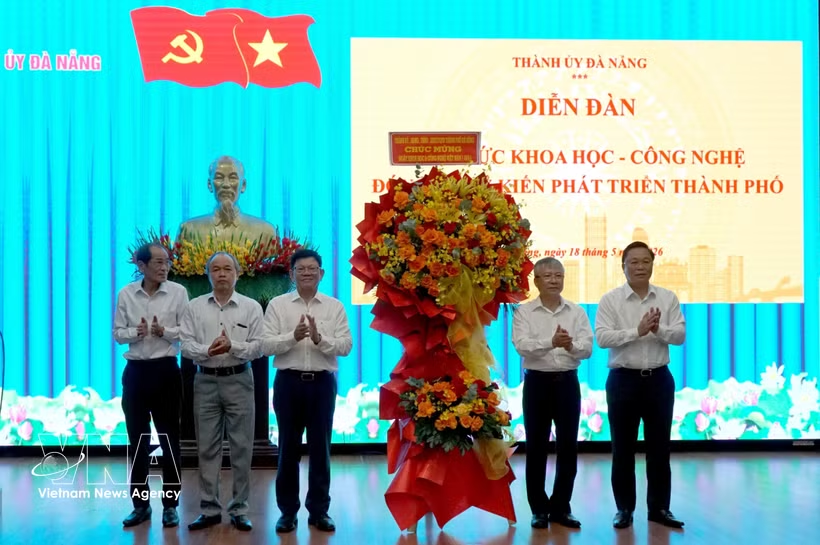
Da Nang city's leaders present flowers to congratulate the Union of Science and Technology Associations in Da Nang on Vietnam Science and Technology Day (May 18). (Photo: VNA)

Da Nang (VNA) – As Da Nang accelerates its push toward a digital economy accounting for up to 40% of its GRDP by 2030, experts and policymakers say developing a high-quality intellectual workforce will be the decisive factor in unlocking the city’s next phase of growth.

Following administrative restructuring and spatial reorganisation, the central city is entering a new development phase with expanded opportunities. Local authorities have set an ambitious target of raising the digital economy’s share to 35–40% of GRDP by the end of the decade - well above the national average.

Vo Cong Tri, Chairman of the Union of Science and Technology Associations (VUSTA) in Da Nang, described high-quality human resources as a “key driver” in the city’s transformation. Da Nang is already regarded as one of Vietnam’s leading “university cities,” with 19 higher education institutions and a high concentration of students and skilled workers. The city is also home to a growing network of science and technology organisations that are helping to foster an innovation ecosystem.

vnanet-tri.jpg
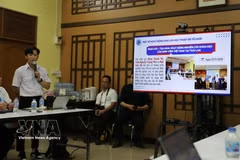
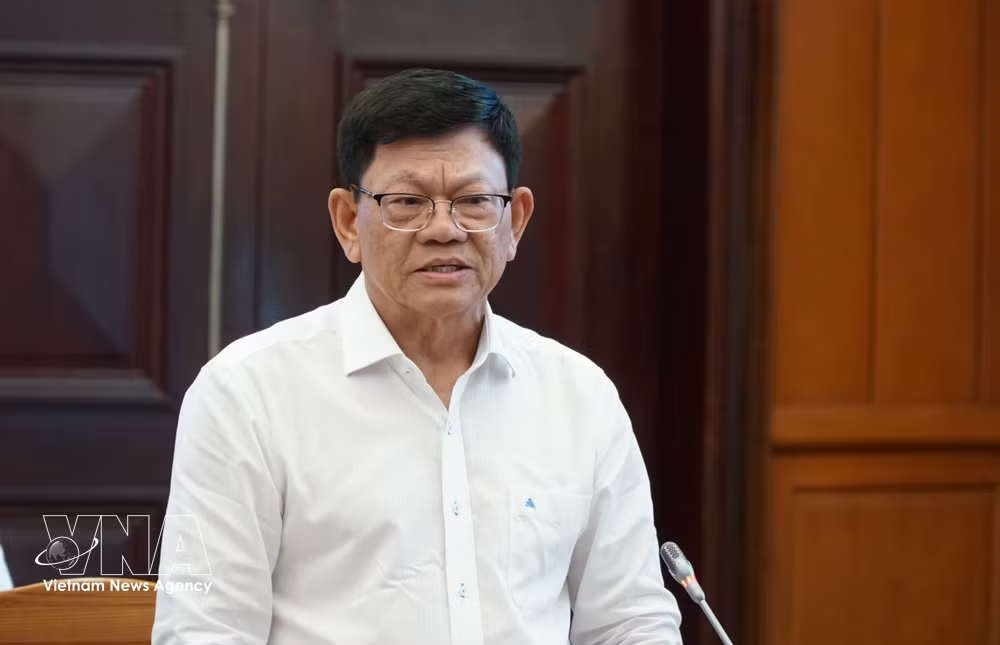
Vo Cong Tri, Chairman of the Union of Science and Technology Associations (VUSTA) in Da Nang, speaks at the forum. (Photo: VNA)

However, Tri stressed that the city must shift its mindset from traditional administrative personnel management to a more dynamic approach of “intellectual capital governance.” This includes targeted training and breakthrough policies to attract talent in strategic sectors such as semiconductor design, artificial intelligence, biotechnology, finance and marine economy.

Echoing this view, Prof. Dr. Bui Van Ga, former Deputy Minister of Education and Training, said Da Nang must go beyond salaries to attract high-tech talent by offering a better living environment, a dynamic innovation ecosystem and flexible incentives, including a dedicated talent fund and greater international mobility.

He stressed the need to align training with national strategic technologies, noting that producing 500 – 1,000 high-quality semiconductor design engineers annually could position Da Nang as Vietnam’s second-largest semiconductor hub within five years, after Ho Chi Minh City.

Dr. Nguyen Quang Thanh, Vice President of the Vietnam Informatics Association, said the digital economy is becoming a cornerstone of Da Nang’s socio-economic development, supported by preferential policies targeting core sectors such as software, semiconductors, digital asset and finance, and digital infrastructure.

To accelerate progress, Thanh proposed expanding digital payments and financial inclusion, while attracting investment into large-scale data centre clusters at both national and international levels. He also highlighted the need to develop clean energy sources to power digital industries and prioritise technologies aligned with the Government’s strategic technology framework.

Assoc. Prof. Dr. Nguyen Gia Nhu, Rector of the School of Computer Science at Duy Tan University, said Da Nang has the potential to position itself as Vietnam’s future digital economy hub. He emphasised the importance of building an innovation ecosystem based on close collaboration between the State, universities, investors, businesses and the community.

A key mechanism, he noted, is public-sector “innovation ordering,” whereby authorities set open challenges, such as reducing traffic congestion, forecasting urban flooding or improving administrative services, for universities and tech firms to develop solutions. This approach could both address practical urban issues and foster the creation of “made in Da Nang” technology products.

According to Le Tri Thanh, Chairman of the Vietnam Fatherland Front Committee in Da Nang, affirmed that intellectuals, scientists and experts are a vital resource, playing a leading role in research, policy advisory, human resource training and innovation. Their contributions have been instrumental to the city’s achievements to date.

As Da Nang moves into a new development phase, officials say the city will need fresh mindset, bold reforms and breakthrough solutions to generate new growth drivers, enhance competitiveness and ensure sustainable development./.

VNA

See more

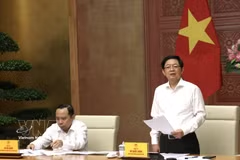
Deputy Prime Minister Ho Quoc Dung speaks at the meeting. (Photo: VNA)

Deputy PM demands full disbursement for sci-tech in 2026

As of May 12, total disbursed capital reached 7.95 trillion VND, equivalent to 14.78% of the Prime Minister’s plan. Of this, central budget disbursement hit 4.06 trillion VND, or 14.8% of the target, while local budget disbursement exceeded 3.88 trillion VND, or 14.75%.

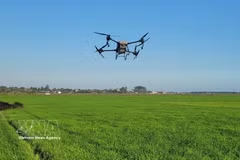
Using drones to spray pesticides in the An Nhut rice fields in Long Dien commune of Ho Chi Minh City. (Photo: VNA)

Solving technology challenge through the “three-party linkage”

According to Pham Duc Nghiem, Deputy Director of the Department of Startups and Technology Enterprises under the Ministry of Science and Technology, the “three party” linkage model involving the State, research institutes/universities and enterprises is becoming essential for developing strategic technologies. Enterprises provide practical problems, universities and research institutes develop technological solutions, while the State creates support mechanisms and policies to accelerate commercialisation.

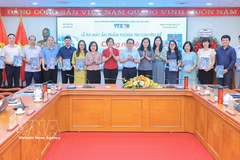
Delegates at the publication launching ceremony. (Photo: VNA)

Vietnam News Agency debuts monthly technology publication

Each 40-page issue is expected to pack 3-5 chapters, delivering a panoramic view of the global sci-tech landscape alongside in-depth analyses of emerging technology trends. The publication aims to explain strategic shifts that will shape the country’s development and examine the sci-tech, innovation and digital transformation policies of other nations.

A worker assembles ultra-precision micro-components used in semiconductor chip production. (Photo: VNA)

Vietnam prioritises 70 high technologies for strategic development

Issued under Decision No. 23/2026/QD-TTg dated May 15, 2026, the list covers a wide range of technologies, including artificial intelligence (AI), big data and data analytics, cloud and edge computing, distributed and high-performance computing, Internet of Things (IoT), blockchain, quantum technology, renewable and clean energy, advanced energy storage, AI-powered real-time disaster forecasting and warning systems, and next-generation microbiology technologies.

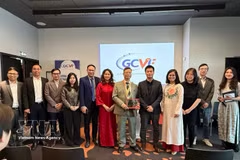
Vietnamese Ambassador to France Trinh Duc Hai (sixth from the right) and the leadership of Global Connect Vietnam France. (Photo: VNA)

Vietnamese association launched in France to foster technology, AI cooperation

In the context of the growing Comprehensive Strategic Partnership between Vietnam and France, Hai said GCVF should position itself as a bridge for knowledge and technology transfer, bringing scientific and technological achievements from France and Europe to support Vietnam’s practical development needs.

Party General Secretary and State President To Lam presents a statute of President Ho Chi Minh to VNU-Hanoi. (Photo: VNA)

Top Vietnamese leader’s vision puts scientists at core of growth drive

As the country enters a new era, the Party and State have designated sci-tech and and innovation as central priorities, Kiem said, adding that VNU-Hanoi, alongside other higher education establishments, must not only produce high-caliber talents but also function as a hub for knowledge transfer and groundbreaking innovation.

Illustrative image (Photo: VNA)

Korean robotics, AI firms interested in Vietnam

KOTRA said it is teaming up with the Korea Institute for Robot Industry Advancement to run the “K-Robot Pavilion"” at the 23rd Vietnam International Exhibition on Machinery, Equipment, Technology and Industrial Products (VINAMAC EXPO 2026) in Hanoi from May 14-16.

Party General Secretary and State President To Lam (left) and Sri Lankan President Anura Kumara Dissanayake come to lay flowers in tribute to late President Ho Chi Minh at the Colombo Public Library on May 8. (Photo: VNA)

Sri Lanka eyes breakthrough sci-tech cooperation with Vietnam

A Sri Lankan official has expressed confidence that science, technology and digital transformation will become a key driver in shifting bilateral ties from traditional friendship to a partnership grounded in innovation and inclusive economic growth.

Vietnam promotes cooperation with United Nations on crime prevention

Vietnam promotes cooperation with United Nations on crime prevention

Vietnam highly values the support of the United Nations Office on Drugs and Crime (UNODC) in strengthening national capacity in crime prevention and criminal justice, drug control, and addressing emerging challenges, particularly cybercrime, said Ambassador Vu Le Thai Hoang.

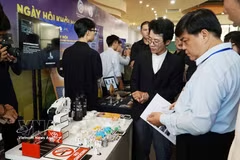
Visitors tour an exhibition showcasing technology and cultural products. (Photo: VNA)

VIPC Summit 2026 highlights Vietnam’s ambitions in strategic technologies

Through the VIPC Summit 2026, Vietnam aims to reaffirm its commitment to building a transparent, competitive and internationally integrated investment environment, while promoting new financial mechanisms and institutions to make science, technology, innovation and digital transformation strategic growth motivation in the coming years.

At the “Digital Trust in Finance 2026” forum (Photo: VNA)

Forum discusses digital trust in finance during AI era

Deputy Minister of Public Security Sen. Lieut. Gen Pham The Tung told the forum that Vietnam’s financial and banking industry is racing through a digital overhaul, creating major opportunities as the country aims for double-digit growth in 2026 and beyond.

Citizens obtain queue numbers for administrative procedures at the Public Service Center of Hanoi's Hoan Kiem ward (Photo: VNA)

All citizen-government transactions to go fully digital by 2035

Looking ahead to 2035, Vietnam envisions becoming a comprehensive and sustainable digital nation where all transactions between citizens and government agencies are conducted online. National databases, with population data at the core, will be interconnected and efficiently utilised to support smart governance and real-time decision-making.

The EV models are manufactured at VinFast's factory in India. (Photo: VNA)

Experts hope for expanded Vietnam-India innovation cooperation

Indian experts voiced confidence that the state visit by Party General Secretary and State President To Lam would create fresh momentum for Vietnam-India cooperation in innovation, digital technology and startups, contributing to the more substantive and effective development of the two countries’ Enhanced Comprehensive Strategic Partnership.

Vietnamese and Australian experts at the meeting (Photo: VNA)

Vietnam, Austria promote cooperation in AI, cybersecurity

The NCA proposed strengthening its strategic partnership with the AIT through several key orientations, including the protection of critical digital infrastructure, data security and trusted digital ecosystems, the application of AI and data analytics in cybersecurity, high-quality human resources training, expert exchanges, and the co-organisation of annual international forums and conferences.