Resolution 57 delivers tangible gains in digital life of citizens

The resolution has generated not only strategic momentum but also practical impact, as digital technologies are increasingly embedded in daily activities, driving socio-economic development and laying a solid foundation for rapid and sustainable growth in the new phase.

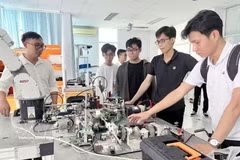
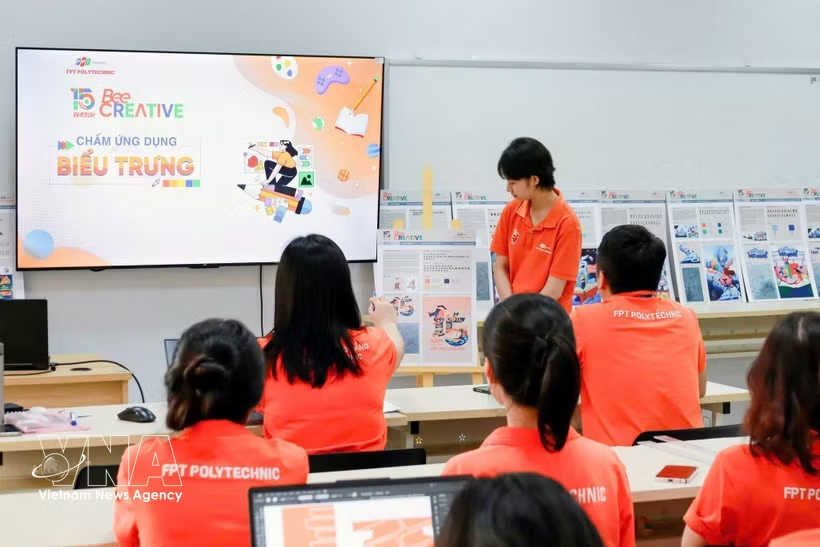
Students engage in hands-on learning through the application of digital technology software. (Illustrative photo: VNA)

Hanoi (VNA) – With strong political resolve, coordinated action across the political system and broad public support, the Politburo’s Resolution No. 57-NQ/TW on breakthroughs in science and technology development, innovation and national digital transformation has been implemented in a comprehensive and synchronised manner across sectors and localities, yielding concrete results in everyday life.

The resolution has generated not only strategic momentum but also practical impact, as digital technologies are increasingly embedded in daily activities, driving socio-economic development and laying a solid foundation for rapid and sustainable growth in the new phase.

In education, digital transformation has shifted from a policy objective to an operational imperative. In Ho Chi Minh City, a digital school model built on advanced online management and learning platforms has enabled both teachers and students to access cutting-edge technologies. Beginning in the 2025–2026 academic year, the city has piloted artificial intelligence (AI) education in more than 170 high-quality schools, as well as digital schools, with flexible implementation tailored to institutional conditions. Schools outside the pilot programme have also been encouraged to integrate AI-related content into curricula and extracurricular activities.

The municipal education sector has accelerated digital governance, including the rollout of digital academic records with a view to fully digitising high school records during the 2025–2026 academic year. A shared digital learning ecosystem has been developed with standardised resources and internationally aligned connectivity platforms, while learning management systems have been widely deployed to support self-learning and assessment in digital environments.

Similar efforts have been observed in Ho Chi Minh City’s neighbouring Dong Nai province, where schools are gradually modernising teaching methods and fostering innovative learning environments. Le Quy Don Secondary School in Long Khanh ward was highlighted as an early adopter of the digital classroom model, where each student is equipped with a personal computer and lessons are delivered through interactive digital content, visual materials and video-based instruction. Such approaches have expanded access to knowledge and enabled students to learn anytime and anywhere through digital resource libraries and online question banks.

Meanwhile, the digital environment allows teachers to shift from knowledge transmitters to designers of learning experiences, with technology serving as a facilitative tool. However, the decisive pedagogical role remains with teachers, and expanding their professional autonomy in digital environments has been identified as a key condition for achieving digital transformation goals in education.

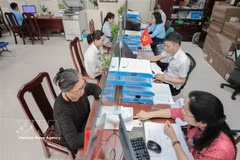
Beyond education, digital technologies are increasingly enhancing public service delivery. In Thanh Hoa province, a pilot model of smart kiosks has reportedly transformed administrative procedures, making them faster, more transparent and more user-friendly. Citizens can scan original documents at the kiosks, where the system automatically verifies and authenticates information before transferring it for processing. Within minutes, legally valid electronic copies can be issued, eliminating the need for prolonged waiting times.

The kiosks also integrate multiple public service functions, including application tracking, online payments and submission of essential administrative procedures. The system is connected to the national public service portal and the Ministry of Public Security’s service ecosystem, enabling convenient access to services such as criminal record certificates, driver’s license issuance and civil registration procedures.

Following positive pilot outcomes, Thanh Hoa plans to expand the model across all 166 communes and wards, with a focus on improving digital infrastructure and access, particularly in rural and mountainous areas.

Meanwhile, Ho Chi Minh City has deployed an AI-integrated camera surveillance system to enhance traffic management. Operating around-the-clock, the system can automatically detect and record a wide range of violations, including those previously difficult to address through manual methods. Since early 2026, nearly 2,000 cameras have identified approximately 122,500 traffic violations.

Further investment and expansion of AI-based monitoring systems are planned, contributing not only to improved governance but also to the development of smart, modern urban environments in line with the objectives of Resolution 57./.

VNA

See more

The Duc Giang General Hospital and Vietnam Post Corporation jointly launch a model applying drones to medical transport services. (Photo: hanoimoi.vn)

Vietnam charts UAV strategy as Hanoi eyes low-altitude economy

Vietnam is accelerating a national strategy to develop unmanned aerial vehicles (UAVs) as a cornerstone of its emerging low-altitude economy, with Hanoi positioning itself to pilot new governance models, regulatory sandboxes and early-stage applications in controlled airspace.

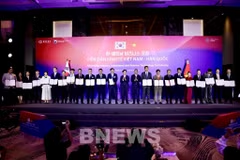
Vietnamese Prime Minister Le Minh Hung and the Republic of Korea's President Lee Jae Myung attend an economic forum in Hanoi on April 23. (Photo: VNA)

SK Group partners to build AI ecosystem in Vietnam

SK Innovation and SK Telecom signed MoUs with Nghe An province and the National Innovation Centre of Vietnam to advance AI ecosystem development and support the country’s long-term growth strategy.

CMC signs an AI cooperation deal with Korean partner FuriosaAI (Photo: CMC)

CMC signs AI cooperation deal with Korean partner

Under the agreement, CMC Global - a member of CMC Corporation - and FuriosaAI will collaborate on developing AI application software, leveraging their respective technological strengths and customer ecosystems to roll out joint projects in the coming period.

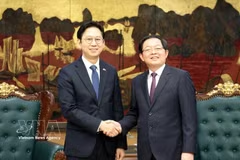
Vietnamese Deputy Prime Minister Ho Quoc Dung (R) and Deputy Prime Minister and Minister of Science and ICT of the Republic of Korea (RoK) Bae Kyung Hoon in Hanoi on April 22, 2026. (Photo: VNA)

Vietnam, RoK promote science, technology cooperation

Deputy Prime Minister Ho Quoc Dung encouraged Korean enterprises to scale up investment in Vietnam, particularly in priority sectors such as infrastructure development, high-tech electronics manufacturing, semiconductors, big data, biotechnology, and smart urban development.

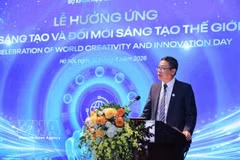
Deputy Minister of Science and Technology Le Xuan Dinh delivers opening remarks at the launching ceremony of the Scientific Innovation Competition 2026 on April 21. (Photo: VNA)

Scientific Innovation Competition opens to OVs, boosting global talent linkages

In response to World Creativity and Innovation Day 2026, the contest provides a platform for individuals and teams nationwide who are passionate about research, creativity, and practical application of science, while promoting a movement of scientific inquiry within the community, particularly among young people.

Dr. Santiago Dueñas Carrera (left), Vice President of Cuba’s BioCubaFarma group, and Cuban Ambassador to Vietnam Rogelio Polanco Fuentes at the press briefing in Hanoi on April 21 (Photo: VNA)

Biotechnology cooperation – new driver of Vietnam - Cuba relations

A representative from BioCubaFarma emphasised that the longstanding Vietnam – Cuba friendship provides a solid foundation for further advancing comprehensive cooperation, especially in science and technology – a key driver of socio-economic development and national healthcare sovereignty.

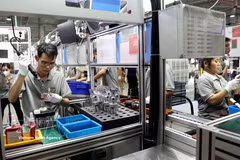
Workers manufacture products at Keystone Electrical Vietnam Co., Ltd. in the Lien Ha Thai industrial park. (Photo: VNA)

Vietnam turning ideas into value, aspirations into reality

Resolution No. 57 of the Politburo on breakthroughs in science-technology development, innovation, and national digital transformation is being vigorously implemented nationwide. Within this framework, innovation is increasingly recognised as a key engine for rapid and sustainable growth.

MK Smart achieves Common Criteria EAL5+ Certification, expanding opportunities in global digital identity

MK Smart achieves Common Criteria EAL5+ Certification, expanding opportunities in global digital identity

As countries accelerate the development of digital governments, electronic identification (eID) and electronic passports (ePassport) are becoming essential infrastructure. At the same time, security requirements are becoming increasingly stringent security requirements, particularly for systems that store sensitive data such as citizens’ identity and biometric information.

Sorting fish prior to transport for distribution. (Photo: VNA)

Fishermen keep pace with digital technology

Across central coastal provinces, authorities have introduced policies to restructure fleets, reduce vessel numbers, and support fishermen in transitioning to more sustainable livelihoods. Provinces such as Dak Lak and Gia Lai have earmarked nearly 1 trillion VND to support occupational changes and decommission inefficient vessels, while others including Nghe An, Quang Tri, Hue, and Quang Ngai are implementing roadmaps to phase out thousands of underqualified boats.

Phuc Loi ward in Hanoi has launched the “Digital Literacy for All” movement, forming support teams to help residents install applications such as iHanoi and eTax. (Photo: VNA)

Hanoi advances technological innovation in key economic sectors

The municipal People's Committee recently issued Plan No. 109/KH-UBND on technological innovation in key economic sectors through 2035, which serves as both a catalyst and a strategic move to systematise, elevate and reinforce the capital’s leading role in the digital era.

General Secretary of the Communist Party of Vietnam (CPV) Central Committee and State President To Lam (first, right, front row) listens to a presentation about the China-ASEAN AI Application Cooperation Centre (Photo: VNA)

Top Vietnamese leader visits China–ASEAN AI Application Cooperation Centre

The China–ASEAN AI Application Cooperation Centre, jointly established by the Guangxi Zhuang Autonomous Region and ASEAN countries, aims to promote inclusive and mutually beneficial development of AI globally. It is regarded as a flagship project in advancing the “Digital Silk Road” initiative in Nanning.