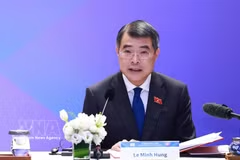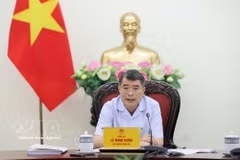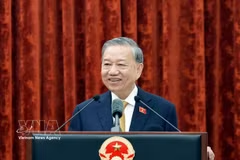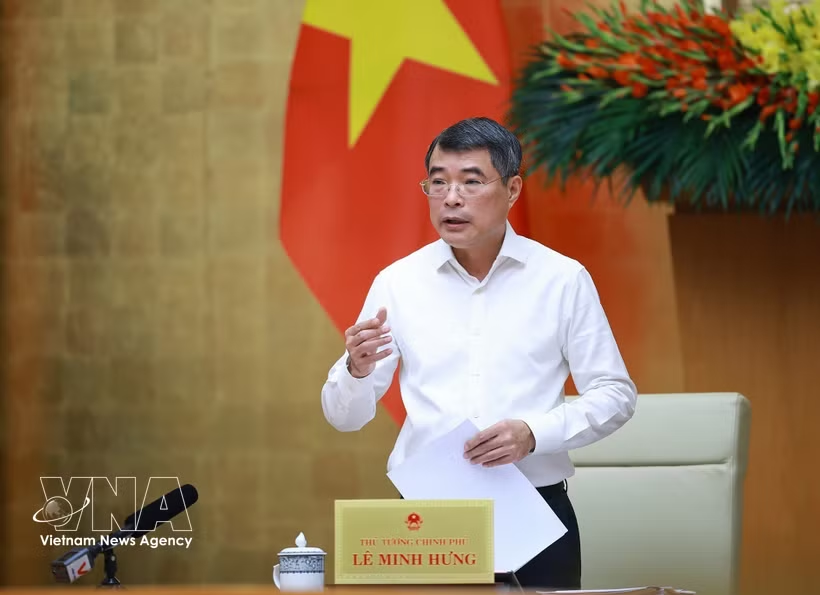
Hanoi (VNA) – Prime Minister Le Minh Hung on May 4 underscored the need to fully and promptly grasp and effectively implement Party and Government resolutions in a concerted, determined manner in order to promote growth, while maintaining macroeconomic stability.
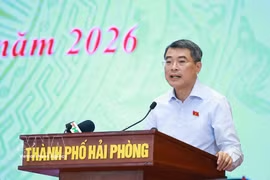
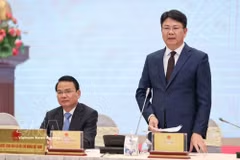
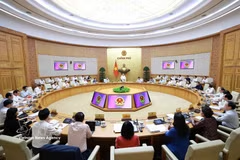
He made the remarks while chairing the Government’s regular meeting for April, the first of the 16th-tenure Government.
At the meeting, the body reviewed socio-economic performance in April and the first four months; the allocation and disbursement of public investment; implementation of national target programmes; reports on the Government and Prime Minister’s direction and governance; and progress in fulfilling assigned tasks in April, alongside key priorities for May and the period ahead.
The session noted that shortly after its consolidation, the 16th Government issued eight resolutions aimed at cutting, decentralising and simplifying administrative procedures and business conditions. Accordingly, 184 administrative procedures were abolished, 134 were decentralised to local authorities, 349 were simplified, and 890 business conditions were removed. The Government also restructured the steering committee on science and technology development, innovation and digital transformation.
In April and the first four months, macroeconomic conditions remained broadly stable, inflation was kept under control, and major economic balances were ensured. In January-April, the consumer price index (CPI) rose by an estimated 3.99%; state budget revenue reached over 1.11 quadrillion VND (42.14 billion USD), equivalent to 44% of the annual estimate and up 15.2% year-on-year; total import-export turnover was estimated at 344.2 billion USD, up 24.2%. Public investment disbursement reached 14.2%, while foreign direct investment (FDI) inflows rose strongly, with newly registered capital exceeding 18.2 billion USD (up 32%) and disbursed FDI reaching 7.4 billion USD (up 9.8%).
Agricultural production remained stable, industrial output continued to grow steadily, and key projects stayed on schedule. Trade and services maintained growth momentum, while tourism recorded strong expansion.
The meeting also pointed to a number of shortcomings, challenges and difficulties.
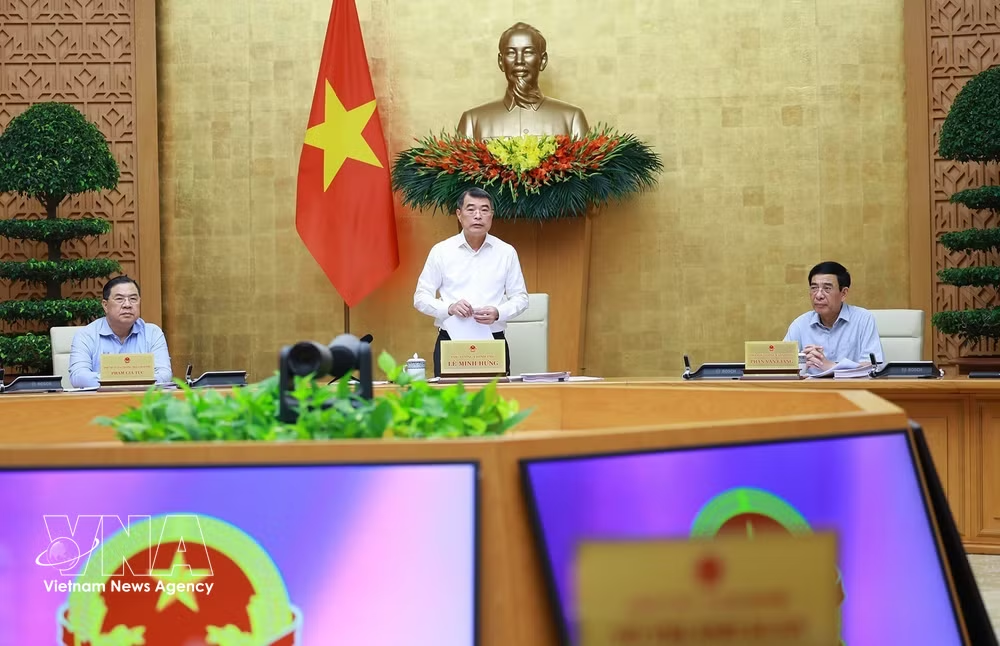
Concluding the session, PM Hung broadly concurred with participants’ assessments and stressed the importance of mobilising and using all resources efficiently for development.
He called for strengthened discipline in the drafting and issuance of legal documents, tighter accountability of heads of agencies, and the use of progress in issuing detailed regulations as a criterion for evaluating task performance.
Ministries and sectors were instructed to accelerate the drafting and promulgation of guiding legal documents, and to review and amend key laws, including those on state budget, public investment, bidding, support for small- and medium-sized enterprises, and land.
The PM urged the timely preparation of draft laws for submission to the Government in May and June, serving presentation to the National Assembly at its second session in October.
He said administrative reform efforts should to be intensified, with further reductions in business conditions and simplification of procedures, alongside enhanced decentralisation paired with stronger oversight. Implementation outcomes will serve as a benchmark for assessing the performance of ministries, sectors and localities.
The Ministry of Finance was tasked with urgently proposing plans for the use of additional revenue and expenditure savings, to be reported to the PM before May 15. It is also to refine mechanisms and policies on taxation and finance, as well as the legal framework for capital markets, corporate bonds, pilot schemes for digital assets, and the development of investment funds and carbon credits.
The leader also called for stronger restructuring of state-owned enterprises and the study of establishing a national investment fund based on the restructuring of the State Capital Investment Corporation.
He stressed the need to decisively address delays in capital allocation, with disbursement results to be publicly reported on a monthly basis.
The State Bank of Vietnam was instructed to manage monetary policy flexibly, maintain stability in the foreign exchange and credit markets, and continue refining the legal framework governing credit activities.
In sectoral development, the Ministry of Agriculture and Environment was tasked with ensuring food security under all circumstances, while the Ministry of Industry and Trade was urged to further develop the domestic market, stimulate consumption, enhance trade promotion, and effectively leverage free trade agreements. Priority is also to be given to accelerating key industrial and energy projects to ensure national energy security and avoid power shortages.
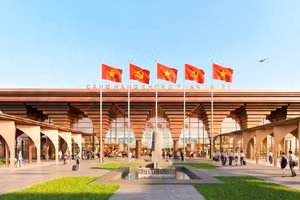
The Ministry of Construction was directed to speed up major infrastructure projects, including the Long Thanh International Airport in Dong Nai province and Gia Binh International Airport in Bac Ninh province, and to expedite preparations for the North–South high-speed railway project. It was also tasked with promoting a healthy and sustainable real estate market and accelerating social housing development, with a target of completing over 110,000 units this year.
In science, technology, innovation and digital transformation, PM Hung called for the effective implementation of Politburo Resolution No. 57, development of digital infrastructure and national data systems, establishment of regulatory sandboxes for new economic and technological models, and promotion of artificial intelligence and the digital economy.
He also highlighted the need to improve the quality of education and training, effectively implement national target programmes, and ensure social welfare, particularly for revolution contributors and vulnerable groups.
On defence, security and foreign affairs, the leader called for effective implementation of assigned tasks and the realisation of cooperation programmes and plans./.