Vietnam, India increasingly aligned on regional, global priorities: Indian researcher

Over the past decade, the Vietnam–India Comprehensive Strategic Partnership has made strong progress, becoming increasingly substantive and comprehensive.

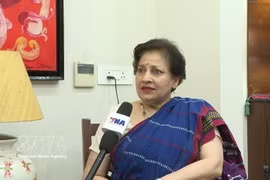
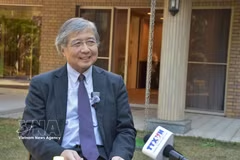
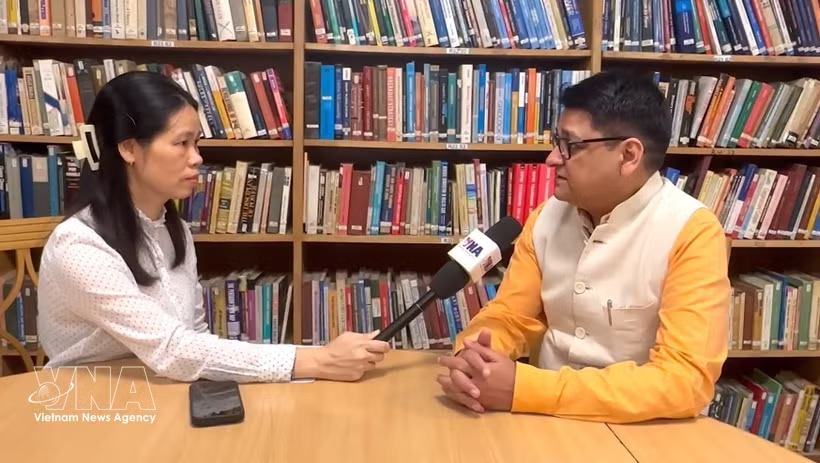
Professor Harsh V. Pant, Vice President of the Observer Research Foundation (ORF) speaks to the Vietnam News Agency’s correspondents in New Delhi. (Photo: VNA)

New Delhi (VNA) – Vietnam and India are increasingly aligned in their regional and global priorities, as reflected in the significant rise in high-level exchanges and growing people-to-people interactions between the two countries, according to Professor Harsh V. Pant, Vice President of the Observer Research Foundation (ORF).​

Speaking to the Vietnam News Agency’s correspondents in New Delhi ahead of the 10th anniversary of the Comprehensive Strategic Partnership (2016–2026) and on the occasion of the state visit by General Secretary of the Communist Party of Vietnam Central Committee and State President To Lam to India from May 5-7 at the invitation of Prime Minister Narendra Modi, Pant said over the past decade, the Vietnam–India Comprehensive Strategic Partnership has made strong progress, becoming increasingly substantive and comprehensive.

The partnership has expanded beyond bilateral cooperation between two Asian nations into a closer alignment based on a shared vision for the regional order, particularly within the framework of a Free and Open Indo-Pacific.​

Economic cooperation has gathered momentum, with Vietnam playing an increasingly important role in India’s Act East policy and emerging as one of India’s leading trading partners within ASEAN, he noted.​

According to Pant, defence and security ties have remained one of the most important pillars of bilateral ties during the past decade. Progress has included closer coordination on regional security, naval ship supply, joint exercises and broader logistical cooperation.​

People-to-people exchanges have also expanded steadily, helping reinforce the social foundation for long-term bilateral relations, he added.

Against the backdrop of profound changes across the Indo-Pacific, the professor described Vietnam-India relations as an important factor in preserving regional stability and balance. At a time of intensifying major-power competition and shifts in the global order, partnerships among like-minded countries such as Vietnam and India are essential to maintaining an open and free regional environment free from hegemonic pressures.​

He said the two countries' continuous elevation of ties from symbolic to substantive has contributed to regional stability and enhanced cooperation, while also helping to balance the impact of great power competition.

Looking ahead, Pant said one of the biggest challenges is raising the level of ambition in bilateral ties. Traditional cooperation mechanisms and conventional models of globalisation are under strain, requiring both sides to explore new avenues of collaboration.

Although economic collaboration has grown, he said it still falls short of potential. He called for stronger economic connectivity, particularly among small and medium-sized enterprises, as well as deeper industrial linkages, academic exchanges, media cooperation and closer engagement between research institutions.

He also stressed that student exchanges, media dialogue and sustained institutional engagement would create a stronger long-term foundation, enabling both countries to preserve strategic autonomy and respond more effectively to emerging international uncertainties in coming years.

Pant described Party General Secretary and State President Lam’s upcoming visit as highly significant. Beyond symbolism, it reaffirms Vietnam’s commitment to strengthening ties with India. It will also offer a chance for the two nations to review achievements and frankly point out challenges, thus highlighting the need for enhancing coordination at the highest level. Direct exchanges between high-raking leaders, he said, remain crucial to reinforcing trust and shaping future cooperation.

Professor Pant emphasised that the visit will help reaffirm both countries’ commitment to joint work in effectively addressing future challenges and seizing new opportunities arising from global uncertainties./.
VNA

See more

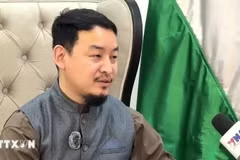
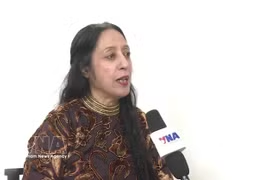
Prof. Anmol Mukhia from South Asian University (Photo: VNA)

Vietnam–India ties poised for new strategic breakthrough: Scholar

With Vietnam–India ties resting on a solid foundation, the upcoming state visit by General Secretary of the Communist Party of Vietnam Central Committee and State President To Lam will play a pivotal role in shaping the next phase of relations toward deeper, more substantive and long-term strategic cooperation.

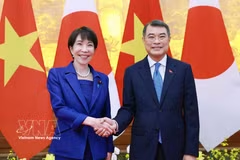
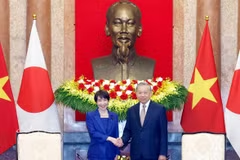
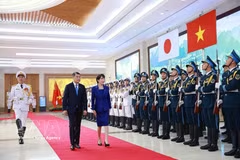
Prime Minister Le Minh Hung and Japanese Prime Minister Takaichi Sanae. (Photo: VNA)

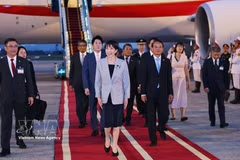
Japanese PM concludes official visit to Vietnam

Prime Minister Takaichi Sanae’s first official visit to Vietnam was a great success, marking an important milestone that creates new momentum and opens up further opportunities for cooperation between the two countries.

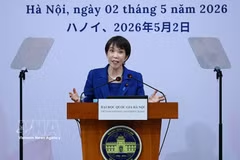
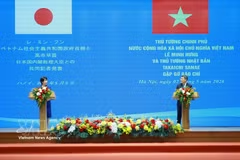
Japanese Prime Minister Takaichi Sanae delivers a keynote policy speech at Vietnam National University, Hanoi. (Photo: VNA)

Japanese PM delivers keynote policy speech in Hanoi

Commenting on Vietnam’s economic progress, PM Takaichi expressed admiration for the country’s rapid rise. Ten years ago, “Made in Vietnam” typically referred to clothing and textiles. Today, however, numerous global companies have established a presence in Vietnam, and many of the gadgets supporting youth culture are now manufactured here. Moreover, many of these electronic products incorporate cutting-edge Japanese technology in their core components.

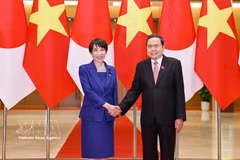
NA Chairman Tran Thanh Man (R) and Japanese Prime Minister Takaichi Sanae (Photo: VNA)

NA Chairman meets with Japanese PM

Both leaders expressed satisfaction with the robust and substantive development of the Vietnam–Japan Comprehensive Strategic Partnership, underscoring the importance of parliamentary cooperation. They agreed to further bolster political trust, high-level exchanges and interactions between two legislatures’ specialised committees, and cooperation among friendship parliamentary groups, young and female legislators.

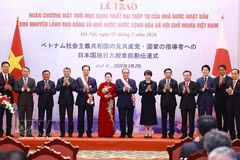
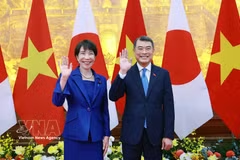
Prime Minister Le Minh Hung and Japanese Prime Minister Takaichi Sanae pose for a photo at the official welcome ceremony on May 2, 2026. (Photo: VNA)

Vietnam, Japan push for more substantive, effective ties

Noting the strong momentum in bilateral ties, built on solid political trust, extensive economic cooperation and growing people-to-people exchanges, PM Hung called for closer coordination to take the partnership to new heights and broaden collaboration across all sectors.

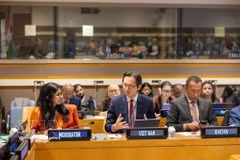
Ambassador Do Hung Viet, Vietnam’s Permanent Representative to the United Nations, speaks at the meeting. (Photo: VNA)

Vietnam calls for solidarity in support of Cuba

Ambassador Do Hung Viet, Vietnam’s Permanent Representative to the United Nations, called on member states to uphold the movement’s spirit of solidarity, continue supporting Cuba, oppose unilateral embargoes and sanctions, and back dialogue efforts between Cuba and the US based on mutual respect, peace, stability and the interests of their people.

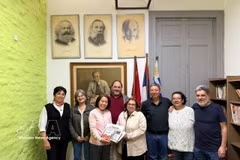
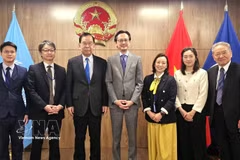
Vietnamese Ambassador Ngo Minh Nguyet poses for a group photo with representatives of the Communist Party of Uruguay. (Photo: VNA)

Communist Party of Uruguay enhances cooperation with Vietnam

The Communist Party of Uruguay (PCU) is ready to coordinate and share materials to support the development of the Communist Party of Vietnam Museum. A photo archive centre in Montevideo currently stores many valuable images and materials on Vietnam and is expected to support information exchange between the two sides.

Nguyen Viet Duc, Vice President of the Union of Vietnamese Associations in Germany, delivers remarks at the working session. (Photo: VNA)

Vietnamese community in Germany strengthens connectivity

Solidarity, mutual support, and resilience remain key characteristics of the Vietnamese community in Germany, with Vietnamese people continuing to value family, prioritise education, make continuous efforts to integrate into host society, and preserve cultural identity while maintaining ties with their homeland.

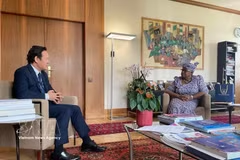
Ambassador Mai Phan Dung and WTO Director-General Ngozi Okonjo-Iweala in a meeting. (Photo: VNA)

Vietnam continues to contribute effectively to multilateral mechanisms: Ambassador

With a solid foundation of political stability, a clear development orientation, and strong international support, Vietnam is well-positioned to continue enhancing its role in multilateral forums, contributing actively to addressing global challenges, and realising its aspiration to become a high-income, developed country by 2045.

Ambassador Do Hung Viet (centre) and Chairman of the Presidium of the Central Committee of the Japanese Communist Party Shii Kazuo (third from the left) and other delegates pose for a group photo (Photo: VNA)

Vietnam values growing ties with Japan: diplomat

Vietnam attaches great importance to the increasingly close and effective Comprehensive Strategic Partnership with Japan, as well as the close and foundational ties between their Communist Parties, Ambassador Do Hung Viet has said.

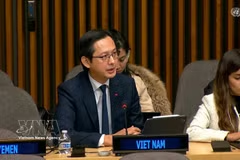
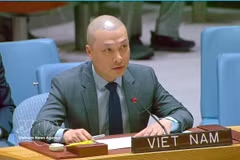
Minister Counsellor Nguyen Hoang Nguyen, Deputy Permanent Representative of Vietnam to the UN addresses the session (Photo: VNA)

Vietnam calls for de-escalation of tension in Middle East

Minister Counsellor Nguyen Hoang Nguyen, Deputy Permanent Representative of Vietnam to the UN reaffirmed Vietnam’s consistent stance of supporting the Palestinian people’s right to self-determination, Palestine’s UN full membership, and the two-state solution based on pre-1967 borders, in accordance with international law and relevant UN resolutions.