Japanese PM delivers keynote policy speech in Hanoi

Commenting on Vietnam’s economic progress, PM Takaichi expressed admiration for the country’s rapid rise. Ten years ago, “Made in Vietnam” typically referred to clothing and textiles. Today, however, numerous global companies have established a presence in Vietnam, and many of the gadgets supporting youth culture are now manufactured here. Moreover, many of these electronic products incorporate cutting-edge Japanese technology in their core components.

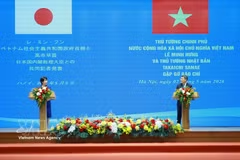
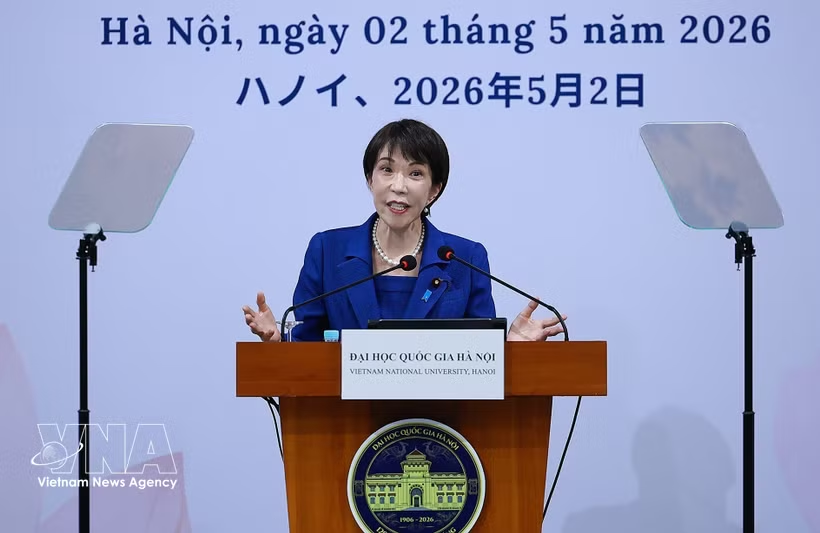
Japanese Prime Minister Takaichi Sanae delivers a keynote policy speech at Vietnam National University, Hanoi. (Photo: VNA)

​Hanoi (VNA) - Japanese Prime Minister Takaichi Sanae visited and delivered a keynote policy speech at the Vietnam National University (VNU) - Hanoi on May 2, conveying a strong message about the future of the Vietnam–Japan Comprehensive Strategic Partnership and announcing important updates to Japan’s Free and Open Indo-Pacific (FOIP) Vision.

Opening her address, PM Takaichi recalled her visit to Vietnam six years ago and expressed her wish to return to Hoi An, home to the historic Japanese bridge Nihonbashi, whose restoration was completed two years ago with Japan’s cooperation.

This bridge, which has withstood the passage of more than 400 years, tells the story of centuries of exchange between Japan and Vietnam, she said, adding that then-Prime Minister Abe chose Vietnam as the destination for his first overseas visit after taking office in 20113.

Commenting on Vietnam’s economic progress, PM Takaichi expressed admiration for the country’s rapid rise. Ten years ago, “Made in Vietnam” typically referred to clothing and textiles. Today, however, numerous global companies have established a presence in Vietnam, and many of the gadgets supporting youth culture are now manufactured here. Moreover, many of these electronic products incorporate cutting-edge Japanese technology in their core components.

According to her, Vietnam’s manufacturing industry has now become an indispensable supplier to the global market, forging an inseparable relationship with the Japanese economy as well.
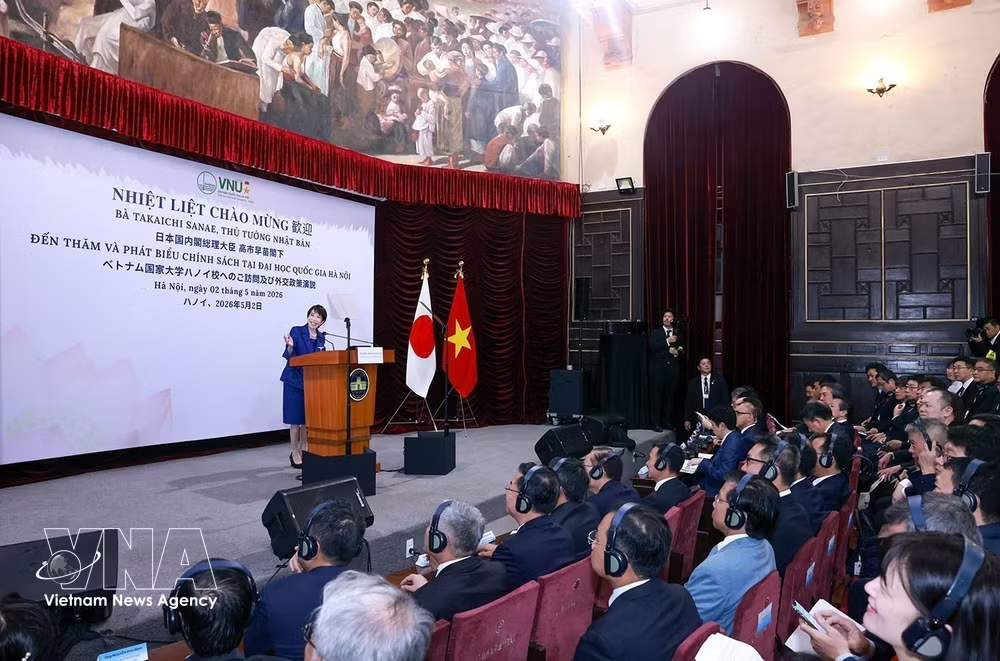
vnanet-policy.jpg
Japanese Prime Minister Takaichi Sanae delivers a keynote policy speech at Vietnam National University, Hanoi. (Photo: VNA)

At the three Thang Long Industrial Parks near Hanoi, 205 Japanese companies operate, providing employment to around 100,000 people and serving as important hubs in the international supply chains for Japanese manufacturers. For example, Canon procures parts from Vietnam, Japan, and elsewhere in Asia, and manufactures one in every four printers worldwide in Vietnam, shipping them to markets around the globe, she added.

Looking ahead, she affirmed that bilateral collaboration has expanded into outer space. She welcomed the inauguration of the Vietnam Space Centre, developed with Japan’s official development assistance, at Hanoi’s Hoa Lạc Hi-Tech Park this March, describing it as a milestone after nearly two decades of sustained efforts since 2006. Japan is also helping Vietnam develop the Earth observation satellite LOTUSat-1 to enhance disaster forecasting and climate change response.

Last year, the "Semiconductor Chip Technology Engineer Programme" was newly established at the Vietnam-Japan University. This is expected to contribute not only to Vietnam’s industrial advancement but also to the strengthening of Japan’s semiconductor supply chain.

Japan is strengthening cooperation to make supply chains more resilient, she said, wishing to advance concrete Japan-Vietnam public-private collaboration.

Marking 10 years since the late Japanese Prime Minister Shinzo Abe first introduced the (FOIP) vision in Kenya in 2016, PM Takaichi reaffirmed the initiative’s continued relevance, particularly as ASEAN adopted the ASEAN Outlook on the Indo-Pacific (AOIP) in 2019, which shares core values and spirits with Japan’s FOIP. She noted that last October, she and ASEAN leaders adopted a joint statement confirming the synergy between FOIP and AOIP and the promotion of further cooperation.

Against the backdrop of structural shifts in the global order, including intensifying geopolitical competition, rapid technological change and the rise of the Global South, PM Takaichi unveiled an updated FOIP framework focused on three priorities: building economic infrastructure for the age of AI and data including strengthening supply chain resilience for energy and critical materials; co-creation of economic growth opportunities through public-private collaboration and rule sharing; and enhancing cooperation in the field of security to ensure regional peace and stability.

On energy security, the Japanese leader said she recently held an emergency online summit with Asian leaders and announced the “Partnership on Wide Energy and Resource Resilience Asia”—POWERR Asia, thanking PM Hung for his participation.

As the first project under "POWERR Asia," Japan and Vietnam concurred to support through NEXI in order to procure crude oil for the Nghi Son Refinery. As a medium- to long-term structural response, the two sides will draw on Japan’s experience to build regional oil stockpiling and release systems, advance energy conservation, and using Japanese technology, develop and disseminate new energy sources such as biofuels, next-generation solar power, nuclear energy and LNG to power.
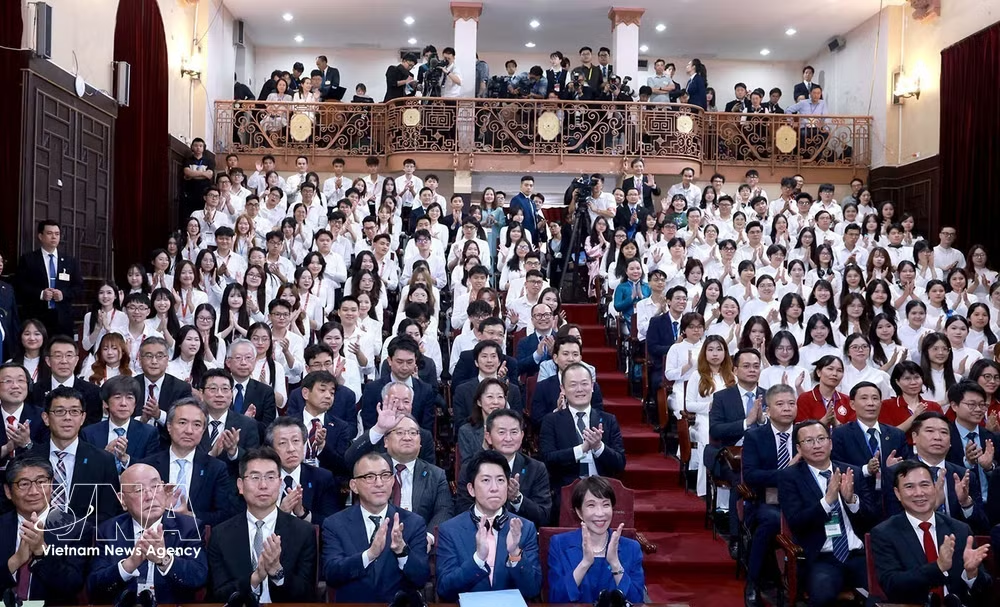
vnanet-policy2.jpg
Japanese Prime Minister Takaichi Sanae poses with students of Vietnam National University, Hanoi. (Photo: VNA)

PM Takaichi also highlighted joint efforts to gain an edge in the digital era. Through the “ASEAN-Japan Co-Creation Initiative for AI” announced last October, countries will develop AI models that reflect Asia’s linguistic and cultural diversity. Japan has also introduced the “the FOIP Digital Corridor” concept, aimed at advancing submarine cables, open radio access networks (Open RAN), satellite communications and all-optical networks across the Indo-Pacific.

On trade and economic cooperation, she stressed the importance of strategically expanding the Comprehensive and Progressive Agreement for Trans-Pacific Partnership (CPTPP) while maintaining its high standards.

In closing, PM Takaichi emphasised that each country has its own Indo-Pacific vision, calling for stronger cooperation among resilient countries to build a “free and open” Indo-Pacific as a foundation for peace and prosperity.

She also expressed hope that her engagement with faculty members and students at Vietnam National University will inspire younger generations in both countries to reflect on the future of Japan, Vietnam and the broader Indo-Pacific, and to envision their own future within it./.
VNA

See more

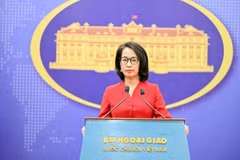
Deputy Minister of Foreign Affairs Nguyen Manh Cuong (Photo; VNA)

Top leader’s upcoming visit to India to shape new cooperation framework: Deputy FM

General Secretary of the Communist Party of Vietnam (CPV) Central Committee and State President To Lam’s state visit to India from May 5- demonstrates Vietnam’s high regard for its Comprehensive Strategic Partnership with India and the broader South Asian region. It also offers a meaningful opportunity for both countries to review a decade of their Comprehensive Strategic Partnership framework and consolidate their multifaceted cooperation.

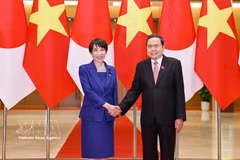
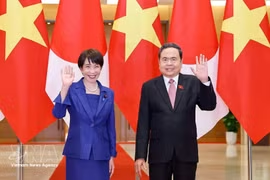
NA Chairman Tran Thanh Man (R) and Japanese Prime Minister Takaichi Sanae (Photo: VNA)

NA Chairman meets with Japanese PM

Both leaders expressed satisfaction with the robust and substantive development of the Vietnam–Japan Comprehensive Strategic Partnership, underscoring the importance of parliamentary cooperation. They agreed to further bolster political trust, high-level exchanges and interactions between two legislatures’ specialised committees, and cooperation among friendship parliamentary groups, young and female legislators.

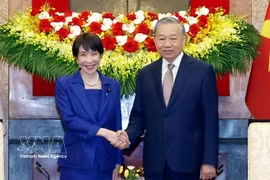
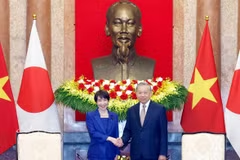
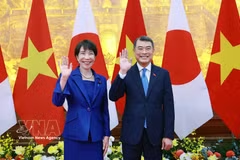
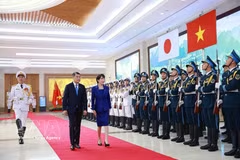
Prime Minister Le Minh Hung and Japanese Prime Minister Takaichi Sanae pose for a photo at the official welcome ceremony on May 2, 2026. (Photo: VNA)

Vietnam, Japan push for more substantive, effective ties

Noting the strong momentum in bilateral ties, built on solid political trust, extensive economic cooperation and growing people-to-people exchanges, PM Hung called for closer coordination to take the partnership to new heights and broaden collaboration across all sectors.

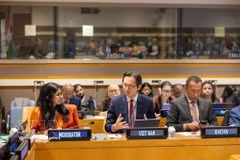
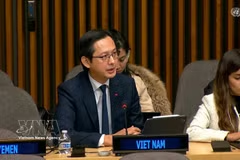
Ambassador Do Hung Viet, Vietnam’s Permanent Representative to the United Nations, speaks at the meeting. (Photo: VNA)

Vietnam calls for solidarity in support of Cuba

Ambassador Do Hung Viet, Vietnam’s Permanent Representative to the United Nations, called on member states to uphold the movement’s spirit of solidarity, continue supporting Cuba, oppose unilateral embargoes and sanctions, and back dialogue efforts between Cuba and the US based on mutual respect, peace, stability and the interests of their people.

Vietnamese Ambassador Ngo Minh Nguyet poses for a group photo with representatives of the Communist Party of Uruguay. (Photo: VNA)

Communist Party of Uruguay enhances cooperation with Vietnam

The Communist Party of Uruguay (PCU) is ready to coordinate and share materials to support the development of the Communist Party of Vietnam Museum. A photo archive centre in Montevideo currently stores many valuable images and materials on Vietnam and is expected to support information exchange between the two sides.

Nguyen Viet Duc, Vice President of the Union of Vietnamese Associations in Germany, delivers remarks at the working session. (Photo: VNA)

Vietnamese community in Germany strengthens connectivity

Solidarity, mutual support, and resilience remain key characteristics of the Vietnamese community in Germany, with Vietnamese people continuing to value family, prioritise education, make continuous efforts to integrate into host society, and preserve cultural identity while maintaining ties with their homeland.

Ambassador Mai Phan Dung and WTO Director-General Ngozi Okonjo-Iweala in a meeting. (Photo: VNA)

Vietnam continues to contribute effectively to multilateral mechanisms: Ambassador

With a solid foundation of political stability, a clear development orientation, and strong international support, Vietnam is well-positioned to continue enhancing its role in multilateral forums, contributing actively to addressing global challenges, and realising its aspiration to become a high-income, developed country by 2045.

Ambassador Do Hung Viet (centre) and Chairman of the Presidium of the Central Committee of the Japanese Communist Party Shii Kazuo (third from the left) and other delegates pose for a group photo (Photo: VNA)

Vietnam values growing ties with Japan: diplomat

Vietnam attaches great importance to the increasingly close and effective Comprehensive Strategic Partnership with Japan, as well as the close and foundational ties between their Communist Parties, Ambassador Do Hung Viet has said.

Minister Counsellor Nguyen Hoang Nguyen, Deputy Permanent Representative of Vietnam to the UN addresses the session (Photo: VNA)

Vietnam calls for de-escalation of tension in Middle East

Minister Counsellor Nguyen Hoang Nguyen, Deputy Permanent Representative of Vietnam to the UN reaffirmed Vietnam’s consistent stance of supporting the Palestinian people’s right to self-determination, Palestine’s UN full membership, and the two-state solution based on pre-1967 borders, in accordance with international law and relevant UN resolutions.

Vietnamese Ambassador to Algeria Tran Quoc Khanh (R) meets with Annaba Governor Abdelkrim Lamouri. (Photo: VNA)

Vietnam promotes multifaceted cooperation with Algerian locality

Ambassador Tran Quoc Khanh affirmed that Vietnam attaches importance to its relationship with Algeria and wishes to expand cooperation with localities, including Annaba, particularly following the elevation of bilateral ties to a Strategic Partnership in November 2025.

Deputy Minister of Foreign Affairs Le Thi Thu Hang, head of the Vietnamese delegation to the 11th NPT Review Conference, addresses the roundtable discussion on April 29. (Photo published by VNA)

Vietnam chairs roundtable on peaceful use of nuclear energy

Deputy Minister of Foreign Affairs Le Thi Thu Hang called for strengthened international cooperation in nuclear applications, with a focus on capacity-building, training, technology transfer and mobilisation of sustainable financial resources to support long-term development goals.