Top Vietnamese leader’s India visit marks historic milestone in Comprehensive Strategic Partnership

According to the ambassador, the visit coincides with the 10th anniversary of the establishment of the Comprehensive Strategic Partnership (2016–2026). Therefore, it is expected to provide an opportunity for leaders to review past achievements and shape future cooperation directions, especially in the context of both countries’ strong development trajectories and evolving regional and global changes.

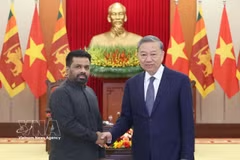
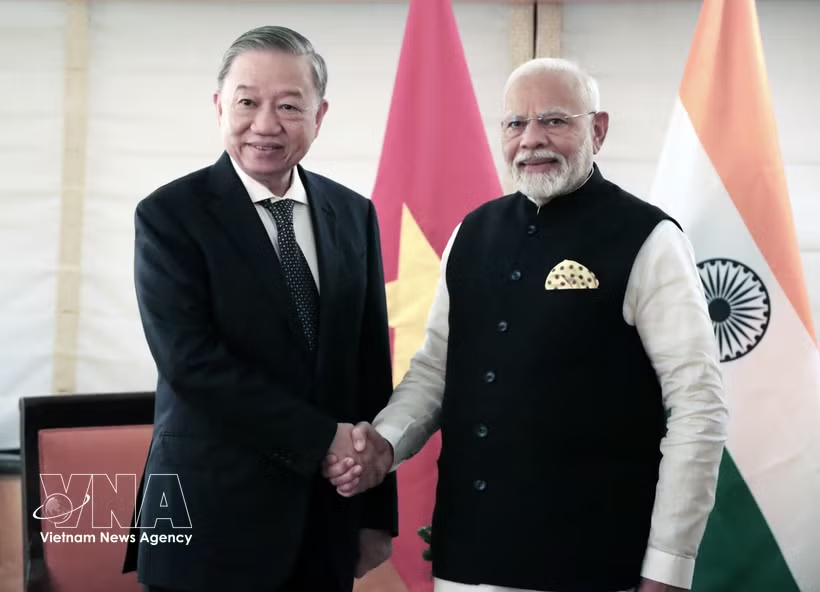
Within the framework of his participation in the 79th session of the United Nations General Assembly and working visit to the US, Party General Secretary and State President To Lam meets with Indian Prime Minister Narendra Modi in New York on September 23, 2024 (local time). (Photo: VNA)

New Delhi (VNA) – As Vietnam – India relations continue to be consolidated and expand robustly, the upcoming state visit to India by General Secretary of the Communist Party of Vietnam (CPV) Central Committee and State President To Lam is widely expected to inject fresh momentum into the Comprehensive Strategic Partnership between the two countries.

In an interview granted to Vietnam News Agency (VNA) correspondents in New Delhi, Vietnamese Ambassador to India Nguyen Thanh Hai emphasised that the trip, scheduled for May 5–7, carries historic importance as it marks the first time a Vietnamese Party General Secretary and State President has paid a state visit to India. The timing, shortly after the successful 14th National Party Congress and the consolidation of key leadership positions by the National Assembly, underscores Vietnam’s high regard for India as a close friend and comprehensive strategic partner. It also reflects Vietnam’s consistent foreign policy of independence, self-reliance, self-strengthening, peace, friendship, cooperation and development, and diversification and multilateralisation of external relations.

According to the ambassador, the visit coincides with the 10th anniversary of the establishment of the Comprehensive Strategic Partnership (2016–2026). Therefore, it is expected to provide an opportunity for leaders to review past achievements and shape future cooperation directions, especially in the context of both countries’ strong development trajectories and evolving regional and global changes.

He further highlighted that the visit will serve to deepen ties between the two countries’ leaders and ruling parties, while enhancing connectivity across ministries, sectors, localities and business communities. Particular emphasis will be placed on fostering collaboration among technology firms, startups and innovation hubs.

Overall, the visit is anticipated to open broader avenues for cooperation, elevate the bilateral relations to new heights, and deliver tangible benefits to citizens, localities and enterprises, thus helping to realise development goals in each nation, as well as to peace, stability and development in the region and the world, Hai affirmed.

Reflecting on a decade of the Comprehensive Strategic Partnership, the diplomat held that Vietnam–India relations have developed comprehensively and effectively, emerging as one of the region’s most dynamic and meaningful partnerships. Political trust has continued to strengthen through frequent high-level exchanges and close coordination at international forums, including the United Nations and ASEAN-led mechanisms.

Defence and security collaboration has also expanded in both scope and substance, guided by the Joint Vision Statement on Vietnam-India Defence Partnership towards 2030. Areas such as training, capacity-building, joint exercises and participation in United Nations peacekeeping operations have been implemented effectively.

Economic, trade and investment ties have recorded notable growth. Bilateral trade reached a record of 16.46 billion USD in 2025, marking a 10.5% increase from the previous year and approximately 2.5 times the figure recorded in 2016. India is now among Vietnam’s top eight trading partners. Investment flows have also progressed, with India running 473 active projects worth 1.1 billion USD in Vietnam, while Vietnamese enterprises are increasingly expanding into the Indian market, including large-scale initiatives such as electric vehicle manufacturing projects.

Cooperation in science and technology, innovation, digital transformation, energy and education has been further promoted. The ambassador also pointed to growing exchanges of students and increasing engagement between startups and technology firms. Meanwhile, people-to-people exchanges, cultural cooperation and tourism have emerged as bright spots, with Vietnam becoming an increasingly attractive destination for Indian visitors. Enhanced direct air connectivity – rising to nearly 90 weekly flights – has significantly boosted travel and exchanges.
vnanet-nguyenthanhhai.jpg
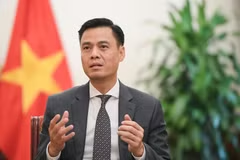
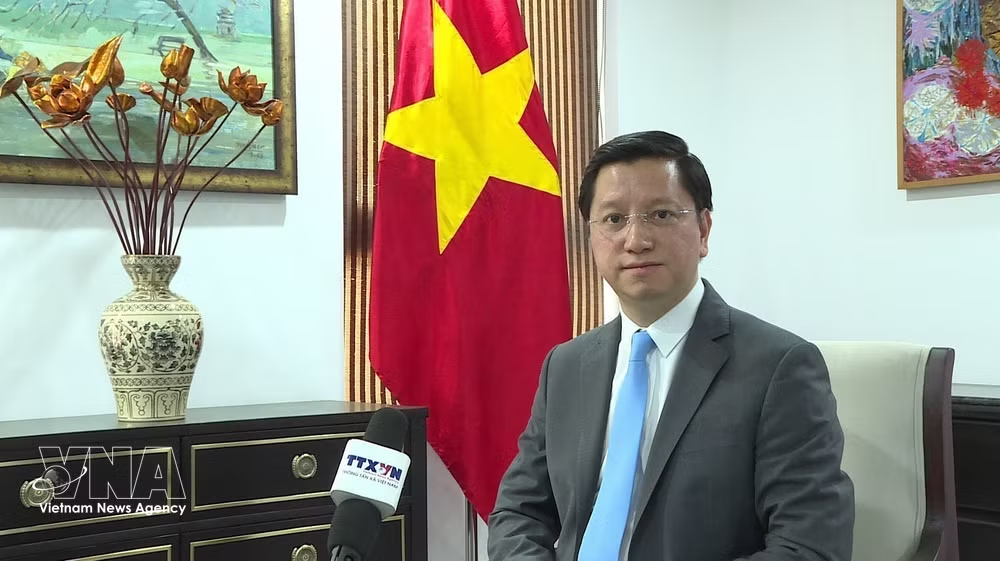
Vietnamese Ambassador to India Nguyen Thanh Hai in an interview granted to the Vietnam News Agency (Photo: VNA)

For the coming period, the ambassador suggested both countries prioritise emerging areas of cooperation, particularly innovation and digital transformation, to harness opportunities from the ongoing technological revolution to achieve the goals of turning Vietnam into a developed country by 2045 and India into the similar status by 2047. He underscored the need to establish platforms and frameworks to facilitate collaboration in high-tech industries, digital and green economy, renewable energy, semiconductors and artificial intelligence.

At the same time, continued efforts to strengthen economic, trade and investment cooperation were deemed essential, including measures to expand market access and further increase bilateral trade commensurate with the scale of both economies.

Hai also stressed the importance of promoting people-to-people exchanges, cultural, education and tourism cooperation to reinforce the social foundation of the bilateral ties. Shared cultural and historical linkages, particularly through Buddhism and heritage preservation, were highlighted as favourable conditions for deeper engagement.

The top Vietnamese leader’s visit will provide an important opportunity for both sides to discuss concrete measures to advance these priorities, thereby bringing practical benefits to the two countries’ people, localities and enterprises, and contributing to the realisation of each country’s development goals, he concluded./.
VNA

See more

Vietnamese Minister of Foreign Affairs Le Hoai Trung (left) and DPRK Minister of Foreign Affairs Choe Son Hui. (Photo: VNA)

Vietnamese FM, DPRK officials discuss ways to boost bilateral ties

Trung reiterated that Vietnam places strong emphasis on strengthening and advancing its ties with the DPRK in a more practical and effective way, in line with the aspirations of the two nation’s people, while contributing to peace, stability, cooperation and development in the region and the world.

Politburo member, Secretary of the Party Central Committee and Chairman of its Organisation Commission Nguyen Duy Ngoc chairs the first meeting of the steering committee for digital transformation in the Party organisation and personnel sector in Hanoi on May 13, 2026. (Photo: VNA)

Party building work prioritises clean, shared data in digital transformation push

Politburo member, Secretary of the Party Central Committee and Chairman of its Organisation Commission Nguyen Duy Ngoc urged provinces and cities to review legal frameworks, decentralisation mechanisms, assigned tasks and administrative procedures, while ensuring synchronisation between local infrastructure systems and the central platform, including equipment, cybersecurity solutions and resource allocation.

General Secretary of the Communist Party of Vietnam Central Committee and State President To Lam speaks at the working session in Hanoi on May 13, 2026. (Photo: VNA)

Party, State leader calls for consolidation of central steering committees on legal, judicial reform

Consolidating the central steering committees for institutional and legal reform and for judicial reform is necessary in order to streamline organisational structures without reducing responsibilities, while ensuring clear accountability, measurable outputs and concrete results. Following the restructuring, the body will be renamed the central steering committee for institutional improvement and law enforcement, with the Party General Secretary and State President serving as its head.

Civil servants provides administrative services for citizens in Son Hai commune of Bac Ninh province. (Photo: VNA)

Reform drive expected to remove barriers, unlock growth momentum

Prime Minister Le Minh Hung recently ordered ministries and agencies to immediately cut at least 30% of administrative procedures, 50% of processing time, 50% of compliance costs and 30% of business conditions, while eliminating all unnecessary procedures.

Ambassador Do Hung Viet, Permanent Representative of Vietnam to the United Nations (UN), meets with Annalena Baerbock, President of the 80th session of the UN General Assembly (UNGA). (Photo: VNA)

Vietnam strives for substantive outcome at NPT review conference

At the meeting this week, Ambassador Viet briefed the UNGA President on developments during the first two weeks of the conference. He stressed that the current international geopolitical landscape poses numerous complex challenges, while reaffirming Vietnam’s determination, together with other member states, to promote substantive and balanced outcomes at the conference.

General Secretary of the Communist Party of Vietnam Central Committee and President of Vietnam To Lam (R) receives Athsaphangthong Siphandone, member of the Lao People’s Revolutionary Party Central Committee, Secretary of the Vientiane Party Committee and Chairman of the municipal People’s Council, in Hanoi on May 12, 2026. (Photo: VNA)

Top leader of Vietnam receives Vientiane official in Hanoi

The host leader stressed that cooperation between localities, particularly between the capitals of Hanoi and Vientiane, plays an especially important role as a pioneering force in effectively implementing the foreign polices of the two Parties and States, while also serving as a bridge between politics and development, as well as between strategy and concrete action.

Prime Minister Le Minh Hung receives Chinese Ambassador to Vietnam He Wei in Hanoi on May 12. Photo: VNA

Prime Minister receives Chinese Ambassador

The Party and State of Vietnam always value the assistance China has provided to Vietnam during its past struggle for national independence as well as in national development today. Vietnam consistently regards the development of relations with China as a steadfast policy, an objective requirement, a strategic choice, and a top priority in its foreign policy of independence, self-reliance, multilateralisation and diversification.

Secretary of the Hanoi Party Committee Tran Duc Thang and Secretary of the Vientiane Party Committee Atsaphangthong Siphandone witness the signing of a memorandum of understanding on cooperation between the Women’s Unions of Hanoi and Vientiane for 2026–2030, as well as a memorandum on enhanced cooperation between the Ho Chi Minh Communist Youth Union of Hanoi and the Lao People’s Revolutionary Youth Union of Vientiane for the same period. (Photo: VNA)

Hanoi, Vientiane promote comprehensive cooperation in new phase

The capitals of Vietnam and Laos signed memoranda of understanding on joint work in the fields of public communication and mass mobilisation, women and youth affairs, foreign relations, industry and trade, education and health care. These are expected to provide an important basis for implementing their cooperation priorities for 2026–2030.