Senior Party official affirms continued institutionalisation of Party resolutions

Responding to the concerns, Tu said the Party's leaders have consistently identified institutionalisation as a decisive step in bringing the Party's resolutions into life.

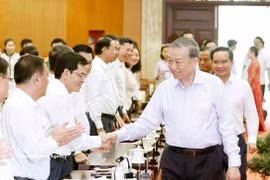
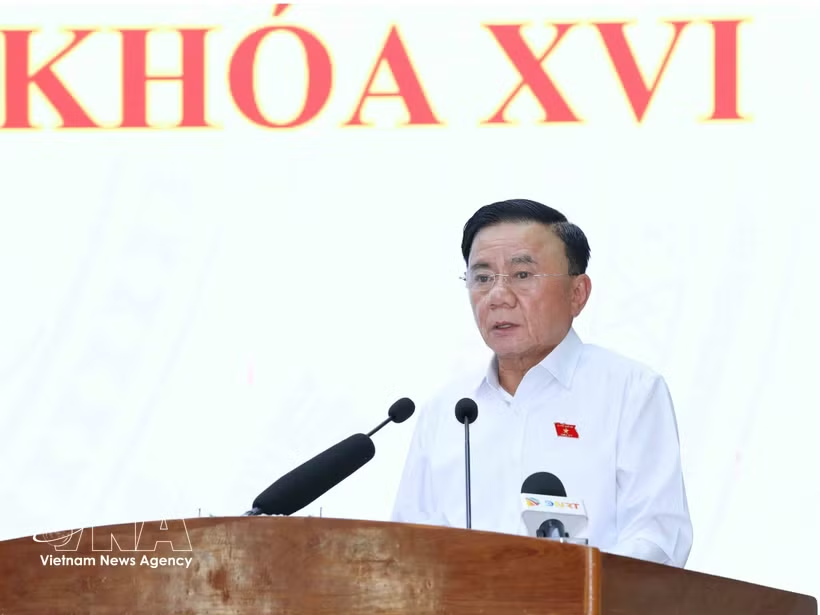
Politburo member and Permanent member of the Party Central Committee’s Secretariat Tran Cam Tu speaks at a meeting with voters in Da Nang city on May 5. (Photo: VNA)

Da Nang (VNA) – Politburo member and Permanent member of the Party Central Committee’s Secretariat Tran Cam Tu on May 5 affirmed that the Party and State will continue promptly institutionalising the Party's major resolutions into laws, mechanisms and concrete policies so that they can quickly be translated into practice.

Meeting voters in Hoa Khanh, Lien Chieu and Hai Van wards in Da Nang city following the first session of the 16th National Assembly, Tu said this will remain a key task in the coming period, particularly in science and technology, innovation, digital transformation and the continued improvement of the two-tier local administration model.

The official noted that many voters' opinions were practical and closely linked to local realities and people’s daily lives. Matters falling within the competence of the city's authorities should be addressed in a timely manner, while broader issues should be reported to competent central agencies for consideration, he said.

Voters raise concerns over local governance

Eight voters raised opinions at the meeting, focusing on improving the organisation and operation of the two-tier local administration model. They proposed increasing staffing at commune and ward levels to ease pressure in areas facing heavy workloads.

They also called for a more synchronised legal framework on land management, staffing allocations aligned with job positions, improved quality of cadre planning, shorter land-related administrative procedures, and careful study of the location of the passenger terminal for the future high-speed railway line.
vnanet-cu-tri.jpg
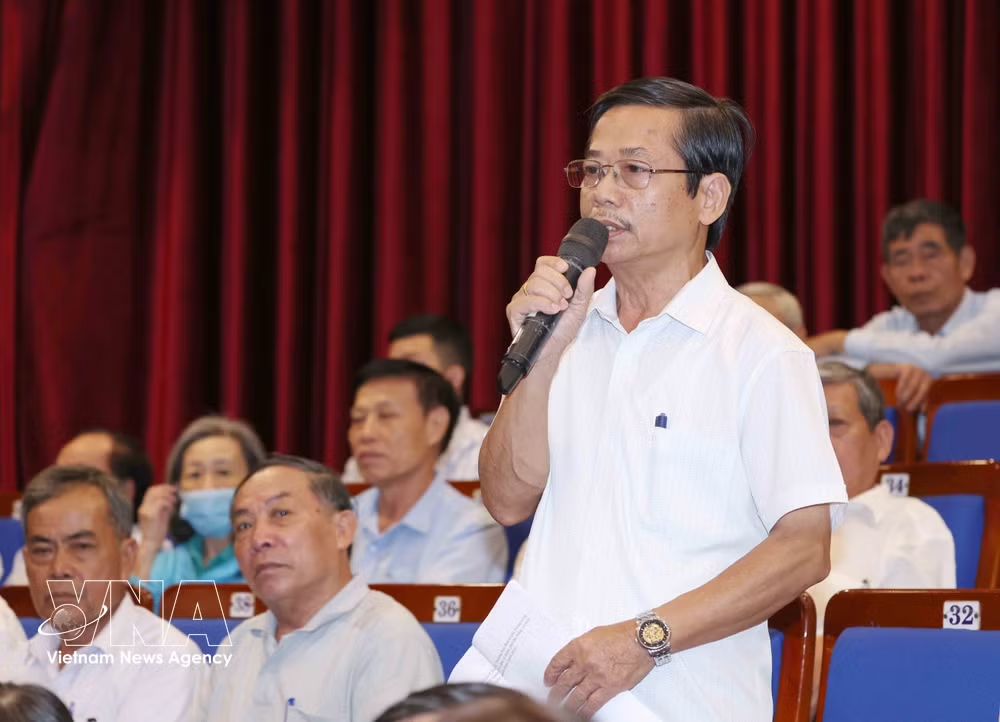
Voter Ngo Anh Van from An Hai ward raises a question at the meeting. (Photo: VNA)

Voters in Lien Chieu ward welcomed a number of major resolutions recently issued by the Politburo and the Party Central Committee, including Resolution No. 57 on science, technology, innovation and digital transformation; Resolution No. 59 on international integration; Resolution No. 66 on reforming law-making and law enforcement; and Resolution No. 68 on the private sector's development.

They said the resolutions reflected renewed mindset, long-term vision and strong determination to create new momentum for national development.

At the same time, voters noted that the implementation in some places remained slow and uneven. They pointed to delays in institutionalisation, unclear accountability of heads of agencies, and monitoring and evaluation that in some cases had yet to produce the expected impact.

Clear responsibilities, stronger coordination

Responding to the concerns, Tu said the Party's leaders have consistently identified institutionalisation as a decisive step in bringing the Party's resolutions into life.

He said the Politburo and the Secretariat will continue directing the National Assembly’s Party Committee, the Government’s Party Committee and relevant agencies to urgently review and formulate programmes for amending, supplementing and promulgating laws, decrees, policies and mechanisms immediately after resolutions are issued.

The guiding principle is “clear tasks, clear lead agencies, clear timelines and clear responsibilities” in order to overcome delays in concretising the Party's resolutions, he said.

For inter-sectoral and inter-regional issues, the central authorities will strengthen coordination mechanisms, particularly in science and technology, digital transformation, development of the private sector, education, healthcare and energy. Each task should be assigned to one lead agency to avoid overlap and shifting of responsibility, while ensuring the most timely and effective service for people and businesses.

Tu also stressed the responsibility of heads of agencies and localities. Units performing well will be recognised and commended, while those showing delays or negligence will be reminded, reviewed or handled in accordance with regulations.

He said implementation outcomes, service quality, and satisfaction of citizens and businesses will serve as important criteria in evaluating officials, Party organisations and public agencies.

For dynamic localities such as Da Nang, Tu said the central authorities consistently encourages innovation, initiative and readiness to take responsibility for the common good.

Effective models and creative approaches suited to practical conditions will be considered for pilot implementation, review and wider replication, he added./.​

VNA

See more

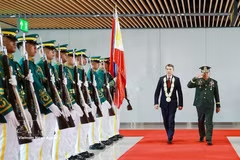
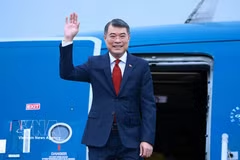
Prime Minister Le Minh Hung begins his participation in the 48th ASEAN Summit in Cebu, the Philippines. (Photo: VNA)

PM Le Minh Hung arrives in Philippines for 48th ASEAN Summit

This marks Prime Minister Le Minh Hung’s first overseas trip and his first in-person participation in a multilateral summit in his new capacity, demonstrating Vietnam’s commitment to proactively and responsibly contributing to ASEAN.

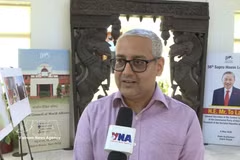
Dr. Rajiv Ranjan from the University of Delhi (Photo: VNA)

Top Vietnamese leader’s visit elevates Vietnam-India ties: Indian scholar

General Secretary of the Communist Party of Vietnam Central Committee and State President To Lam’s May 5-7 state visit to India not only advances bilateral ties but also contributes more broadly to promoting a multipolar and multilateral world order, and a more balanced and inclusive Asia as well.

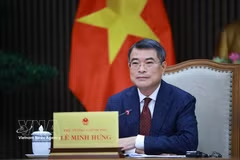
Prime Minister Le Minh Hung (Photo: VNA)

📝OP-ED: Vietnam affirms proactive, constructive role in ASEAN

As Southeast Asia becomes increasingly hit by strategic competition among major powers, maintaining unity and cohesion within ASEAN has become a prerequisite to preserve the bloc’s central role. In this process, Vietnam has emerged as an important balancing force.

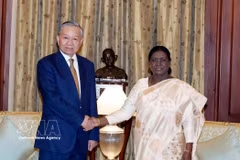
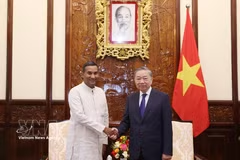
General Secretary of the Communist Party of Vietnam Central Committee and State President To Lam meets with Indian President Droupadi Murmu in New Delhi on May 6 afternoon (local time). Photo: VNA

Vietnam’s top leader meets with Indian President

Party General Secretary and State President To Lam reaffirmed Vietnam’s consistent policy of attaching high priority to its relationship with India. Vietnam supports India playing a greater role in regional and international multilateral forums and supports India’s “Act East” policy and closer connectivity with ASEAN countries.

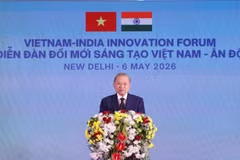
General Secretary of the Communist Party of Vietnam Central Committee and State President To Lam delivers a keynote address at the Vietnam–India Innovation Forum. (Photo: VNA)

Vietnam, India step up cooperation in human resources, science, technology, innovation

General Secretary of the Communist Party of Vietnam Central Committee and State President To Lam suggested creating cooperation spaces in science and technology through large-scale projects and long-term mechanisms, advancing a Vietnam–India Digital Partnership, and promoting a ‘co-research, co-development, co-production’ model to generate jointly branded technology products capable of deeper integration into global value chains.

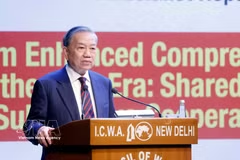
General Secretary of the Communist Party of Vietnam Central Committee and State President To Lam delivers the policy speech at the Indian Council of World Affairs (Photo: VNA)

Vietnam, India share vision, strategic convergence: Top Vietnamese leader

In his address, Party General Secretary and State President To Lam stressed that over thousands of years of formation and development, history and culture have served as strong bonds linking Vietnam and India. Though geographically distant, the two countries have been connected since early times. Indian religious, philosophical and civilisational values spread through maritime trade routes and became deeply embedded in Vietnam’s cultural and spiritual life.

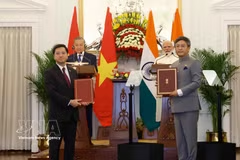
General Secretary of the Communist Party of Vietnam Central Committee and State President To Lam and Indian Prime Minister Narendra Modi witness the exchange of various cooperation agreements (Photo: VNA)

Vietnamese, Indian leaders witness exchange of various deals

The signed documents include a Memorandum of Understanding (MoU) on cooperation in digital technology between the Vietnamese Ministry of Science and Technology and the Indian Ministry of Electronics and Information Technology, a MoU on pharmaceutical management between the Vietnamese Ministry of Health’s Drug Administration and the Indian Ministry of Health and Family Welfare’s Central Drugs Standard Control Organisation, and the Vietnam–India Cultural Exchange Programme for 2026 - 2030.

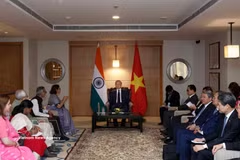
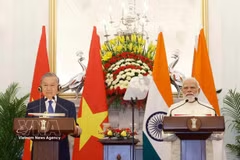
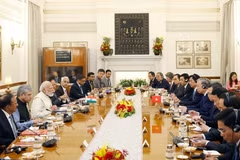
At the talks between General Secretary of the Communist Party of Vietnam Central Committee and State President To Lam and Indian Prime Minister Narendra Modi (Photo: VNA)

Top Vietnamese leader holds talks with Indian PM

On such basis, the two sides agreed to lift ties to an “Enhanced Comprehensive Strategic Partnership” guided by the spirit of “shared vision, strategic convergence, and substantive cooperation”, ushering in a new phase of bilateral development.

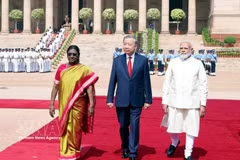
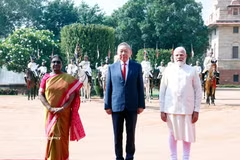
India’s President Droupadi Murmu (L) and Prime Minister Narendra Modi (R) co-chair the official welcome ceremony for General Secretary of the Communist Party of Vietnam Central Committee and State President To Lam (Photo: VNA)

Official welcome ceremony held for top Vietnamese leader in New Delhi

The ongoing state visit to India by the top Vietnamese leader stands as clear evidence of Vietnam’s foreign policy in the new era, emphasising independence, self-reliance, self-strengthening, peace, friendship, cooperation, and development, diversification and multilateralisation of external relations, and being a responsible member of the international community.