ASEAN praises Vietnam’s experience in enhancing peacekeeping training capacity

Vietnam has taken steps to strengthen self-reliance and standardise specialised training courses to meet international benchmarks. Notably, the country has established its first International Trauma Life Support (ITLS) Training Centre.

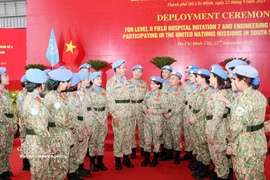
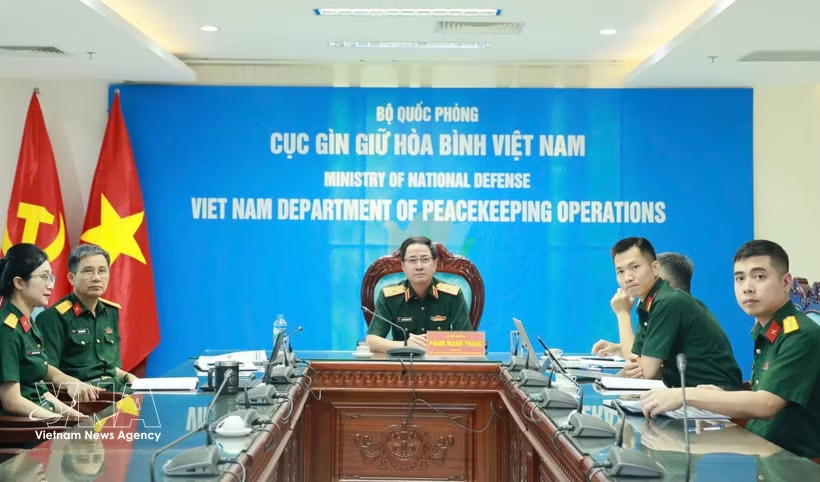
The Vietnamese delegation led by Major General Pham Manh Thang, Director of the Vietnam Department of Peacekeeping Operations, at the 10th meeting of the ASEAN Peacekeeping Centres Network (APCN), held online from May 4–8. (Photo: VNA)

Hanoi (VNA) – Delegates at the 10th meeting of the ASEAN Peacekeeping Centres Network (APCN) have commended Vietnam’s contributions, highlighting its practical and wide-ranging experience in improving peacekeeping training capacity.

At the plenary session on May 6, held as part of the conference conducted online from May 4–8, Major General Pham Manh Thang, Director of the Vietnam Department of Peacekeeping Operations and head of the Vietnamese Ministry of National Defence delegation, said the event provided an important forum for ASEAN member states to sustain momentum and strengthen cooperation in capacity-building through training. This, he noted, would enable more effective contributions to United Nations peacekeeping missions, particularly amid emerging challenges.

Vietnam has actively implemented the UN’s Action for Peacekeeping and Action for Peacekeeping Plus initiatives, aimed at enhancing effectiveness through greater accountability, stronger capabilities and deeper partnerships among member states, improving training quality and deployment readiness.

Emphasising that training quality is a decisive factor in mission effectiveness, Thang outlined several of Vietnam’s key lessons. These include developing comprehensive pre-deployment training programmes for both individuals and units in line with UN standards; building a pool of internationally qualified instructors; applying modern training methods and tools; implementing simulation-based training models; and regularly updating and sharing lessons learned from UN missions.

He added that Vietnam has taken steps to strengthen self-reliance and standardise specialised training courses to meet international benchmarks. Notably, the country has established its first International Trauma Life Support (ITLS) Training Centre.

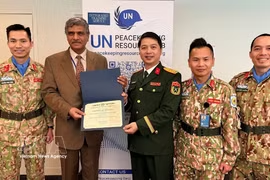
In March 2026, the United Nations Staff Officer Course (UNSOC) organised by the Vietnam Department of Peacekeeping Operations was certified by the UN Department of Peace Operations as meeting pre-deployment training standards – marking a significant qualitative milestone. This achievement underscores Vietnam’s growing training capacity and its contribution to enhancing the capabilities of the regional peacekeeping training network.

Participants at the conference expressed strong interest in Vietnam’s successful experience, particularly in organising training, preparing forces for deployment, and developing high-quality instructors through international cooperation.

A representative of the Philippines, the host of the meeting, proposed that Vietnam deploy mobile training teams to share its expertise with other countries in the region.

The conference brought together more than 40 delegates from 11 APCN member states, as well as representatives from the ASEAN Secretariat and the Integrated Training Service under the UN Department of Peace Operations./.


VNA

See more

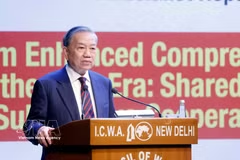
General Secretary of the Communist Party of Vietnam Central Committee and State President To Lam delivers the policy speech at the Indian Council of World Affairs (Photo: VNA)

Vietnam, India share vision, strategic convergence: Top Vietnamese leader

In his address, Party General Secretary and State President To Lam stressed that over thousands of years of formation and development, history and culture have served as strong bonds linking Vietnam and India. Though geographically distant, the two countries have been connected since early times. Indian religious, philosophical and civilisational values spread through maritime trade routes and became deeply embedded in Vietnam’s cultural and spiritual life.

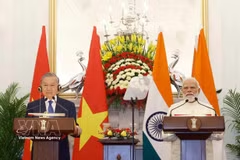
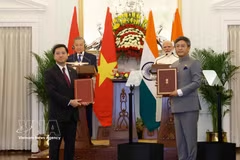
General Secretary of the Communist Party of Vietnam Central Committee and State President To Lam and Indian Prime Minister Narendra Modi witness the exchange of various cooperation agreements (Photo: VNA)

Vietnamese, Indian leaders witness exchange of various deals

The signed documents include a Memorandum of Understanding (MoU) on cooperation in digital technology between the Vietnamese Ministry of Science and Technology and the Indian Ministry of Electronics and Information Technology, a MoU on pharmaceutical management between the Vietnamese Ministry of Health’s Drug Administration and the Indian Ministry of Health and Family Welfare’s Central Drugs Standard Control Organisation, and the Vietnam–India Cultural Exchange Programme for 2026 - 2030.

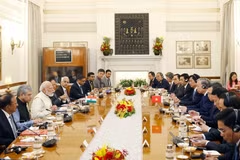
At the talks between General Secretary of the Communist Party of Vietnam Central Committee and State President To Lam and Indian Prime Minister Narendra Modi (Photo: VNA)

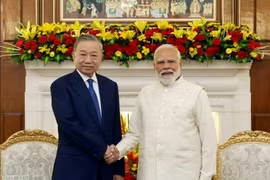
Top Vietnamese leader holds talks with Indian PM

On such basis, the two sides agreed to lift ties to an “Enhanced Comprehensive Strategic Partnership” guided by the spirit of “shared vision, strategic convergence, and substantive cooperation”, ushering in a new phase of bilateral development.

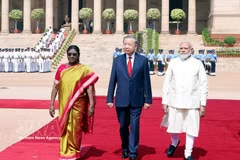
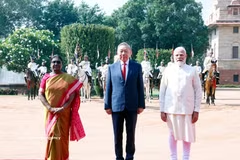
India’s President Droupadi Murmu (L) and Prime Minister Narendra Modi (R) co-chair the official welcome ceremony for General Secretary of the Communist Party of Vietnam Central Committee and State President To Lam (Photo: VNA)

Official welcome ceremony held for top Vietnamese leader in New Delhi

The ongoing state visit to India by the top Vietnamese leader stands as clear evidence of Vietnam’s foreign policy in the new era, emphasising independence, self-reliance, self-strengthening, peace, friendship, cooperation, and development, diversification and multilateralisation of external relations, and being a responsible member of the international community.

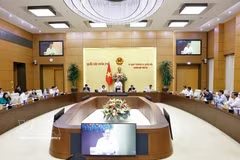
At the 55th session of the 15th National Assembly Standing Committee. (Photo: VNA)

Legislative programme in 2026 adjusted

Under the resolution, the NA Standing Committee decided to add several draft laws and resolutions to the legislative agenda in 2026 for consideration and adoption at the second session of the 16th National Assembly, scheduled for October 2026.

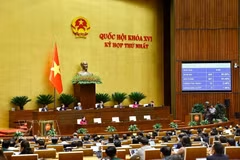
The National Assembly votes to approve the Resolution on the pilot implementation of the public lawyer institution (Photo: VNA)

National Assembly adopts 2027 supervision programme

At its third session, the 16th legislature will review a wide range of Government reports, including supplementary assessments of socio-economic and state budget performance in 2026 and results in early 2027, thrift practice and wastefulness prevention, gender equality, anti-corruption, crime prevention, law enforcement, detention management, environmental protection and drug prevention.

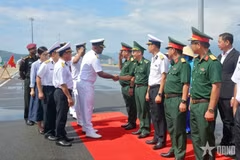
Representatives of military units in Khanh Hoa welcome the Indian naval delegation on May 5. (Photo: qdnd.vn)

Indian Navy ship visits Khanh Hoa

The Indian Navy ship INS Sagardhwani arrived at Cam Ranh International Port in the south central province of Khanh Hoa on May 5, beginning an official visit to the locality.

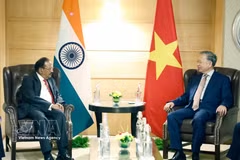
General Secretary of the Communist Party of Vietnam Central Committee and State President To Lam (R) receives Indian National Security Advisor Ajit Doval. (Photo: VNA)

Top Vietnamese leader receives Indian National Security Advisor in New Delhi

On the basis of the Vietnam – India Comprehensive Strategic Partnership, the two sides particularly emphasised the need for effective coordination in combating terrorism, transnational crime, online fraud, and emerging threats, thereby contributing to ensuring national security and social order in each country.