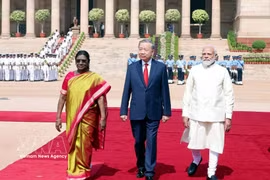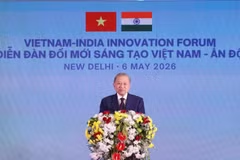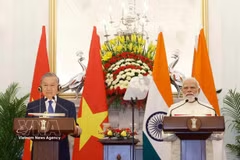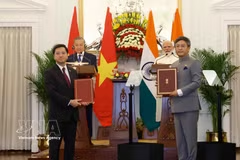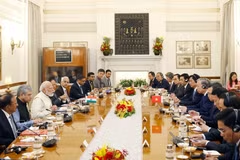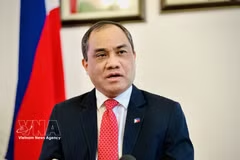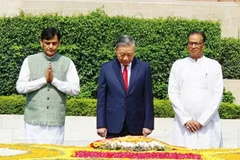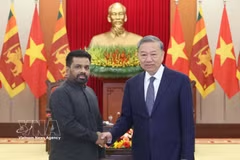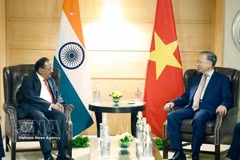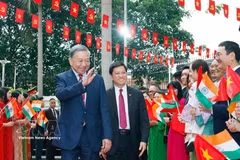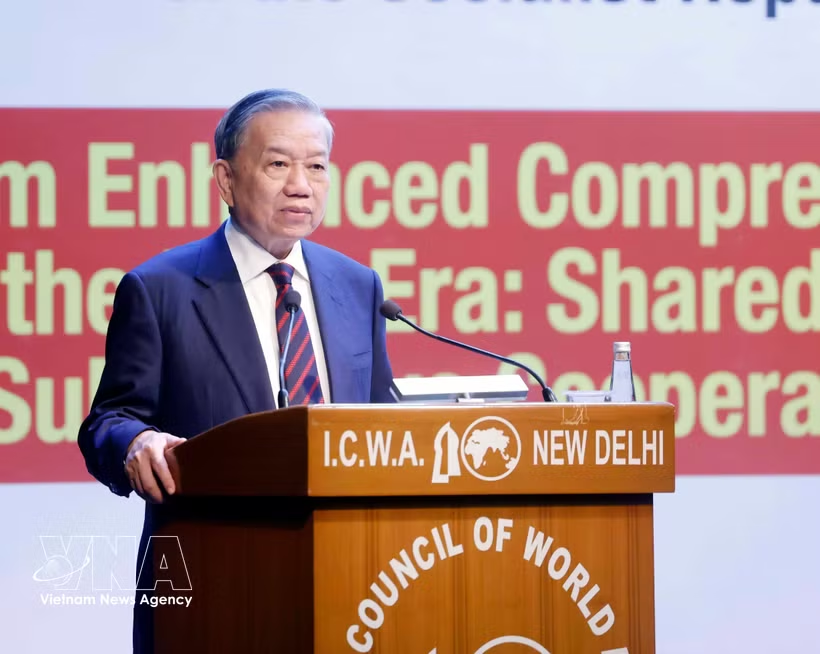
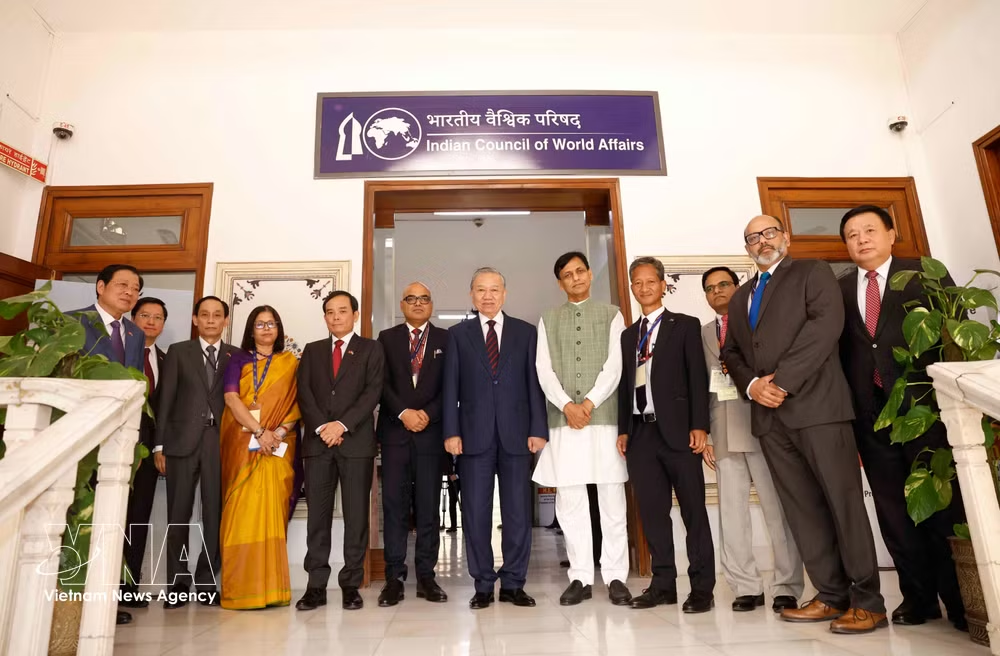
New Delhi (VNA) - General Secretary of the Communist Party of Vietnam Central Committee and State President To Lam on May 6 delivered a policy speech at the Indian Council of World Affairs (ICWA) under the theme “Vietnam–India Enhanced Comprehensive Strategic Partnership in a New Era: Shared Vision, Strategic Convergence, and Substantive Cooperation”, as part of his ongoing state visit to India.
The ICWA, with a track record spanning more than eight decades, ranks among India’s most prestigious strategic research bodies. It has played a pioneering role in shaping Indian foreign policy and has hosted landmark events in the external relations of India, Vietnam and nations across Asia and the globe, gathering leaders, policymakers and diplomats worldwide.
Vietnam, India look toward new development goals
In his address, General Secretary and President Lam stressed that over thousands of years of formation and development, history and culture have served as strong bonds linking Vietnam and India. Though geographically distant, the two countries have been connected since early times. Indian religious, philosophical and civilisational values spread through maritime trade routes and became deeply embedded in Vietnam’s cultural and spiritual life.
The shared historical journeys of struggle for national independence and construction forged deep empathy, solidarity and close ties between the two countries' people and successive generations of leaders, beginning with President Ho Chi Minh’s profound respect for Mahatma Gandhi and his close friendship with India’s first Prime Minister Jawaharlal Nehru, united by aspirations for independence, peace, justice and prosperity.
The Vietnamese leader affirmed that Vietnam deeply values and will always remember the immense, sincere, and invaluable support extended by Indian people, political parties, and Government during its past struggle for national independence and reunification, as well as the continued assistance in national reconstruction and development today.
The development paths of Vietnam and India over the past 80 years share many similarities and remarkable achievements, he said, adding that both emerged from extremely difficult colonial economies, even impoverished, underdeveloped, structurally imbalanced, and heavily dependent on external forces. Driven by aspirations for prosperity and the well-being of their people, both have steadily built independent, self-reliant, and resilient economies.
On external ties, the two nations share the principles of independence, self-reliance, resilience, peace, and support for dialogue, along with a proactive, balanced, and responsible approach to global and regional issues.
He was impressed by India’s philosophy “The world is one family”, which upholds friendship, mutual respect, solidarity, and aspirations for peace and prosperity, which also resonate strongly with Vietnam.
Vietnam highly values India’s responsible contributions through cooperation frameworks and strategic connectivity initiatives, including its Act East policy fostering linkages with Southeast Asia and Indo-Pacific initiatives aimed at building an open, inclusive and rules-based regional order, he said. He also commended India’s growing role in multilateral mechanisms, contributing to dialogue, connectivity and the resolution of shared challenges.
Vietnam, for its part, has successfully undertaken major international responsibilities, including contributing personnel to the United Nations (UN) peacekeeping missions, he added.
Both Vietnam and India are now targeting new development milestones as they approach the centenary of independence, seeking to balance economic growth with social progress, with sci-tech playing a central role. Built on a foundation of trust and close ties, bilateral ties have steadily evolved, from the establishment of diplomatic relations in 1972, to a Strategic Partnership in 2007, and a Comprehensive Strategic Partnership in 2016, and continue to widen and deepen.
National defence-security ties remain a key strategic pillar, supported by numerous credit lines and technology transfers. Education-training, tourism, and people-to-people exchanges have also expanded, with around 80 direct flights operating weekly between the two countries.
According to him, the world is undergoing rapid and unprecedented changes, with intensifying competition among major powers. International law, the UN, and multilateral mechanisms are facing serious challenges.
Countries, including Vietnam and India, are confronting the paradoxes of the modern era: rising demand for cooperation alongside eroding trust; deeper economic integration coupled with increased vulnerability; and rapid technological advancement that, while transformative, also widens development gaps. Transformations present major challenges but also opportunities, if seized in a timely manner and amplified through greater connectivity, he added.
Further consolidating and deepening strategic trust
In the context of new developments and evolving requirements in each country’s growth trajectory, both sides need to consolidate, renew and elevate Vietnam–India relations to a new level.
General Secretary and President Lam emphasised that the development paths of both nations, as well as their bilateral ties, demonstrate that Vietnam and India have become natural partners in matters of peace, security and development. The two countries share perspectives and visions on numerous issues relating to national development, as well as regional and global affairs, with many converging interests.
These connections, shared visions and strategic convergence form a solid foundation for both countries to strengthen cooperation, contribute effectively to their respective development journeys in a new era, and help shape a more stable and sustainable regional and international environment.
Building on over five decades of strong bilateral relations, the Vietnamese leader underscored the importance of further consolidating and deepening strategic trust—seen as both a prerequisite for maintaining stable ties and a cornerstone for enhancing effective cooperation and jointly addressing shared challenges.
In the new phase, both sides should continue to expand comprehensive exchanges across all channels – governments, parliaments, political parties, and people-to-people links – at both central and local levels. There is also a need to broaden cooperation in strategic areas, promote efforts, enhance the effectiveness of actions, and strengthen coordination of positions at multilateral forums.
The two countries are expected to expand connectivity and strengthen development linkages, thereby creating fresh momentum for regional integration. Vietnam is ready to cooperate with India in pharmaceuticals and welcomes Indian pharmaceutical firms to invest in production facilities in Vietnam for the Southeast Asian market.
Both sides also aim to elevate and accelerate cooperation in science, innovation and strategic technologies into a key pillar of bilateral relations. Vietnam places particular importance on working with India in areas such as semiconductors, artificial intelligence and digital transformation.
Promoting socio-cultural values and enhancing people-to-people exchanges remain essential. The two sides should deepen cooperation in education, training, culture and tourism, while strengthening locality-to-locality linkage and people-to-people exchanges, contributing to a shared space of peace and stability.
The Vietnamese leader highlighted that centuries-old historical connections, together with more than 50 years of diplomatic relations, have created a deeply rooted and invaluable foundation for bilateral ties. For Vietnam, India remains an important partner and a close, trusted friend.
Entering a new era, under the framework of an Enhanced Comprehensive Strategic Partnership guided by the principle of “shared vision, strategic convergence and substantive cooperation”, and supported by determined government actions and the dynamism of businesses in both countries, General Secretary and President Lam expressed confidence that Vietnam–India relations will continue to grow stronger, more substantive and more closely connected, bringing tangible benefits to both nations and contributing positively to peace, stability, cooperation and prosperity in the region and beyond.
Earlier at the ICWA, the Vietnamese leader attended a photo exhibition marking the 10th anniversary of the Comprehensive Strategic Partnership between the two countries, organised by the Vietnam News Agency. The exhibition showcased key milestones in their long-standing friendship, underpinned by strong political trust and wide-ranging cooperation./.