Vietnam, India expand trade cooperation in new growth phase

Over the past decade, Vietnam and India have continuously strengthened political trust while expanding practical cooperation across all spheres, including trade, investment, digital technology, energy, innovation and manufacturing.

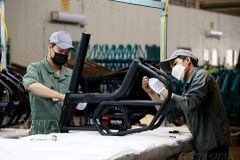
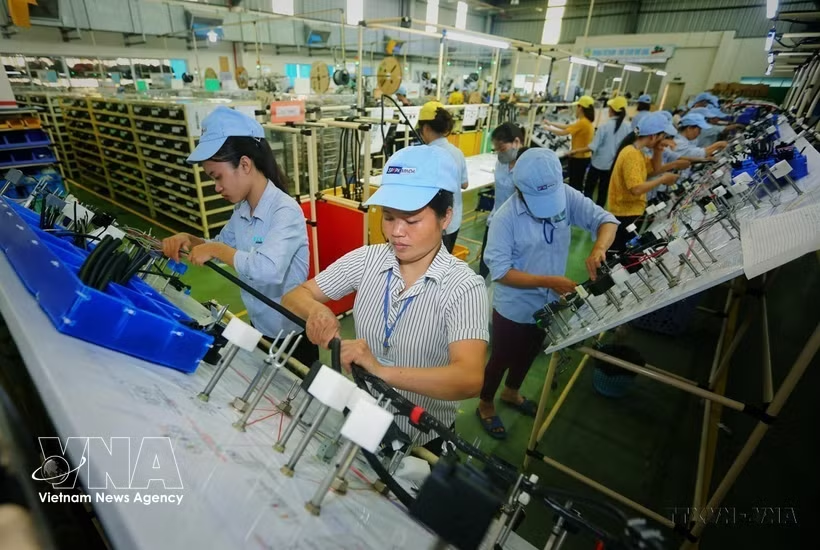
Manufacturing electrical and electronic components at Minda Vietnam Automotive Co., Ltd, an Indian-invested company in Phu Tho province. ( File Photo: VNA)

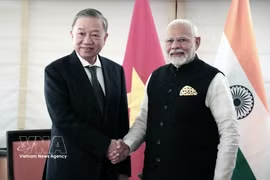
Hanoi (VNA) – The coming state visit to India by Party General Secretary and State President To Lam is expected to create momentum helping the two countries shape the framework for bilateral cooperation in a new development phase.

The visit comes as the two countries continue to deepen their Comprehensive Strategic Partnership, which was established in 2016. Over the past decade, Vietnam and India have continuously strengthened political trust while expanding practical cooperation across all spheres, including trade, investment, digital technology, energy, innovation and manufacturing.

Economic complementarity

The Vietnamese Ministry of Industry and Trade reported that bilateral trade has maintained strong growth in recent years, tripling from 5.4 billion USD in 2016 to 16.4 billion USD in 2025, the highest level recorded so far.

In 2025 alone, their trade turnover reached 16.46 billion USD, up 10.5% compared with 2024. Vietnam’s exports to India rose 14.2% to 10.3 billion USD while imports increased 4.9% to 6.1 billion USD.

The upward trend has continued in 2026. In the first quarter, bilateral trade hit 4.8 billion USD, up 28% year-on-year. Vietnam shipped 2.9 billion USD worth of goods to India, up 25%, while its imports from the latter climbed 34% to 1.8 billion USD.

Vietnam’s exports to India are dominated by manufactured and processed products, accounting for more than 70% of total shipments. Major items include electronics, machinery, agricultural and aquatic products, rubber, pepper, iron and steel products. Meanwhile, imports from the South Asian country mainly include textile materials, plastics, steel, seafood and pharmaceuticals serving domestic production and export.

Specialists said one of the most notable features of current economic ties is the increasing complementarity of the two economies. India boasts advantages in market scale, raw materials, software, pharmaceuticals and supporting industries, while Vietnam has developed strong manufacturing and export capacity and is deeply integrated into global markets through a network of new-generation free trade agreements.

This complementarity has reduced direct competition and increasingly shifted cooperation towards supply-chain integration, production linkages and market expansion. As global manufacturers diversify production bases beyond traditional centres, Vietnam and India are emerging as important links in regional supply-chain restructuring.
vnanet-potal-moi-quan-he-huu-nghi-viet-nam-an-do-ngay-cang-ben-vung-va-phat-trien-7511221.jpg
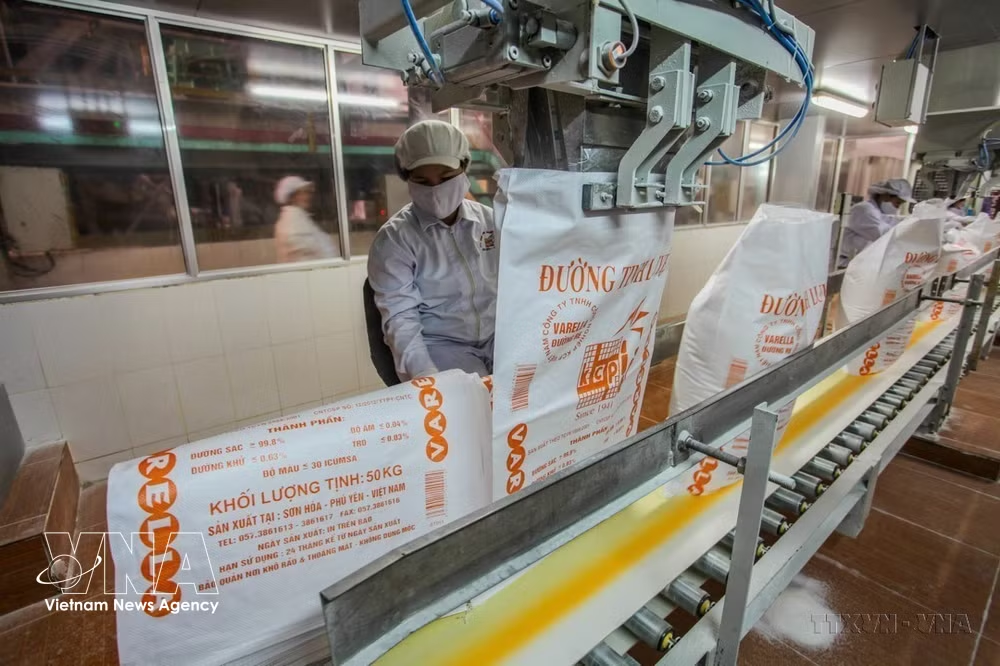
The refined sugar (RE) production line at the factory of KCP Vietnam Industrial Co., Ltd, a wholly Indian-owned company in Dak Lak province. (Photo: VNA)

Investment collaboration is also broadening. India is currently running projects in 20 of Vietnam’s 34 provinces and cities. Ho Chi Minh City is the top destination of Indian investments, followed by Dak Lak, Khanh Hoa, Thanh Hoa, Tay Ninh, Nghe An and Phu Tho.

Meanwhile, Vietnam has 30 investment projects in India with total registered capital of nearly 150.5 million USD. A notable development is Vingroup’s plan to build an electric vehicle factory in Tamil Nadu.

Vast room for cooperation expansion

Textiles and footwear are becoming major areas for deeper industrial cooperation. As global textile supply chains are being reconfigured, Vietnam’s strengths in manufacturing and exports complement India’s advantages in cotton, natural fibres, dyeing and raw materials. Besides, specialised fairs such as Bharat Tex 2026 and MEET AT AGRA 2026 are expected to further bridge their businesses operating in leather, production technology and supporting industries.

Digital technology is also emerging as a new growth driver. A memorandum of understanding on cooperation between the Vietnam Software and IT Services Association and India’s Services Export Promotion Council has strengthened business links in digital services, software outsourcing, artificial intelligence, the Internet of Things and digital transformation.

Retail distribution is opening up further opportunities. On April 24, the Vietnam Trade Office in India held talks with Reliance Retail on expanding the presence of Vietnamese products in the SMART Bazaar network, including fresh fruits, coffee, cashew nuts, processed seafood and fast-moving consumer goods.

Experts said direct access to India’s modern retail system will help Vietnamese goods move beyond traditional intermediary channels, thus raising added value and strengthening brand recognition in one of the world’s largest consumer markets.

Further momentum is expected from the review and upgrade of the ASEAN – India Trade in Goods Agreement (AITIGA). At the 12th meeting of the AITIGA Joint Committee in Jakarta in late March, ASEAN and India agreed to work towards substantially concluding negotiations in 2026.

Experts believe that the target of 20 billion USD in trade between Vietnam and India is no longer a distant milestone if both sides continue to maintain their current growth rate and further promote business connectivity, logistics, payments, investment promotion, and technology cooperation.

More importantly, the Vietnam – India economic relationship is now not only bilateral but also linked to the shaping of new supply chains in the Indo-Pacific region. In the context of a volatile global economy, strengthening relations with a highly complementary partner like India will help Vietnamese businesses enhance their resilience, diversify markets, and expand their long-term development opportunities./.

VNA

See more

A corner of Long Xuyen ward in An Giang province, a key trading hub of the Long Xuyen quadrangle region. (Photo: VNA)

Vietnam remains regional bright spot despite external risks: int’l institutions

According to the Asian Development Outlook (ADO) report released on April 10, the Asian Development Bank (ADB) forecasts Vietnam’s GDP to reach 7.2% in 2026 and remain around 7% in 2027. Sharing this view, the ASEAN+3 Macroeconomic Research Office (AMRO) and United Overseas Bank (UOB) also project growth in the range of 7–7.2%.

Workers process pangasius for export at a factory of the Go Dang Tien Giang JSC in Dong Thap province. (Photo: VNA)

Agro-forestry-fishery exports up 5.4% in four months

Asia remained the largest export market, accounting for 44.1% of total turnover, followed by the Americas and Europe with shares of 20.9% and 15.8%, respectively. Export value to Asia rose 11.5%, Europe 3.7% and Oceania 19.8%, while shipments to the Americas and Africa fell 3.5% and 26%, respectively.

Illustrative image (Photo: VNA)

Rising demand for hybrid vehicle lifts Toyota Vietnam’s April sales

Toyota-branded vehicles accounted for 6,378 units, including 2,375 domestically assembled cars and 4,003 completely built-up imports. The results showed a positive recovery in Vietnam’s auto market, while reaffirming the sustained appeal of Toyota models among local customers.

Illustrative photo (Photo: cafef.vn)

Banks strengthen digital shields against online fraud

By April 12, more than 3.7 million customer alerts had been issued through the information system for management, supervision and prevention of fraud risks in payment operations (SIMO). More than 1.2 million customers temporarily suspended or cancelled transactions after receiving warnings, involving nearly 4.17 trillion VND (158.12 million USD).

In the first four months, an average of 29,900 enterprises were newly established or resumed operations each month. (Illustrative photo: VNA)

New businesses, market re-entries up 32.8% in first four months

In April alone, nearly 20,400 enterprises were newly established. The most notable feature was not the number of new firms but the quality of capital inflows. Although the number of newly established enterprises fell 7.1% from March, registered capital increased 9.7% to nearly 246.8 trillion VND (9.36 billion USD).

Construction of Tu Lien bridge in Hanoi (Photo: VNA)

CPI up 0.84% in April on rising energy, dining costs

The CPI in April advanced 3.31% compared to December 2025 and 5.46% from a year earlier. For the first four months of 2026, the index climbed 3.99% against the same period last year, with core inflation growing 3.89%.

At Giang Dien Industrial Park in Dong Nai province (Photo: VNA)

FDI flows to Vietnam up 32% in four months

Realised FDI in Vietnam during the first four months was estimated at 7.40 billion USD, up 9.8% year-on-year, the highest level for the period in the past five years.

Rooftop solar panels in the Mekong Delta city of Can Tho. (Photo: VNA)

Rooftop solar power to ease pressure on electricity supply

As electricity demand surges, particularly during the hot season, Vietnam is stepping up efforts to promote rooftop solar power as a practical solution to ensure energy security, improve efficiency, and ease pressure on the national grid.

An unmanned aerial vehicle is used in rice cultivation in Vi Thanh 1 commune, Can Tho city. (Photo: VNA)

Shrinking farmland forces agriculture to go high-tech

Ministry of Finance data show that about 60% of companies have started using basic digital tech, while roughly 20% now have clear digital strategies. But only 5% has gone all the way with full-blown digital transformation.

SIAL Canada CEO Stéphane Thuillier (right) visits the Vietnam pavilion and speaks with a representative of the Vietnam Trade Office. (Photo: VNA)

Vietnamese exports expand foothold in Canada

The Vietnam Trade Office in Canada organised a national pavilion this year, supporting 15 companies in product displays while helping connect five others operating independent booths. The initiative is designed to enhance product promotion, facilitate partnerships and broaden market access in North America, particularly in the processed food segment.

Core site (Vinh Truong hamlet, Phuoc Dinh commune) for the construction of the Ninh Thuan 1 nuclear power plant. (Photo: VNA)

All-out push to fast-track Vietnam’s first nuclear power plants

Khanh Hoa province has also intensified oversight, introduced housing support of 5 million VND (nearly 190 USD) per month for displaced residents awaiting resettlement, and clarified responsibilities for land inventory, measurement and site selection. Notably, more than 9.8 billion VND has been disbursed to relocate 570 graves, helping accelerate clearance for the Ninh Thuan 1 Plant.

Traditional handicraft products at the Vietnamese booth attract visitors at the Paris Fair (Photo: VNA)

Vietnamese products shine at Paris Fair

Amid deepening international integration, the presence of Vietnamese enterprises at the annual Foire de Paris continues to affirm the appeal of Vietnamese goods and culture in the French market. The event also provides an opportunity for Vietnamese businesses to directly engage with French and European consumers, thereby strengthening their foothold in this promising market.

Do Gia Thang, Secretary-General of the Vietnam Business Association in Australia (VBAA) and Chairman of the Vietnam–Australia Young Entrepreneurs Club (Photo: VNA)

International Financial Centre - Vietnam's strategic move in global race: Expert

Vietnam is pursuing a “one centre – two destinations” model. Ho Chi Minh City is envisioned as a comprehensive financial hub linked with a free trade zone, while Da Nang will focus on innovation, fintech, digital assets and serve as a testing ground for new financial models. This complementary structure allows Vietnam to develop a tailored approach rather than replicate existing financial centres.

Financial buildings in central Ho Chi Minh City along the Saigon River, facing the Thu Thiem peninsula in An Khanh ward. (Photo: VNA)

Ho Chi Minh City attracts significant investment from France

Ho Chi Minh City is emerging as an attractive destination for French investors, particularly in infrastructure, sustainable urban development and green transition. French investment of more than 2.2 billion USD is contributing to economic growth and opening up broader prospects for long-term cooperation.