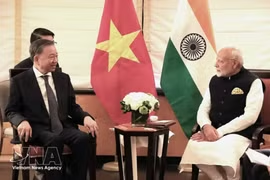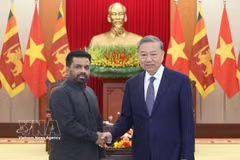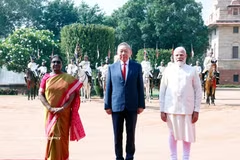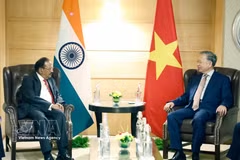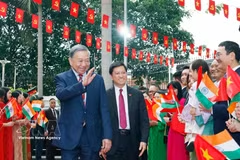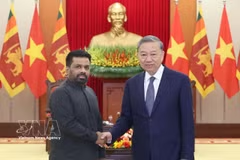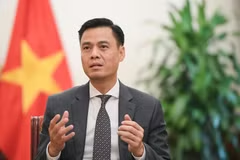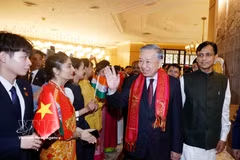
New Delhi (VNA) – Vietnam and India have issued a Joint Statement on Enhanced Comprehensive Strategic Partnership between the two countries on the occasion of the state visit to India from May 5-7 by General Secretary of the Communist Party of Vietnam (CPV) Central Committee and State President To Lam.
The following is the full text of the statement.
Joint Statement on Enhanced Comprehensive Strategic Partnership
Between the Socialist Republic of Vietnam and the Republic of India
1. At the invitation of Prime Minister of India, H.E. Shri Narendra Modi, the General Secretary of Central Committee of Communist Party of Vietnam, President of the Socialist Republic of Vietnam, H.E. Mr. To Lam, paid a State Visit to India from 05 May to 07 May 2026. General Secretary, President H.E. Mr. To Lam was accompanied by a high-level delegation. A strong business delegation also accompanied the dignitary.
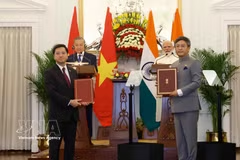
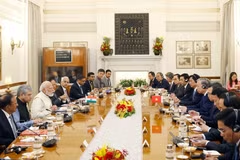
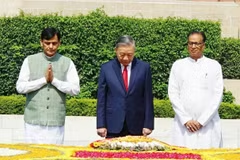
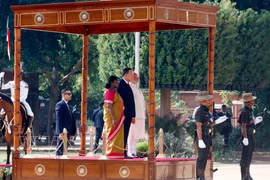
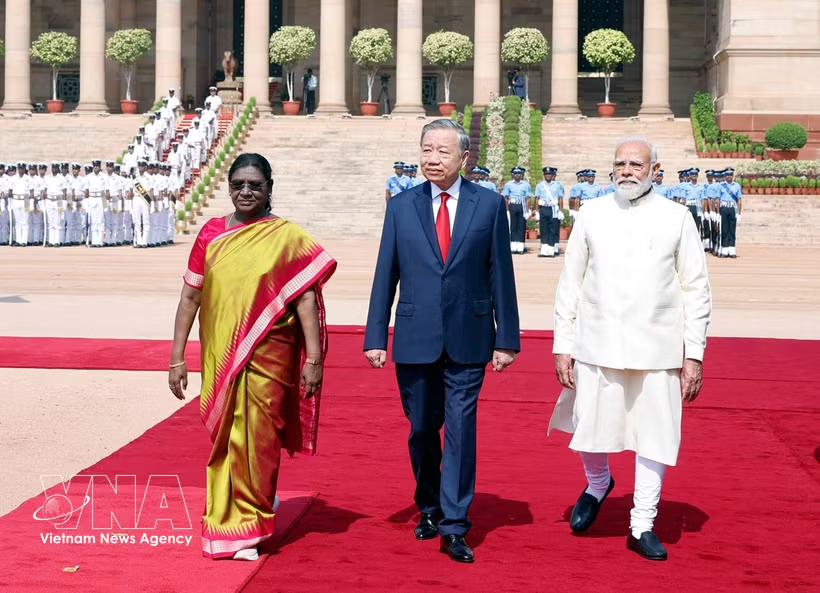
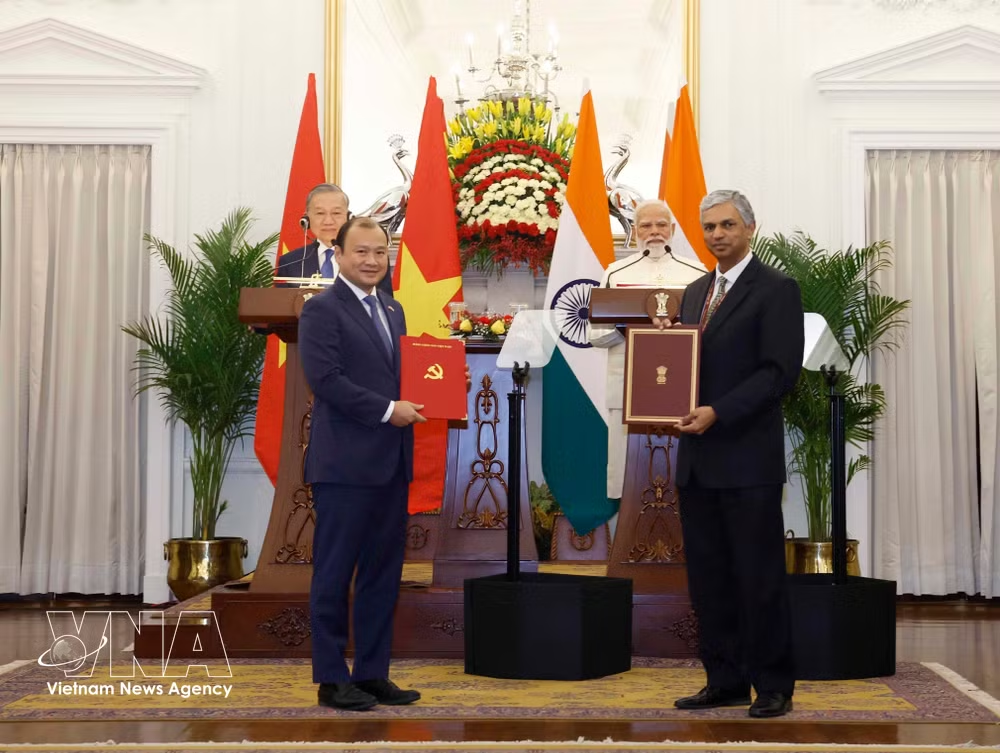
2. On 06 May 2026, General Secretary, President To Lam was accorded a ceremonial reception at Rashtrapati Bhavan. He visited Raj Ghat to pay floral tributes to Mahatma Gandhi. This was followed by bilateral talks between Prime Minister Modi and General Secretary, President To Lam. Thereafter, the two leaders witnessed the exchange of bilateral documents. Prime Minister Modi hosted a banquet lunch in honour of the visiting dignitary. General Secretary, President To Lam met President, H.E. Smt. Droupadi Murmu, who also hosted a banquet dinner for him. General Secretary, President To Lam delivered a policy speech at the Indian Council of World Affairs, and addressed the Vietnam – India Innovation Forum. General Secretary, President To Lam is also scheduled to visit Mumbai for interactions and exchanges with the State Government and businesses, and address at the Vietnam - India Business Forum.
POLITICAL
3. Prime Minister Modi and General Secretary, President To Lam held wide-ranging discussions in a warm and cordial atmosphere. They reviewed the entire gamut of bilateral relations and exchanged views on regional and global issues of mutual interest. Prime Minister Modi congratulated General Secretary To Lam on his election as President of Viet Nam and expressed confidence that under his leadership, Vietnam will continue to make steady progress towards its development aspirations. General Secretary, President To Lam congratulated Prime Minister Modi for significant achievements in national development, high economic growth and for India’s initiatives to strengthen multilateralism and to promote Global South cooperation. The leaders underlined that deepening Vietnam - India ties will continue to bring mutual benefit to their peoples and contribute meaningfully towards achieving their respective national goals, i.e. India’s Viksit Bharat 2047 and Vietnam’s Vision 2045.
4. Sharing the common views on the transformative shifts in the global and regional landscape, the two leaders recognised the strong foundation of relations based on mutual trust, respect, understanding, shared outlook and effective cooperation across numerous fields. They therefore agreed to elevate the bilateral relations to Enhanced Comprehensive Strategic Partnership in the spirit of ‘shared vision, strategic convergence, substantive cooperation’, further translating the enormous goodwill into tangible outcomes.
5. They noted that 2026 marks the 10th anniversary of the Vietnam - India Comprehensive Strategic Partnership and agreed to celebrate this occasion in a befitting manner. Welcoming the significant progress achieved in bilateral cooperation over the past decade, the two sides agreed to continue the effective implementation of the outcomes of high-level talks and visits in recent years, including the Joint Statement on Strengthening the Comprehensive Strategic Partnership between Vietnam and India in August 2024, the Vietnam - India Joint Vision for Peace, Prosperity and People in 2020, and the outcomes of the meetings between the leaders of the two countries. The leaders agreed to maintain regular engagements at all levels, including at the leadership-level.
6. Taking note of the constitution of India - Vietnam Parliamentary Friendship Group in the Parliament of India, the leaders welcomed enhancing cooperation between the two countries’ legislatures and continuing close coordination between parliamentary delegations of both sides at multilateral forums, including at the Inter-Parliamentary Union and ASEAN Inter-Parliamentary Assembly.
7. The leaders acknowledged that regular dialogue and exchanges under existing institutional mechanisms across multiple sectors of the cooperation have deepened trust and enhanced mutual understanding. In this regard, they agreed that the Political Consultation & Strategic Dialogue; and the Joint Commission Meeting on Economic, Trade, Scientific Cooperation remain key pillars underpinning Vietnam - India relations. The leaders also agreed that meetings under these mechanisms, particularly in the areas of defence, security maritime domain, trade and investment, agriculture, health, ICT, cyber, science & technology, space and atomic energy, be convened regularly. The two sides look forward to the establishment of Strategic Diplomacy - Defence Dialogue (2+2).
8. The leaders agreed to accelerate the effective implementation of the Plan of Action between Vietnam and India for the period of 2024 - 2028 and this Joint Statement.
ECONOMIC, TRADE AND INVESTMENT
9. The two sides agreed to reinforce cooperation between the two rapidly growing economies at the level of governments and businesses for increasing two-way trade, investment and technological partnership. Noting the increase in bilateral trade in the last 10 years, the leaders emphasized the need to further enhance it in a balanced and mutually beneficial manner, and agreed on a new trade goal of 25 billion USD by 2030.
10. They decided that both sides will facilitate market access, including for agricultural products in respective countries. They welcomed the decision to grant market access for Vietnamese Durians and Indian Grapes. They also agreed to expedite market access for Vietnamese Pomelos and Indian Pomegranates, by quickly resolving technical issues through expedited bilateral consultations.
11. Both sides agreed to enhance the supply chains in sectors of mutual interest. Vietnam affirmed its commitments to diversify its supply sources and to import more products from India to serve its domestic production and export needs. Both sides agreed to explore ways for a more conducive regulatory environment to facilitate ease of doing business for companies of both countries, including in standards compliance certification. They underlined the importance of maintaining constructive dialogue for resolving mutual concerns under bilateral institutional mechanisms.
12. The leaders agreed that the ongoing review of the ASEAN India Trade in Goods Agreement (AITIGA) should be concluded at the earliest. They concurred that the resulting agreement should be mutually beneficial, trade facilitative and relevant to current global trading practices.
13. The leaders agreed to encourage greater two-way investments to further strengthen Vietnam - India economic ties, especially in the fields of high-technology, transport, manufacturing, logistics, renewable energy, smart agriculture, electric vehicles and information technology, healthcare, agriculture and agro-processing, aquaculture, tourism and hospitality, among others. They also agreed to strengthen the linkages between the two countries’ startup ecosystems and encourage substantive cooperation among innovation centers.
14. Commending the decades-old institutional linkages between Vietnam and India in the field of oil and gas exploration, and recognizing the mutually beneficial cooperation in this sector, the leaders agreed to further enhance the exploration and production activities, including development of new wells where Indian companies are interested in participating, in accordance with Vietnamese law and international law, particularly the 1982 UNCLOS.
15. Recognising the growing importance of e-commerce and the digital economy, the leaders agreed to strengthen cooperation in these areas, through enhanced sharing of experiences in developing enabling regulations and policies to support their growth and support businesses, especially MSMEs to participate in e-commerce to integrate deeply and sustainably in the regional and global value chains.
HEALTH
16. The leaders reaffirmed their commitment to strengthening cooperation in the health sector. Acknowledging the advancements made by the Indian pharmaceutical industry, the two sides agreed to explore ways for the potential participation of Indian companies in the procurement of medicines for Vietnamese public healthcare facilities from 2027, as mutually agreed. Recognising the growing importance of technology, they encouraged cooperation in the digital transformation of healthcare, including the application of AI in the health sector.
17. Given the long history and rich heritage of traditional medicine in both countries, the leaders agreed to promote exchange of knowledge, research and best practices, while encouraging closer institutional linkages. They welcomed the progress towards the completion of the MoU on Traditional Medicine and the proposed MoU on the establishment of an Academic Chair in Ayurveda in Vietnam.
DEFENCE AND SECURITY
18. The leaders reaffirmed that defence and security cooperation is a key pillar of the Vietnam - India Comprehensive Strategic Partnership. They commended the effective implementation of the Joint Vision Statement on Vietnam - India Defence Partnership towards 2030, which continues to guide the growing defence ties between the two countries.
19. The leaders agreed to further strengthen cooperation and enhance engagements in both traditional and emerging areas of defence cooperation, including defence policy dialogue, joint exercises, staff talks, joint research and co-production of new defence technologies, enhanced port calls by Naval vessels and Air force aircrafts, peacekeeping activities, information sharing, hydrography, defence exhibitions, capacity building, defence industrial cooperation, maritime security, maritime safety, and search and rescue operations based on mutual interest and priorities of the two countries, which will also contribute to greater stability in the wider Indo-Pacific region. They also decided to enhance defence systems procurement between the two countries.
20. The leaders welcomed the steady progress in the implementation of the Defence Lines of Credit extended by India for Vietnam, which have contributed to strengthening Vietnam’s defence capabilities and advancing bilateral defence cooperation.
21. The leaders expressed satisfaction on the implementation of the bilateral defence agreements, including Mutual Logistics Support Agreement; Memorandum of Agreement on Submarine Search and Rescue Support and Cooperation; and Letter of Intent on Strengthening Defence Industrial Cooperation.
22. The leaders welcomed the inaugural joint hydrographic survey by the two navies in May 2025 off the coast of Vietnam and agreed to regularly conduct similar exercises in the future.
23. Vietnam appreciated the training offered by India for Vietnamese defence personnel under the Indian Technical and Economic Cooperation (ITEC) Programme, through Indian Army, Navy, and Air Force Training Teams at the Telecommunications University (TCU), Naval Academy, Airforce College, Nha Trang towards capacity building; India’s support for the establishment of the Army Software Park at TCU, Nha Trang. The leaders welcomed that two countries would co-chair the ASEAN Defence Ministers' Meeting-Plus Experts' Working Group (ADMM-Plus EWG) on Cyber Security for the 2027 - 2030 cycle.
24. The leaders agreed to strengthen cooperation in legal and judicial fields between the two countries through the effective implementation of the MoU between the Ministry of Justice of Vietnam and the Ministry of Law and Justice of India.
25. Both sides agreed to deepen cooperation between the Ministry of Public Security of Vietnam and the National Security Council Secretariat of India to realize shared objectives. They further agreed to broaden collaboration in the fields of information sharing, cybersecurity, counterterrorism and combating high-tech crime, transnational crime, money laundering and online scams. In addition, both sides underscored the importance of effectively utilizing existing cooperation mechanisms, including the Vietnam - India Security Dialogue.
26. The leaders welcomed the successful convening of the First Vietnam - India Cyber Policy Dialogue, during which both sides exchanged views on recent developments in cyber policies, reviewed cyber threat landscape, identified areas of bilateral cooperation, and discussed joint capacity building activities and cooperation at multilateral fora on ICT issues.
27. The two sides agreed to enhance the exchange of experience and expand cooperation in the security domain, including promoting cooperation in training and capacity building for law enforcement officers, support for professional training, foreign language training, cybersecurity incident response skills, UN Peacekeeping, and other cooperation activities as mutually agreed.
MARITIME
28. Recognising that Vietnam and India are maritime countries with a millennia-old history of exchanges, the leaders emphasised maritime domain as one of the key pillars of their cooperation and called for enhanced maritime cooperation between the two sides. They noted that the bilateral Maritime Security Dialogue has fostered mutual trust and better understanding of respective concerns and underscored the importance of convening it regularly. Viet Nam thanked India for invitation to assign an International Liaison Officer at the Information Fusion Centre - Indian Ocean Region (IFC-IOR) at Gurugram, India, to strengthen cooperation in Maritime Domain Awareness. Prime Minister Modi welcomed Viet Nam joining Indo-Pacific Oceans Initiative (IPOI) and looked forward to enhanced cooperation under that framework. Vietnam will continue to coordinate with India and other partners within the framework of the IPOI, while fostering further synergies between IPOI and the ASEAN Outlook on the Indo-Pacific (AOIP) and promoting substantive cooperation in the ASEAN - India Year of Maritime Cooperation 2026.
29. Both leaders agreed to enhance collaboration in oceanography, including areas such as ocean observing platforms, data management, ocean prediction and services, capacity building and maritime scientific research. Prime Minister Modi welcomed cooperation with Vietnam in the setting up of Pangasius breeding and farming facilities, and enabling Mussels’ breeding and procurement in India.
SCIENCE & TECHNOLOGY, INCLUDING CRITICAL AND EMERGING TECHNOLOGIES
30. The leaders reiterated the significance of digital technologies and welcomed the signing of the MoU between State Bank of Vietnam and Reserve Bank of India on financial innovation and digital payments. They agreed to promote linkages for retail payment platforms via QR Codes that would facilitate tourism and businesses of both sides.
31. The leaders agreed to facilitate greater collaboration and partnership in critical and emerging technology areas such as Digital Public Infrastructure, 6G, Artificial Intelligence, space and nuclear technology, marine sciences, biotechnology, pharmaceuticals, advanced materials and critical minerals. Cooperation will focus on practical initiatives such as joint research, R&D centers, and product development as mutually beneficial.
32. The leaders acknowledged their respective climate, sustainable development goals and energy transition priorities and agreed to enhance cooperation in clean and renewable energy, as well as climate and disaster resilient technologies. They recognised the relevance of Mission LiFE (Lifestyle for Environment) and institutions such as International Solar Alliance (ISA) in this regard. India welcomed Viet Nam’s interest to join the Global Biofuels Alliance (GBA). The leaders also acknowledged the importance of the Coalition for Disaster Resilient Infrastructure (CDRI) in promoting international cooperation in disaster risk reduction and resilience. They encouraged further cooperation in applying digital and advanced technologies in smart agriculture, sustainable water management, and air pollution control.
33. The leaders noted with satisfaction the ongoing collaboration in the field of peaceful uses of atomic energy and agreed to intensify follow-up on various avenues of further cooperation emerging from the 4th Vietnam - India Joint Committee Meeting on atomic energy. India appreciates Viet Nam’s invitation to participate in its nuclear power sector. Vietnam thanked India for the supply of Cobalt-60 and both sides agreed to explore modalities for its continued supply to Vietnam.
34. They noted the progress towards the establishment of the ASEAN - India tracking, data reception station and data processing facility in Vietnam. Vietnam agreed to expedite the remaining processes on its side with a view to facilitate the completion of project at the earliest.
35. The leaders welcomed the signing of MoU between IREL (India) Limited, Government of India, and the Institute for Technology of Radioactive and Rare Elements, VINATOM, Government of Vietnam, on mutual cooperation in the field of Rare Earths, and emphasised its early and full implementation.
DEVELOPMENT PARTNERSHIP
36. The leaders commended the extensive and impactful development partnership between the two countries, underpinned by the Quick Impact Projects (QIPs) under Mekong-Ganga Cooperation framework, ITEC programmes, and educational scholarships. They noted with satisfaction implementation of 66 QIPs through India’s support across 32 out of Viet Nam’s 34 provinces, which have received widespread appreciation from local governments and communities for their grassroots socio-economic impact.
37. The leaders underscored that India’s ITEC programme is a key pillar of bilateral development cooperation. Vietnam underlined its appreciation for India’s strong and continued support in capacity building of Vietnamese officials through the ITEC programme, including through specialized training courses tailored to their requirements, as well as the ICCR scholarships for students and scholars.
38. The leaders encouraged greater student, faculty and research exchanges between universities, think tanks and other institutions of the two countries. They welcomed the MoU between Ho Chi Minh National Academy of Politics and Nalanda University of India.
CULTURE, TOURISM COOPERATION AND PEOPLE-TO-PEOPLE EXCHANGES
39. Vietnam expressed deep appreciation for India’s gesture in sending the Holy Relics of Lord Buddha to Vietnam for exposition during May-June 2025. The leaders recognized that the profound response of the Vietnamese people to the Holy Relics reflected deep civilizational bonds, shared spiritual heritage and enduring friendship between the two countries.
40. The leaders acknowledged that tourism is a key driver of people-to-people ties and economic growth. They welcomed the signing of the MoU on Cooperation in the field of Tourism and decided to encourage growth of two-way tourism in a sustainable and inclusive manner, including cultural and heritage, medical and wellness tourism among others. Prime Minister Modi invited Viet Nam’s tourists and pilgrims to visit the Buddhist Circuit in India. Welcoming the increase in direct flights between the two countries, they encouraged their civil aviation authorities to discuss enhancing air connectivity.
41. The leaders welcomed the signing of the Cultural Exchange Programme for 2026 - 2030 and agreed to further promote cultural exchanges and people-to-people links.
42. Underlining the deep civilizational bonds between the two countries, the leaders encouraged greater exchange of Buddhist scholars, monks, pilgrims and students. Vietnam appreciated India’s commitment to the preservation of My Son UNESCO World Heritage Site and the restoration and conservation work done by the Archaeological Survey of India in the A, H and K Blocks, as well as the ongoing work in the E & F Blocks, and Nhan Tower project in Dak Lak province of Vietnam.
43. India appreciated Vietnam’s support for the annual organisation of the International Day of Yoga in a large number of Vietnamese cities and provinces. The leaders expressed support for greater cooperation among yoga institutions of the two countries. They also agreed to enhance cultural exchanges between the two countries and to establish ICCR Chairs of India Studies in Da Nang University and University of Social Sciences and Humanities.
44. The leaders welcomed the signing of an MoU on the Establishment of Friendship and Cooperation between Mumbai and Ho Chi Minh City and encouraged such cooperation and connectivity.
45. The two sides stressed upon the importance of cooperation in the field of mobility of human resources. Both sides welcomed establishment of a Consular Dialogue to address issues of mutual interest, including the facilitation of labour market mobility.
REGIONAL AND INTERNATIONAL COOPERATION
46. Acknowledging the evolving global geopolitical and economic landscape, the leaders underscored the growing strategic convergence between Vietnam and India to promote international order based on international law, grounded in peace, stability, cooperation and prosperity in the region and beyond. They called for strengthening the voice and role of the Global South in global governance.
47. The leaders agreed to strengthen cooperation in multilateral fora, including the United Nations. Reaffirming their commitment to multilateralism, the leaders expressed strong support for reforms in international organizations, including the UNSC, so as to make them more representative and reflective of contemporary realities. Prime Minister Modi appreciated Vietnam’s continued support for India’s permanent membership in a reformed UNSC.
48. Vietmam welcomed India’s 2026 BRICS Chairmanship, while India reaffirmed its commitment to supporting Vietnam’s role as a BRICS Partner Country.
49. The leaders recognised that Vietnam is a key pillar in India’s Act East Policy, Vision MAHASAGAR and Indo-Pacific Vision, driving India’s engagement with the Mekong sub-region, ASEAN and Indo-Pacific. The leaders reaffirmed their shared vision for a free, open and rules-based Indo-Pacific region. Viet Nam appreciated India’s consistent support for ASEAN Unity and ASEAN Centrality in the evolving regional architecture for regional peace, stability and prosperity. The two sides supported further strengthening of the ASEAN - India Comprehensive Strategic Partnership, which complements bilateral relations with respective Member States.
50. Underlining the link between prosperity and security, the leaders reaffirmed the importance of maintaining peace, stability, security and freedom of navigation and overflight in the South China Sea (East Sea), while pursuing the peaceful resolution of disputes in accordance with international law, particularly the 1982 United Nations Convention on the Law of the Sea (UNCLOS), without resorting to threat or use of force. The leaders underscored the importance of non-militarization and self-restraint in the conduct of all activities by claimants and all other states, and avoidance of actions that could further complicate the situation or escalate disputes affecting peace and stability. The leaders underlined that UNCLOS is the comprehensive legal framework governing all activities in the oceans and seas. The leaders further called for the full and effective implementation of the Declaration on the Conduct of Parties in the South China Sea (DOC) in its entirety and the early conclusion of negotiations towards a substantive and effective Code of Conduct in the South China Sea (COC) in accordance with international law, including UNCLOS, that does not prejudice the legitimate rights and interests of all nations, including those not party to these negotiations.
51. The leaders unequivocally condemned terrorism in all forms and manifestations, including cross-border terrorism. They called for zero tolerance of terrorism and for concerted international efforts to combat terrorism in a comprehensive and sustained manner, including through the UN and the FATF. The leaders called for disrupting of terror financing networks and safe havens, dismantling of terror infrastructure and bringing perpetrators of terrorism to justice swiftly.
52. General Secretary, President To Lam thanked Prime Minister Modi for the warm hospitality and excellent arrangements made for him and his delegation. He extended an invitation to Prime Minister Modi to visit Vietnam.
New Delhi
May 06, 2026