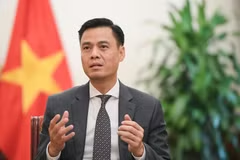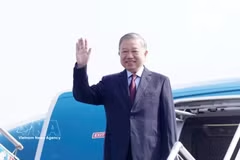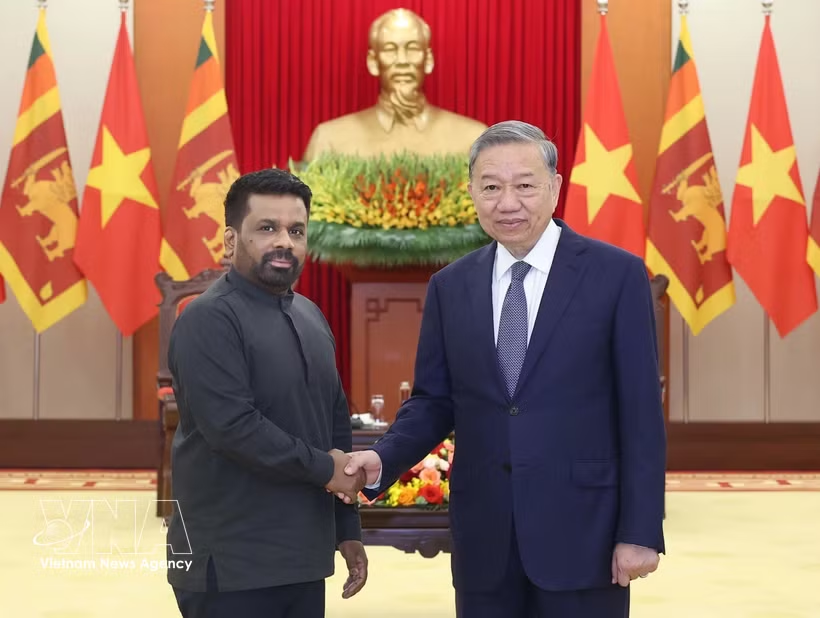
Hanoi (VNA) – The upcoming state visit to Sri Lanka by General Secretary of the Communist Party of Vietnam Central Committee and State President To Lam is expected to mark a significant milestone in the bilateral ties, deepening longstanding political trust and elevating the bilateral relations to a higher level, Sri Lankan Minister of Foreign Affairs, Foreign Employment and Tourism Vijitha Herath has said.
In an interview with the Vietnam News Agency (VNA)’s correspondent in South Asia ahead of the visit, the minister described the trip as a reflection of the two countries’ long-standing friendship and shared commitment to deepening cooperation amid a rapidly changing global context.
He affirmed that Sri Lanka attaches great importance to its longstanding relationship with Vietnam, which was built on historical foundations, cultural similarities, mutual trust, and shared values.
The minister noted that the bilateral ties date back to Sri Lanka’s recognition of Vietnam in 1970, during a difficult period in Vietnam’s history, making Sri Lanka one of the first countries to establish diplomatic relations with the Southeast Asian nation.
Despite certain challenges, Sri Lanka had consistently supported Vietnam and maintained a principled stance against colonialism and external interference. This early solidarity laid the solid foundation for the close relations today, he said.
The minister highlighted deep cultural links, particularly shared Buddhist heritage, as well as long-standing people-to-people understanding.
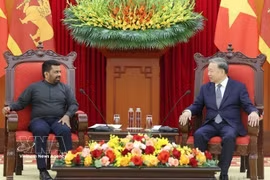
High-level exchanges have played a central role in sustaining the bilateral relations, with recent milestones including the 55th anniversary of diplomatic relations and the state visit to Vietnam by Sri Lankan President Anura Kumara Dissanayake last year, which further strengthened cooperation across sectors.
Regarding economic cooperation, Herath said the two sides have made progress but still hold significant untapped potential to expand two-way trade. Existing agreements on customs cooperation, double taxation avoidance, and investment promotion between the two nations have created a strong institutional framework for trade and investment, and long-term economic partnership. Sri Lanka has so far invested 40.9 million USD in Vietnam, mainly in the garment-textile industry, generating more than 15,000 jobs.
Despite growing cooperation in politics, defence, education, and culture, the minister acknowledged external challenges linked to global and regional volatility. However, he said the two sides have effectively managed these through structured dialogue mechanisms, including regular political consultations between the two foreign ministries.
In the coming period, the two countries remain committed to maintaining this positive momentum, he said, adding that the upcoming fifth round of political consultations, to be hosted by Sri Lanka, reflects the shared determination to further deepen and diversify this enduring partnership.
Institutional mechanisms such as the Sri Lanka – Vietnam Parliamentary Friendship Group and the Sri Lanka – Vietnam Joint Commission have also played an important role in sustaining close parliamentary ties and people-to-people exchanges between the two countries, he said.
The official described the top Vietnamese leader’s state visit as “particularly significant,” noting that it is the first such visit by a Party General Secretary and State President of Vietnam to Sri Lanka since diplomatic relations were established.
He said the timing is important as the two countries seek to strengthen their long-term partnership amid evolving regional and global changes. The trip stands as a symbol of stable and increasing development of the bilateral relations, while also underscoring the importance the two sides attach to maintaining close high-level political engagement.
The trip is expected to consolidate recent positive momentum, especially following the state visit of Sri Lankan President Anura Kumara Dissanayake last year, he said, adding that it will also provide an opportunity to expand cooperation in the fields of trade and investment, science and technology, education, tourism, cultural and religious exchanges, and emerging areas such as green initiatives, energy cooperation, and digital transformation.
A key expected outcome is progress toward establishing direct air connectivity, which will significantly boost tourism, trade, and investment flows, he said.
The minister also expressed hope for discussions on raising bilateral trade to an ambitious target of 1 billion USD. He noted Sri Lanka’s interest in advancing cooperation with ASEAN mechanisms, including its early accession as a sectoral dialogue partner of ASEAN and its membership in the Regional Comprehensive Economic Partnership (RCEP).
He noted that the visit would not only deepen existing political trust but also elevate the bilateral partnership toward a more strategic, comprehensive, and future-oriented level.
Against this backdrop, the Vietnamese leader’s visit is hoped to consolidate the longstanding foundation of political trust between Vietnam and Sri Lanka and lift their multifaceted partnership to a higher and more strategic level, the minister stated.
Outlining Sri Lanka’s priorities, Herath said the country seeks a pragmatic, forward-looking partnership with Vietnam based on mutual benefit.
Economic cooperation remains central, with an emphasis on trade expansion, investment, and supply chain integration. Sri Lanka is also interested in emerging sectors such as electric vehicle manufacturing, welcoming Vietnamese companies to explore opportunities in joint ventures, local sourcing, and battery-related industries, supported by Sri Lanka’s rare earth potential.
Green growth and renewable energy are key priorities, with the two nations committed to net-zero emissions by 2050, he said, adding that Sri Lanka hopes to learn from Vietnam’s rapid progress in solar and wind energy, as well as energy storage, while encouraging joint investment in clean energy projects.
The minister also highlighted Sri Lanka’s ambition to position itself as a regional hub for investment and connectivity, particularly through projects such as Colombo Port City, which could offer opportunities for Vietnamese investors in real estate, finance, and services, while serving as a gateway to South Asia.
Sri Lanka also seeks stronger cooperation in digital transformation, education, innovation, agriculture, tourism, and logistics, and drawing lessons from Vietnam’s experience in agricultural modernisation and regional connectivity to expand access to ASEAN and East Asian markets.
Beyond economic ties, Herath stressed the importance of cultural exchanges, people-to-people connection, and multilateral coordination, anchored in shared Buddhist heritage and common values./.