Top Vietnamese leader receives Indian National Security Advisor in New Delhi

On the basis of the Vietnam – India Comprehensive Strategic Partnership, the two sides particularly emphasised the need for effective coordination in combating terrorism, transnational crime, online fraud, and emerging threats, thereby contributing to ensuring national security and social order in each country.

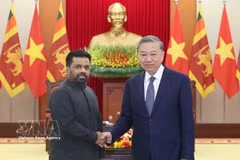
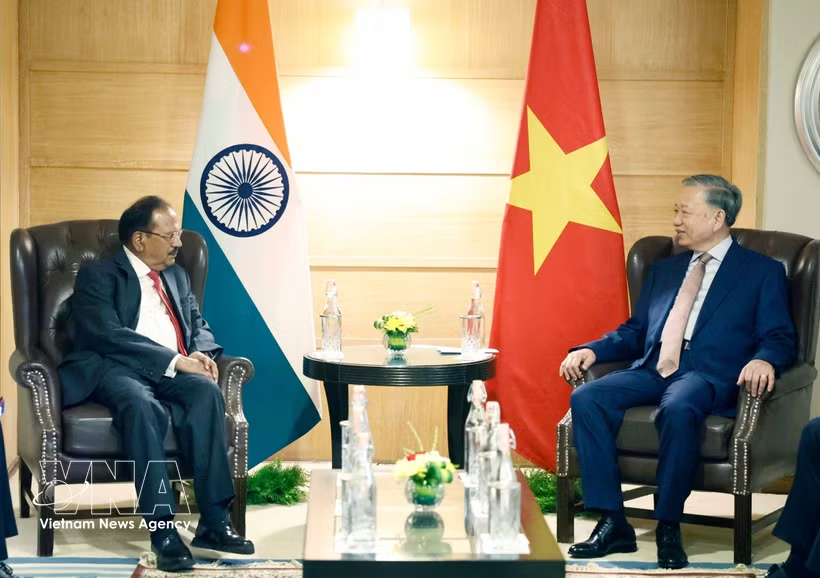
General Secretary of the Communist Party of Vietnam Central Committee and State President To Lam (R) receives Indian National Security Advisor Ajit Doval. (Photo: VNA)

New Delhi (VNA) - General Secretary of the Communist Party of Vietnam Central Committee and State President To Lam received Indian National Security Advisor Ajit Doval in New Delhi on May 5 afternoon (local time), as part of his state visit to the South Asian country.

Welcoming the Vietnamese leader’s visit in his new capacity shortly after the 16th National Assembly of Vietnam completed the consolidation of key State leadership positions, Doval emphasised the special significance of the visit, describing it as an important milestone in further deepening the Comprehensive Strategic Partnership between the two countries, particularly in key areas related to security and development.

The Indian official noted that “instability” and “uncertainty” have become defining features of the current global landscape. However, he stressed that mutual trust and a shared aspiration for development serve as stabilising factors in such a context. He expressed hope that the two countries will continue to strengthen cooperation, foster development, and elevate bilateral relations to new heights.

Doval also voiced his admiration for Vietnam’s comprehensive development achievements and its increasingly prominent role and position on the international stage. He reaffirmed that India consistently regards Vietnam as a leading important partner in the region, with positive contributions to peace, stability, cooperation, and development.

General Secretary and President Lam emphasised that Vietnam–India relations are built on a solid foundation of political trust, shared strategic vision, and long-term development interests. He reaffirmed that Vietnam consistently attaches importance to and wishes to further strengthen its relations with India, and supports the country in playing an increasingly important role in regional and global mechanisms.

He noted that despite many fluctuations in the global and regional situation, Vietnam–India relations have remained strong and resilient, and his visit serves as a testament to the traditional friendship and cooperation between the two countries, thereby contributing to peace, stability, and development in the region and the world.

Highlighting the vast potential for cooperation, he stressed the need for both sides to promote substantive collaboration across all areas, including economy, science and technology, digital transformation, emerging technologies, education and training, and people-to-people exchanges.

At the meeting, both sides assessed that security cooperation is playing an increasingly important role in the bilateral relations and underscored the need to further strengthen coordination among security, law enforcement, and policy-making agencies. General Secretary and President Lam proposed the two nations enhance the sharing of strategic information, expand cooperation in cybersecurity, protect digital infrastructure, combat high-tech crimes, and improve capacity to respond to non-traditional security challenges.
vnanet-ce1bb91-ve1baa5n-1.jpg
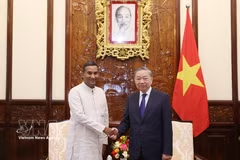
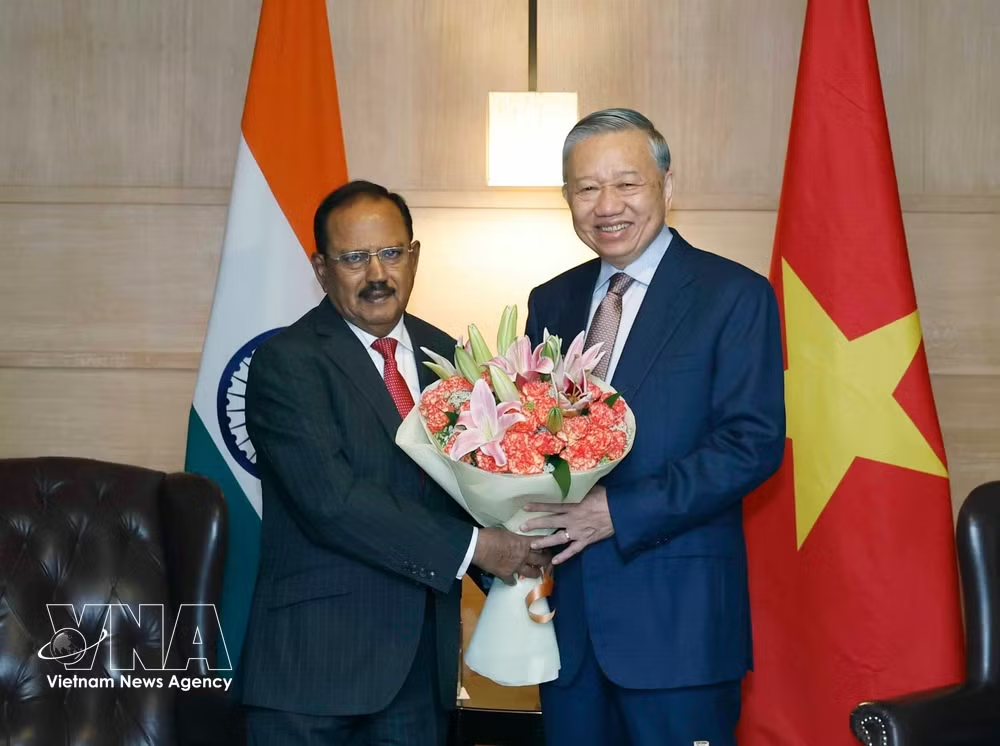
Indian National Security Advisor Ajit Doval (L) presents flowers to Party General Secretary and State President To Lam. (Photo: VNA)

On the basis of the Vietnam – India Comprehensive Strategic Partnership, the two sides particularly emphasised the need for effective coordination in combating terrorism, transnational crime, online fraud, and emerging threats, thereby contributing to ensuring national security and social order in each country.

They also agreed to promote the linkage between security and development while expanding cooperation in strategic technology areas such as artificial intelligence, digital transformation, innovation, energy, and high-quality human resources training, considering this a crucial foundation for enhancing each nation's strategic autonomy in the context of increasing global technological competition.

Regarding regional and international issues, the two sides agreed on maintaining peace, stability, security, safety, and freedom of navigation and overflight; and resolving disputes peacefully on the basis of international law, especially the 1982 United Nations Convention on the Law of the Sea (UNCLOS). They also agreed to continue increasing strategic consultations and coordinating closely at regional and international forums, thereby actively helping to shape a stable, inclusive, and rules-based regional architecture in the context of a rapidly changing regional security environment with many latent risks.

Both sides expressed confidence that with the traditional friendship, a high level of strategic trust, strong political will from the leaders of both countries, and many similarities in viewpoints on various areas of cooperation, especially in the security field, Vietnam – India relations will develop more deeply, substantively, and effectively for the benefit of the people in each country, as well as for peace, stability, and sustainable development in the region and the world./.
VNA

See more

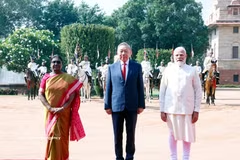
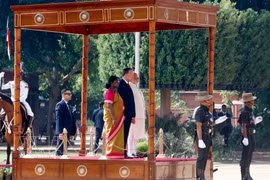
India’s President Droupadi Murmu (L) and Prime Minister Narendra Modi (R) co-chair the official welcome ceremony for General Secretary of the Communist Party of Vietnam Central Committee and State President To Lam (Photo: VNA)

Official welcome ceremony held for top Vietnamese leader in New Delhi

The ongoing state visit to India by the top Vietnamese leader stands as clear evidence of Vietnam’s foreign policy in the new era, emphasising independence, self-reliance, self-strengthening, peace, friendship, cooperation, and development, diversification and multilateralisation of external relations, and being a responsible member of the international community.

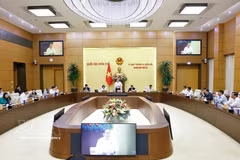
At the 55th session of the 15th National Assembly Standing Committee. (Photo: VNA)

Legislative programme in 2026 adjusted

Under the resolution, the NA Standing Committee decided to add several draft laws and resolutions to the legislative agenda in 2026 for consideration and adoption at the second session of the 16th National Assembly, scheduled for October 2026.

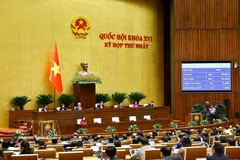
The National Assembly votes to approve the Resolution on the pilot implementation of the public lawyer institution (Photo: VNA)

National Assembly adopts 2027 supervision programme

At its third session, the 16th legislature will review a wide range of Government reports, including supplementary assessments of socio-economic and state budget performance in 2026 and results in early 2027, thrift practice and wastefulness prevention, gender equality, anti-corruption, crime prevention, law enforcement, detention management, environmental protection and drug prevention.

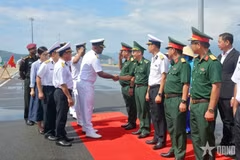
Representatives of military units in Khanh Hoa welcome the Indian naval delegation on May 5. (Photo: qdnd.vn)

Indian Navy ship visits Khanh Hoa

The Indian Navy ship INS Sagardhwani arrived at Cam Ranh International Port in the south central province of Khanh Hoa on May 5, beginning an official visit to the locality.

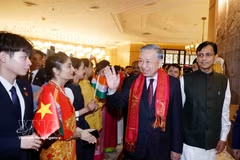
Representatives of the Vietnamese community and staff of the Vietnamese Embassy in India welcome Party General Secretary and State President To Lam. (Photo: VNA)

Party General Secretary, State President To Lam begins state visit to India

The visit also reflects the Vietnamese Party and State's foreign policy of independence, self-reliance, self-strengthening, peace, friendship, cooperation, development, multilateralisation and diversification of external relations, and being a responsible member of the international community in the new era, as set out by the 14th National Party Congress.

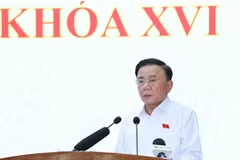
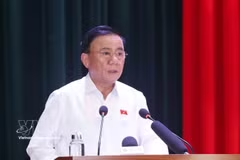
Politburo member and Permanent member of the Party Central Committee’s Secretariat Tran Cam Tu speaks at a meeting with voters in the central city of Da Nang (Photo: VNA)

Senior Party official calls for stronger decentralisation with tighter oversight

The National Assembly and Government will continue reviewing and amending laws while accelerating decentralisation alongside stronger supervision to empower local initiative, Politburo member and Permanent member of the Party Central Committee’s Secretariat Tran Cam Tu said on May 5 at a meeting voters from Hai Chau, An Khe, Thanh Khe, Son Tra, An Hai and Hoa Cuong wards in the central city of Da Nang.

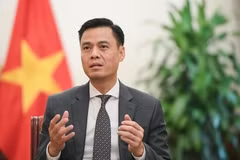
Vietnamese Ambassador to Sri Lanka and Maldives Trinh Thi Tam (Photo: VNA)

Top Vietnamese leader’s visit to Sri Lanka to generate new impetus

Taking place as both economies undergo profound transitions, the visit is anticipated to reinforce political trust and serve as a platform to discuss ways for stronger economic, trade, and investment ties. It will also aim to expand collaboration in such potential areas as agriculture, high technology, fisheries, education and training, tourism, and logistics, with new agreements likely to be signed or advanced.

Spokesperson of the Ministry of Foreign Affairs Pham Thu Hang (Photo: VNA)

Vietnam calls on China to respect sovereignty over Hoang Sa

Vietnam urged China to respect the rights of Vietnamese fishermen to conduct lawful activities in Vietnam’s waters and in maritime areas beyond national jurisdiction in accordance with international law, particularly the 1982 UNCLOS.