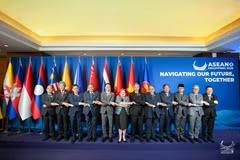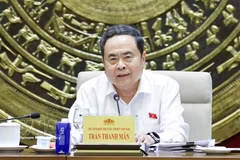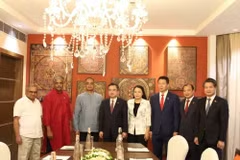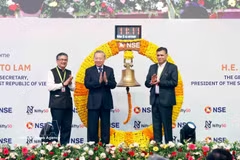
Hanoi (VNA) – Against the backdrop of rapidly evolving and increasingly complex global and regional landscapes, the 48th ASEAN Summit in the Philippines from May 7–8 is well beyond immediate crisis management and carries pivotal significance as the launchpad for the ASEAN Community Vision 2045, a strategic milestone designed to shape the region’s long-term trajectory for decades to come.
In that process, Vietnam is stepping into a conspicuously larger role, shifting from an “active player” to a “co-architect” in shaping the region’s strategic priorities and development approaches in the new period.
Linking vision with practical action
From the earliest drafting of the 2045 ASEAN Vision, Vietnam pushed proposals to keep the framework substantive, feasible, and balanced across member states. Its approach consistently stresses shoring up intra-bloc solidarity, building resilience, and heading off fragmentation risks as great power competition intensifies.
More importantly, Vietnam has moved beyond engaging in strategic orientation by actively wiring the long-term vision to concrete steps. This is particularly critical as one of ASEAN’s longstanding challenges has been the gap between commitments and action. Closing that gap would boost not just the bloc’s effectiveness but also its credibility and centrality within the regional architecture.
As external shocks multiply, particularly Middle Eastern turmoil rippling through global energy supply chains, Vietnam has demonstrated a proactive role by tabling initiatives to harden ASEAN’s resilience. One signature idea is the launch of a strategic petroleum reserve fund that would enable collective energy security management and reduce reliance on outside suppliers.
At the same time, Vietnam is advancing intra-regional energy cooperation, working with Singapore on technical studies for cross-border undersea cables that could underpin the ASEAN Power Grid. If realised, this initiative could anchor an integrated regional energy market critical to supply stability and clean energy transition.
Another noteworthy point in Vietnam’s strategic thinking is pushing ASEAN cooperation beyond the region itself. With Middle East crises increasingly ensnaring ASEAN citizens abroad, Vietnam proposed a consular coordination mechanism for member states to protect their nationals in third countries, a concrete step toward translating the concept of an “ASEAN Community” into tangible benefits for its people.
A balancing force and consensus builder
As Southeast Asia becomes increasingly hit by strategic competition among major powers, maintaining unity and cohesion within ASEAN has become a prerequisite to preserve the bloc’s central role. In this process, Vietnam has emerged as an important balancing force.
Vietnam has consistently pursued a balanced and flexible approach grounded in core principles, particularly consensus, non-interference, and the peaceful settlement of disputes in accordance with international law. These principles serve as the “glue” enabling member states, despite differing interests, to find common ground.
That role is particularly visible in sensitive issues like the East Sea and Myanmar crisis, where Vietnam has often favoured on dialogue-driven approaches designed to narrow differences and forge intra-bloc consensus, reinforcing ASEAN’s collective negotiating position in relations with external partners.
In trade and economic spheres, amid mounting external pressure measures, Vietnam has clearly advocated cooperation over confrontation and encouraged ASEAN to coordinate its responses rather than acting individually. This approach reflects a long-term strategic mindset: strengthening internal capacity to mitigate risks instead of being drawn into spirals of competition.
Seen in this light, Vietnam is functioning less as a dutiful member than as a “strategic coordinator”, steering ASEAN’s collective responses onto a stable, sustainable path.
Driving economic connectivity
On the economic pillar, Vietnam remains an engine of regional integration through expanded trade, investment, and infrastructure links. Beyond fulfilling commitments, it is putting forward new initiatives in supply chains, energy, and digital infrastructure.
Vietnam has also played an active role in narrowing development gaps, particularly through coordinating the Initiative for ASEAN Integration (IAI). By promoting logistics connectivity, digital economy, and infrastructure upgrades, Vietnam is helping ensure that regional integration becomes more inclusive and less vulnerable to fragmentation, a factor that could weaken regional solidarity.
Crucially, Vietnam’s proposals map onto the region’s broader economic transformation, where digital technology, clean energy, and infrastructure links are becoming new growth drivers. This reflects a vision of an ASEAN stitched together not just by policy but by economic architecture and hard infrastructure.
Vietnam’s growing imprint
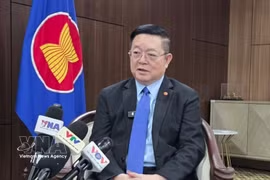
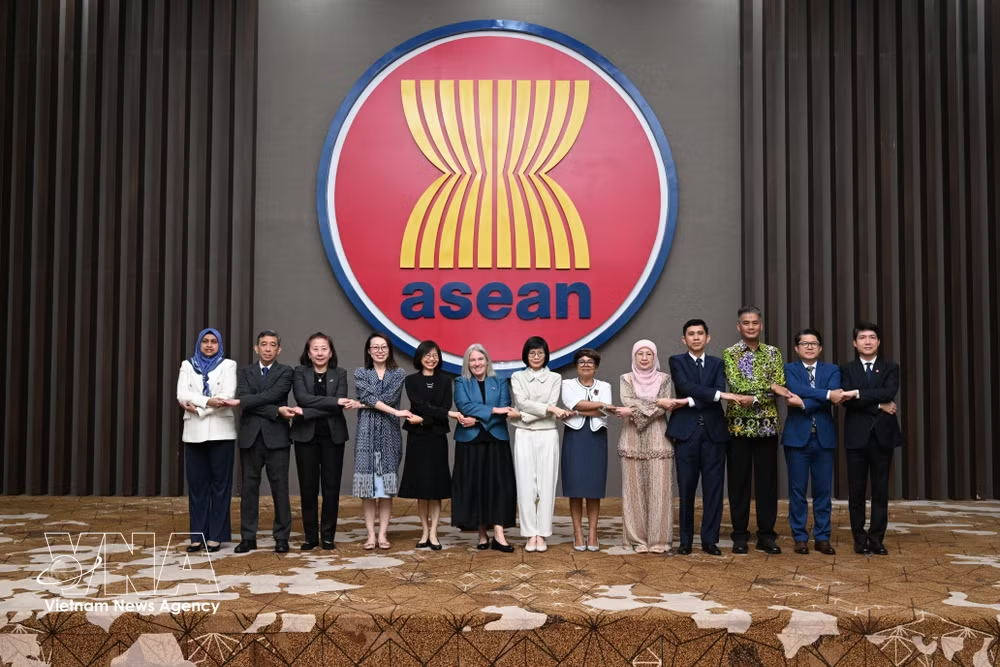
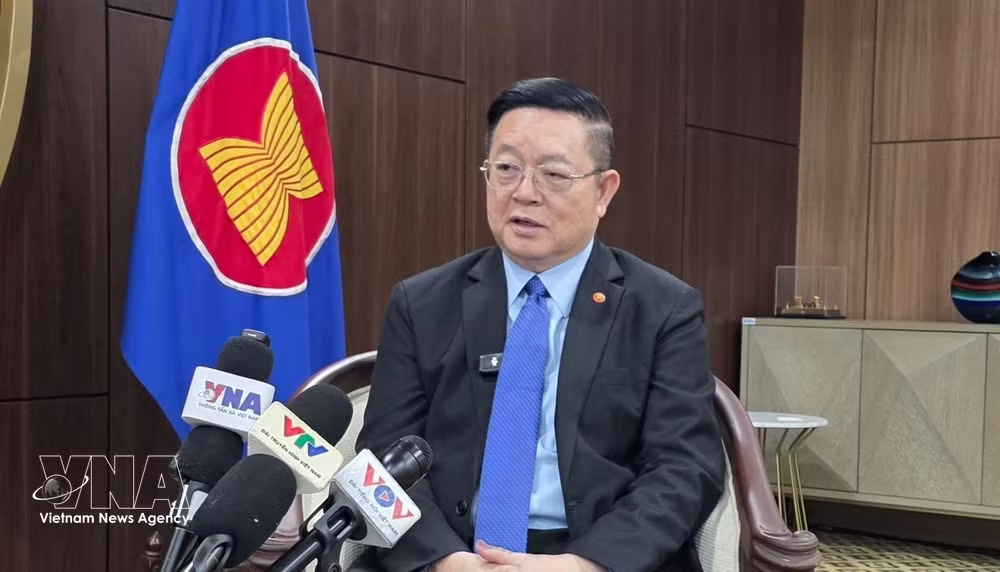
According to ASEAN Secretary-General Kao Kim Hourn, Vietnam has been an important and constructive member over the past three decades, making notable contributions across all three ASEAN pillars of politics-security, economy, and socio-culture. As ASEAN moves forward with the 2045 Vision, Vietnam’s role is expected to keep growing.
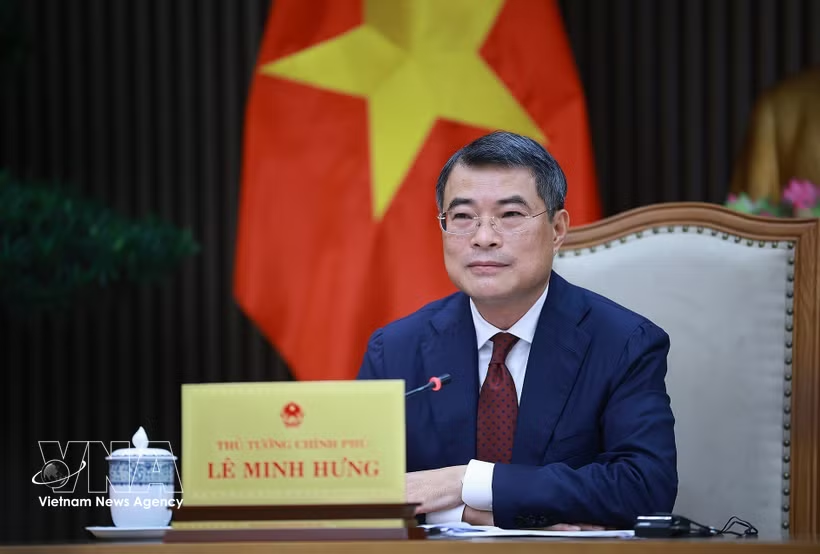
The ASEAN Secretary-General noted that Prime Minister Le Minh Hung’s first attendance at the ASEAN Summit as Government leader signals continuity and strategic vision within Vietnam’s new leadership, setting the stage for deeper contributions to the region’s collective agenda.
From the perspective of external partners, New Zealand Ambassador to ASEAN Joanna Anderson praised Vietnam’s flexible coordinating role, particularly in energy security and economic matters. Meanwhile, Indonesian Ambassador to ASEAN Derry Aman underscored Vietnam’s role as a unifying force that consistently demonstrates strong commitment to ASEAN’s core principles.
These assessments underscore the broad international recognition of Vietnam’s increasingly proactive and substantive role within ASEAN.
It is evident that Vietnam’s role in ASEAN is evolving in a deeper and more proactive direction. The combination of long-term strategic thinking and concrete, practical actions is enabling Vietnam to leave an increasingly distinct imprint on the regional development trajectory.
Amid a rapidly changing integration landscape, Vietnam’s journey within ASEAN is no longer limited to adaptation; it is entering a new phase of co-creation, helping shape an ASEAN that is cohesive, resilient, and future-oriented./.