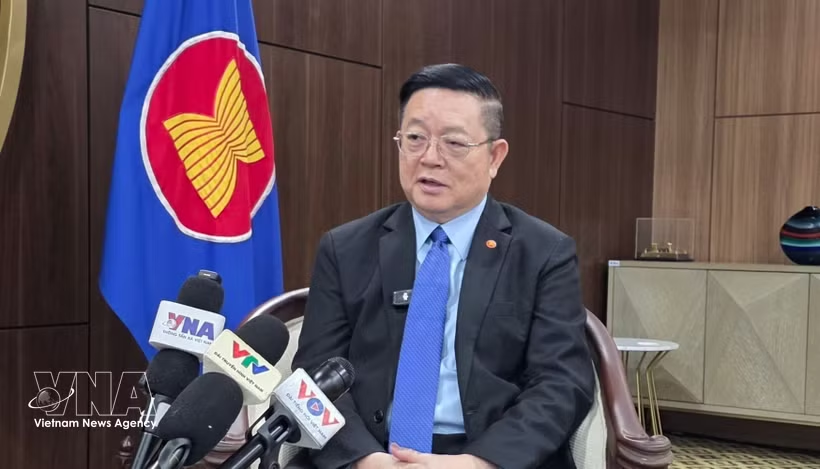
Jakarta (VNA) – ASEAN Secretary-General Kao Kim Hourn has highlighted Vietnam as a key driver of the bloc’s future development, citing its growing contributions to regional stability, integration, and community-building, as well as its capacity to help ASEAN navigate emerging challenges.
In an interview with the Vietnam News Agency’s correspondents in Jakarta ahead of the 48th ASEAN Summit in the Philippines on May 7–8, Hourn highlighted Vietnam as a proactive and responsible member whose sustained economic momentum and policy efforts have reinforced ASEAN’s collective resilience.
As the group begins implementing the ASEAN Community Vision 2045, he noted that Vietnam’s role will become even more pivotal in shaping long-term development trajectory and strengthening intra-bloc connectivity.
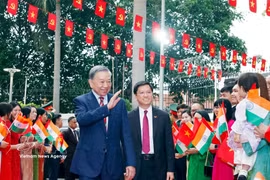
He highlighted Vietnamese Prime Minister Le Minh Hung’s presence at the summit as evidence of leadership continuity and forward-looking strategy, underpinning the country’s deeper involvement in ASEAN affairs.
Vietnam is expected to maintain active contributions across the bloc’s three pillars - the political-security community, the economic community, and the socio-cultural community; while further enhancing regional connectivity through infrastructure projects and stronger economic linkages.
In addition, Vietnam’s role in mechanisms such as the Initiative for ASEAN Integration(IAI) underscores its practical contributions to narrowing development gaps and strengthening intra-group cohesion, the Secretary-General said, expressing his belief that Vietnam will continue to be an important, responsible member, making effective contributions to the bloc’s development in the time ahead.
He stressed that the upcoming summit takes place against a backdrop of mounting geopolitical and economic uncertainties, with recent developments in the Middle East exerting far-reaching impacts. One of the most pressing concerns, he noted, is the risk of an energy crisis, which will be high on the summit’s agenda alongside related issues.
ASEAN leaders are expected to prioritise coordinated action at both national and regional levels to better navigate increasingly complex challenges, he said, noting that delegates will focus their discussion on solutions to ensure supply, stabilise prices, and maintain affordable access to food for people across the region.
The summit will also address the protection of citizens and migrant workers, particularly in response to instability in the Middle East, where large numbers of ASEAN nationals are employed. Member states are stepping up coordination to provide consular assistance, safeguard citizens’ rights and safety, and strengthen cooperation mechanisms for emergency response.
On energy cooperation, ASEAN is pursuing a comprehensive approach that balances short- and long-term solutions. Efforts include upgrading the ASEAN Power Grid, accelerating the transition to renewable energy sources such as solar, wind and biomass, and promoting electric vehicle industry, he said.
Some member states are also exploring nuclear energy options, underscoring the need for broader cooperation to reduce reliance on a single source, he added.
In terms of food security, ASEAN is working to improve the efficiency and flexibility of regional stockpiling mechanisms, including the ASEAN Plus Three Emergency Rice Reserve, while diversifying supply sources through both intra-bloc cooperation and external partnerships to ensure stable supply and affordability under all scenarios.
Regarding the digital economic development, negotiations on the ASEAN Digital Economy Framework Agreement are being accelerated and are expected to conclude this year, laying the groundwork for forming a more integrated, dynamic and competitive digital ecosystem in the region, Hourn went on.
The capacity for self-resilient response is key for ASEAN to move toward a sustainable future, he stated./.