Thai sugar industry urged to adapt amid emerging challenges

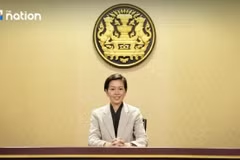
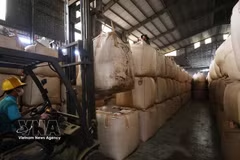
Nantapong Chiralerspong, Director-General of TPSO, said that increased sugar cane and sugar output both in Thailand and the global market, coupled with Indonesia's self-sufficiency policy, require proactive industry adaptation.

Bangkok (VNA) – The Trade Policy and Strategy Office (TPSO) of Thailand is urging sugar producers to pursue value-added strategies, shifting to a bio-economy while the office warns about a possible glut in the second half of this year.

Nantapong Chiralerspong, Director-General of TPSO, was quoted by local media as saying that increased sugar cane and sugar output both in Thailand and the global market, coupled with Indonesia's self-sufficiency policy, require proactive industry adaptation.

He said sugar stakeholders should align production with market demand, explore new export markets, and accelerate the industry's evolution towards value-added processing with a focus on bio-energy and bio-products.

If major manufacturers produce more ethanol, Nantapong said sugar prices could improve.

He said Thailand's 2025-2026 sugar cane output is expected to rise due to favourable rainfall, with total cane crushing projected to reach 98 million tonnes, up 7% year-on-year.

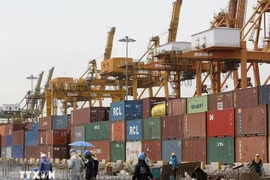
In 2025, Thailand was the world's second-largest sugar exporter, trailing Brazil, and shipped 5.5 million tonnes valued at more than 2.6 billion USD. Exports to Indonesia were valued at 715 million USD, accounting for more than 27% of total exports. Other key markets included Cambodia, the Republic of Korea and the Philippines.

With Indonesia shifting to a self-sufficiency policy, Nantapong said Thai sugar producers must diversify their export options.

Potential risks for the latter half of this year include a possible domestic sugar glut and reduced demand from Indonesia, noted TPSO. Increased production by major global suppliers such as India and Brazil is expected to depress global sugar prices.

However, despite this pricing pressure, the situation is unlikely to escalate into a crisis, said Nantapong.

According to Grand View Research, the global sugar market is expected to post an average annual growth rate of 6.5% through 2030, surpassing 102 billion USD.

In 2025, the top five sugar importers were China, the US, Indonesia, Bangladesh and India.

To reduce market concentration risk, Nantapong said Thailand should consider expanding its customer base in East Asia and Central Asia, where purchasing power remains strong.

Maintaining quality, standards, and traceability will be essential to build importer confidence, he said./.

VNA

See more

Malaysia accelerates economic restructuring to tackle energy crisis (Photo: Straitstimes.com)

Malaysia steps up economic restructuring amid energy crisis

Participants agreed the crisis, though expected to last up to 18 months, offers a key opportunity for Malaysia and ASEAN to reshape their economic models through innovation, stronger public-private partnerships, and data-driven governance.

Singapore deploys AI to combat financial scams

Singapore deploys AI to combat financial scams

In its statement, the Monetary Authority of Singapore (MAS) said as part of broader efforts to harness AI/ML for industry-wide use cases, it is conducting a Proof-of-Value (POV) to explore AI/ML techniques for pre-emptive scam detection.

Heightened financial instability leads to ASEAN+3 leaders remaining vigilant over excessive volatility and disorderly movements in currency and financial markets. (Illustrative photo: thevibes.com)

ASEAN+3 agrees to cooperate in addressing crude oil supply challenges

In a joint statement approved at a meeting on the sidelines of the Asian Development Bank annual gathering in Samarkand, in southeastern Uzbekistan, ASEAN+3 finance ministers and central bank governors stressed that increasing conflicts in the Middle East have significantly heightened downside risks to the regional outlook.

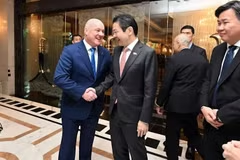
Singaporean Prime Minister Lawrence Wong (second from right) and New Zealand Prime Minister Christopher Luxon (second from left) witness the signing of the pact on May 4 (Photo: The Straits Times)

Singapore, New Zealand sign agreement to ensure essential goods supply

Once domestic procedures are completed, the agreement will take effect and be incorporated into the existing bilateral free trade agreement. It also establishes a framework for both countries to facilitate the movement of goods, share information, and consult each other before or during supply chain disruptions, providing businesses and consumers with greater confidence and stability, MTI said.

Illustrative image (Photo: Jakarta Post)

Indonesia protects workers in digital age

The Indonesian Government is also encouraging firms to adopt flexible and energy-efficient working models, including remote work for at least one day per week, in response to evolving economic and environmental conditions.

The Bank of Thailand had cut the rate at its previous meeting in February. (Photo: BLOOMBERG)

Thailand’s central bank holds key rate

The Bank of Thailand's monetary policy committee voted unanimously to maintain the one-day repurchase rate at 1.00%, the lowest level in more than three years. It had cut the rate at its February meeting.

At a working session between Uruguay Undersecretary of Foreign Affairs Valeria Csukasi and diplomats of Vietnam, Thailand, the Philippines, Indonesia, and Malaysia (Photo: VNA)

Uruguay pushes for closer ties with ASEAN

Vietnamese Ambassador to Argentina and Uruguay Ngo Minh Nguyet suggested Uruguay work closely with Vietnam to advance negotiations on a preferential trade agreement between Vietnam and the Southern Common Market. She also underscored Vietnam’s commitment to supporting Uruguay’s bid to join the Comprehensive and Progressive Agreement for Trans-Pacific Partnership (CPTPP) and the Regional Comprehensive Economic Partnership (RCEP).

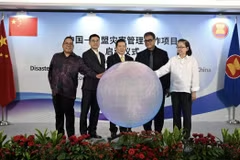
ASEAN, China enhance cooperation in disaster management

ASEAN, China enhance cooperation in disaster management

The ASEAN–China disaster management project is designed to enhance regional coordination in disaster prevention and mitigation through capacity-building, technological and equipment support for command and emergency assessment, experience-sharing in early warning and response, as well as promoting technological connectivity, resource complementarity and mutual learning.

Thailand intensifies crackdown on illegal online payment networks (Photo: Bangkok Post)

Thailand steps up crackdown on cybercrime

Thai police have arrested 28 individuals linked to an illegal payment platform suspected of processing around 5 billion THB (over 153.5 million USD) per month for approximately 600 gambling websites.

Illustrative Image (Photo: gmanetwork.com)

Philippines posts wider trade deficit amid rising import costs

The Philippines' exports surged 20.4% year-on-year to 6.78 billion USD in March, marking the highest level since the Philippine Statistics Authority began compiling trade data in 1991. Meanwhile, imports rose 12.3% to 11.29 billion USD, also reaching a record high.

Illustrative image (Photo: Antara)

Indonesia warns of serious health risks due to El Niño

To minimise El Niño's negative effects, the Jakarta administration has advised residents to stay hydrated, wear masks when going outside to reduce exposure to air pollution, and limit outdoor activities during peak sunlight hours from 11am to 3pm.

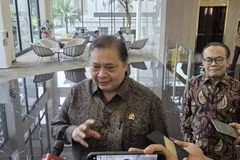
Coordinating Minister for Economic Affairs Airlangga Hartarto at his office in Jakarta, April 28, 2026. (Photo: ANTARA/Bayu Saputra)

Indonesia cuts import duties on LPG, plastic raw materials to 0%

Import duties on certain plastic products and LPG used by the petrochemical industry will be cut to 0% for six months starting in May, after which the Indonesian government will reassess market conditions before deciding whether to extend or adjust the measure.