Vietnam's roasted coffee exports to Thailand rise as demand shifts to premium brews

Vietnam shipped about 9,900 tonnes of coffee worth 80.6 million USD to Thailand in the first quarter, up 22.5% in volume and 28.7% in value from a year earlier, according to Vietnam Customs.

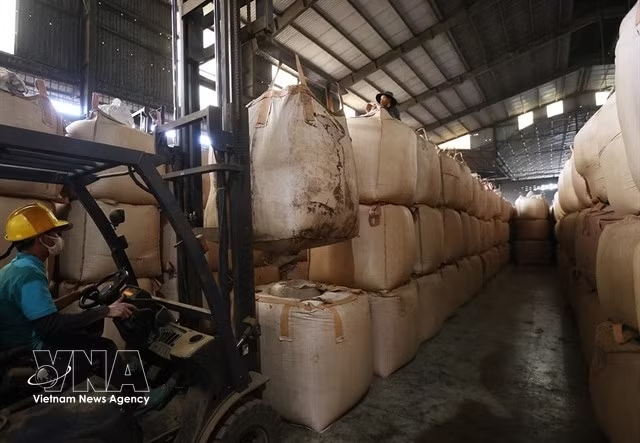
Coffee beans stockpiled at a warehouse in Gia Lai province (Photo: VNA)


Hanoi (VNS/VNA) - Vietnam’s coffee exports to Thailand rose rapidly in early 2026, driven by growing demand for roasted and processed products, even as global coffee prices eased in mid-April.

Vietnam shipped about 9,900 tonnes of coffee worth 80.6 million USD to Thailand in the first quarter, up 22.5% in volume and 28.7% in value from a year earlier, according to Vietnam Customs.

The faster increase in export value compared with volume points to a shift toward higher-value processed coffee. In the first two months, processed products accounted for 83.6% of Vietnam’s coffee export revenue to Thailand.

In its April bulletin, the Ministry of Industry and Trade said that Thai consumers, particularly in major cities, are increasingly moving away from instant coffee toward roasted and ground coffee, espresso-based drinks and specialty varieties.

The expansion of modern coffee chains in Bangkok, Chiang Mai and key tourist destinations in Thailand has boosted demand for higher-quality, traceable coffee products.

Vietnam’s share of Thailand’s coffee imports rose to 35.7% over the past year from 24.2%, making it one of the country’s leading suppliers, according to trade data.

Coffee consumption in Thailand is projected to grow by 7 to 8% annually through 2032, potentially exceeding 120,000 tonnes by the end of the six-year period, market researchers say. However, competition is intensifying as suppliers from Brazil, Malaysia and Indonesia expand their presence.

Vietnamese coffee remains competitively priced compared with regional rivals, supported by geographic proximity, lower logistics costs and tariff advantages within the ASEAN trade bloc, data from the International Trade Centre shows.

Industry officials said higher-value segments such as roasted and ground coffee, instant coffee and private-label products offer opportunities for Vietnamese exporters to strengthen their position in Thailand’s fast-growing market.

Coffee consumption in Thailand has become widespread, averaging more than 340 cups per person annually. The domestic market was estimated at 65 billion THB (2 billion USD) in 2025, up 8.3% from a year earlier.

Thailand produces relatively small volumes of coffee, with around 35,000ha under cultivation and annual output of 40,000 to 50,000 tonnes of green beans./.

VNA

See more

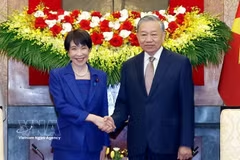
Party General Secretary and State President To Lam (R) receives Japanese Prime Minister Sanae Takaichi in Hanoi on May 2 (Photo: VNA)

Japanese PM highlights outcomes of visits to Vietnam, Australia

Speaking to the press in Canberra on May 4, the Japanese PM stressed that during her visits to Vietnam and Australia, in addition to deepening personal trust among leaders, she and the leaders were able to reach agreement on advancing concrete cooperation toward their shared objective of enhancing national resilience and autonomy, and becoming stronger and more prosperous together as a region.

Foreign investment in Thailand surges in Q1

Foreign investment in Thailand surges in Q1

According to Thailand's Board of Investment (BOI), the combined value of the 624 project applications submitted during the January-March period was roughly 2.4 times the value recorded in the same period last year, reflecting strong foreign interest despite global economic volatility.

Malaysia accelerates economic restructuring to tackle energy crisis (Photo: Straitstimes.com)

Malaysia steps up economic restructuring amid energy crisis

Participants agreed the crisis, though expected to last up to 18 months, offers a key opportunity for Malaysia and ASEAN to reshape their economic models through innovation, stronger public-private partnerships, and data-driven governance.

Singapore deploys AI to combat financial scams

Singapore deploys AI to combat financial scams

In its statement, the Monetary Authority of Singapore (MAS) said as part of broader efforts to harness AI/ML for industry-wide use cases, it is conducting a Proof-of-Value (POV) to explore AI/ML techniques for pre-emptive scam detection.

Heightened financial instability leads to ASEAN+3 leaders remaining vigilant over excessive volatility and disorderly movements in currency and financial markets. (Illustrative photo: thevibes.com)

ASEAN+3 agrees to cooperate in addressing crude oil supply challenges

In a joint statement approved at a meeting on the sidelines of the Asian Development Bank annual gathering in Samarkand, in southeastern Uzbekistan, ASEAN+3 finance ministers and central bank governors stressed that increasing conflicts in the Middle East have significantly heightened downside risks to the regional outlook.

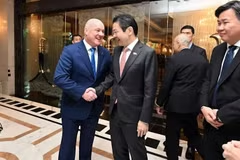
Singaporean Prime Minister Lawrence Wong (second from right) and New Zealand Prime Minister Christopher Luxon (second from left) witness the signing of the pact on May 4 (Photo: The Straits Times)

Singapore, New Zealand sign agreement to ensure essential goods supply

Once domestic procedures are completed, the agreement will take effect and be incorporated into the existing bilateral free trade agreement. It also establishes a framework for both countries to facilitate the movement of goods, share information, and consult each other before or during supply chain disruptions, providing businesses and consumers with greater confidence and stability, MTI said.