Foreign investment in Thailand surges in Q1

According to Thailand's Board of Investment (BOI), the combined value of the 624 project applications submitted during the January-March period was roughly 2.4 times the value recorded in the same period last year, reflecting strong foreign interest despite global economic volatility.

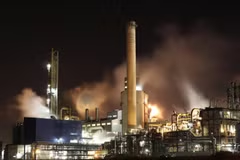
Bangkok (VNA) - Thailand's investment pledges soared to about 31 billion USD in the first quarter of 2026, led by projects in the digital and electronics sectors riding the artificial intelligence boom.

According to Thailand's Board of Investment (BOI), the combined value of the 624 project applications submitted during the January-March period was roughly 2.4 times the value recorded in the same period last year, reflecting strong foreign interest despite global economic volatility.

The key sectors include digital and electronics supporting artificial intelligence (AI), clean energy, agriculture and food processing, and logistics.

The BOI noted improvements in regulatory conditions, including the introduction of efficiency standards for electricity and water usage in line with international benchmarks. Investors are also required to obtain certification from the Energy Regulatory Commission (ERC) on electricity supply before submitting applications.

In addition, applicants must present project plans demonstrating tangible benefits for Thailand, such as human resource development, support for small and medium-sized enterprises, or contributions to domestic supply chains. These commitments must be fulfilled prior to accessing corporate income tax incentives, ensuring projects deliver meaningful value to the economy.

First-quarter investment applications above 1 trillion THB is a clear signal that Thailand is shifting from a traditional manufacturing base to a base for the industries of the future, BOI Secretary General Narit Therdsteerasukdi said in a statement.

Narit attributed the surge to the Southeast Asian country's stable power grid, growing clean-energy capacity, quality talent, robust supply chains, government support, and its neutral position outside of ongoing geopolitical conflicts./.

VNA

See more

Malaysia accelerates economic restructuring to tackle energy crisis (Photo: Straitstimes.com)

Malaysia steps up economic restructuring amid energy crisis

Participants agreed the crisis, though expected to last up to 18 months, offers a key opportunity for Malaysia and ASEAN to reshape their economic models through innovation, stronger public-private partnerships, and data-driven governance.

Singapore deploys AI to combat financial scams

Singapore deploys AI to combat financial scams

In its statement, the Monetary Authority of Singapore (MAS) said as part of broader efforts to harness AI/ML for industry-wide use cases, it is conducting a Proof-of-Value (POV) to explore AI/ML techniques for pre-emptive scam detection.

Heightened financial instability leads to ASEAN+3 leaders remaining vigilant over excessive volatility and disorderly movements in currency and financial markets. (Illustrative photo: thevibes.com)

ASEAN+3 agrees to cooperate in addressing crude oil supply challenges

In a joint statement approved at a meeting on the sidelines of the Asian Development Bank annual gathering in Samarkand, in southeastern Uzbekistan, ASEAN+3 finance ministers and central bank governors stressed that increasing conflicts in the Middle East have significantly heightened downside risks to the regional outlook.

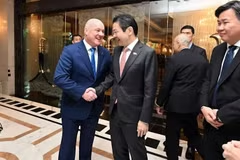
Singaporean Prime Minister Lawrence Wong (second from right) and New Zealand Prime Minister Christopher Luxon (second from left) witness the signing of the pact on May 4 (Photo: The Straits Times)

Singapore, New Zealand sign agreement to ensure essential goods supply

Once domestic procedures are completed, the agreement will take effect and be incorporated into the existing bilateral free trade agreement. It also establishes a framework for both countries to facilitate the movement of goods, share information, and consult each other before or during supply chain disruptions, providing businesses and consumers with greater confidence and stability, MTI said.

Illustrative image (Photo: Jakarta Post)

Indonesia protects workers in digital age

The Indonesian Government is also encouraging firms to adopt flexible and energy-efficient working models, including remote work for at least one day per week, in response to evolving economic and environmental conditions.

The Bank of Thailand had cut the rate at its previous meeting in February. (Photo: BLOOMBERG)

Thailand’s central bank holds key rate

The Bank of Thailand's monetary policy committee voted unanimously to maintain the one-day repurchase rate at 1.00%, the lowest level in more than three years. It had cut the rate at its February meeting.

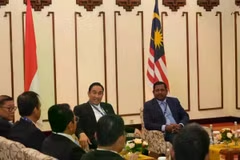
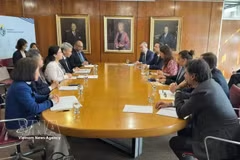
At a working session between Uruguay Undersecretary of Foreign Affairs Valeria Csukasi and diplomats of Vietnam, Thailand, the Philippines, Indonesia, and Malaysia (Photo: VNA)

Uruguay pushes for closer ties with ASEAN

Vietnamese Ambassador to Argentina and Uruguay Ngo Minh Nguyet suggested Uruguay work closely with Vietnam to advance negotiations on a preferential trade agreement between Vietnam and the Southern Common Market. She also underscored Vietnam’s commitment to supporting Uruguay’s bid to join the Comprehensive and Progressive Agreement for Trans-Pacific Partnership (CPTPP) and the Regional Comprehensive Economic Partnership (RCEP).